NASHVILLE – October 27, 2026 -- The Delaware Department of Transportation (DelDOT) has taken TransCore's latest-generation Integrity Back Office System live on schedule and has already granted system acceptance, replacing its legacy platform for statewide tolling and E-ZPass operations.
New platform consolidates five core toll functions in one system
The upgraded system unifies toll processing, account management, image review, violations processing and financial reporting. TransCore and DelDOT have worked together for many years on E-ZPass customer service operations.
The deployment moves Delaware to a cloud-capable architecture built to run in clustered, scalable Kubernetes environments. TransCore says the design handles high transaction volumes and adapts to policy and fee changes.
Nashville – October 27, 2026 -- TransCore, a tolling technology and traffic-management supplier, has appointed Deborah Sharpless as its first Chief Experience Officer (CXO), a newly created executive role aimed at tightening ties with tolling and transportation agencies.
Former Maryland Transportation Authority CFO brings 25 years of public sector experience
Sharpless has more than 25 years of experience in finance, operations and customer service. Most recently she was Chief Financial Officer of the Maryland Transportation Authority (MDTA), a role she took after serving as Deputy Executive Director.
She also chaired the E-ZPass Interagency Group Executive Board and served as a Director on the International Bridge, Tunnel and Turnpike Association (IBTTA) Board.
Nashville – October 27, 2026 -- TransCore has won a nearly six-year, $146 million contract to run back-office and customer service operations for the RiverLink tolling system on the Louisville–Southern Indiana Ohio River Bridges Project. The Louisville-Southern Indiana Ohio River Bridges (LSIORB) Joint Board, representing Kentucky and Indiana, selected the company as its new toll service provider.
TransCore will deploy its cloud-based Integrity Back Office System
The Integrity® Back Office System is built for high-volume transaction processing, AI-enabled workflows and flexible customer service operations. TransCore will handle account management, invoicing, image review and customer service.
Customer support will include walk-up service centers in both states and a locally based call center. The states aim for a more consistent and reliable customer experience across the Ohio River Bridges corridor.
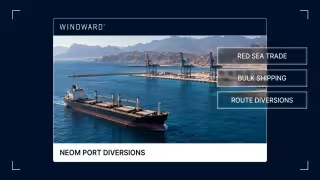
NEOM – October 27, 2026 -- Monthly RoRo vessel calls at the Port of NEOM reached 30 in September 2026, about 70% above the pre-war average of 17. War-diverted cargo is lifting traffic at a port built for a megacity that is shrinking, according to Windward maritime analysis.
The growth runs against NEOM's own trajectory. The Public Investment Fund wrote down its giga-projects by $8 billion at the end of 2024 and ordered spending cuts of more than 20%. The Line was paused in September 2025, and the $2.5 billion NEOM Stadium planned for the 2034 World Cup was shelved in early October 2026.
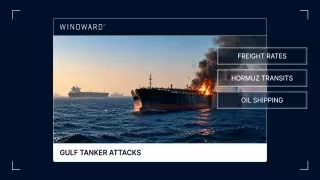
Qatar – October 27, 2026 -- The benchmark VLCC rate from Saudi Arabia to China has passed $1.3 million per day, pushing freight above 25-30% of the cost of Gulf crude versus 1-3% in normal market conditions, according to Windward. The surge follows a tanker strike off Qatar on October 7.
Tanker struck 51 nautical miles off Qatar breaks the Hormuz-only attack pattern
An unnamed tanker was hit by multiple projectiles 51 nautical miles off Madinat ash Shamal, UK Maritime Trade Operations (UKMTO) reported on October 7. It is the first attack outside the Strait of Hormuz since September 9, when a Greek-owned very large crude carrier was struck in Iraqi waters.
UKMTO has logged 16 attacks on ships in the Middle East Gulf in 10 days. Windward confirmed 12 of the vessels, 11 of them tankers. All were transiting dark through the U.S. military-assisted southern corridor.
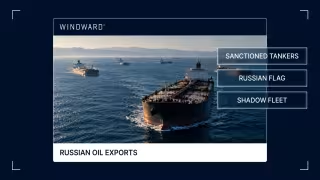
Russia – October 27, 2026 -- Sanctioned vessels carried 78 million barrels, or 55% of Russia's September oil exports, and 63% of its crude, as EU-owned tankers retreated from exposed routes, according to Windward analysis using Vortexa data.
Russia shipped 142.7 million barrels of crude and oil products in September. Crude accounted for 110.4 million barrels, about 3.7 million barrels per day and broadly level with August's 3.78 million bpd as reported by the IEA. Clean petroleum products totaled 14.9 million barrels, mostly naphtha (9.8 million), alongside 17.4 million barrels of fuel oil and feedstocks.
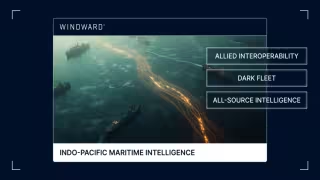
Indo-Pacific – – October 27, 2026 -- Russia reflagged 84 dark fleet tankers to its own registry in Q3 2026, more than four times the Q2 figure, according to Windward's Q3 2026 Maritime Risk Report. The maritime intelligence provider argues that allied navies and coast guards cannot counter such activity while each partner works from a separate slice of the picture.
Russia now flags 223 tankers, 18% of the total
One in three Aframax tankers worldwide now sits in the dark fleet, per the report. These vessels cross theaters routinely. Iranian crude loaded in the Gulf is commonly transferred ship to ship off Malaysia's Johor coast, roughly halfway between Iran and China, which buys about 90% of Iranian oil. One cargo can pass through CENTCOM and INDOPACOM and several national jurisdictions before discharge, and no single partner sees the whole route.
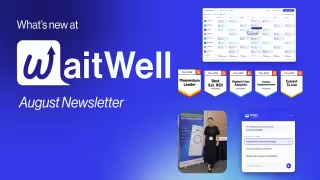
North America – October 27, 2026 -- WaitWell ranks first at 9.4/10 in a nine-platform comparison of urgent care queue management systems published on its own website, ahead of Solv Health at 8.2, QLess at 7.4 and Qminder at 7.2.
The evaluation scored platforms on remote patient check-in, walk-in queue management, appointment scheduling integration, HIPAA compliance, EHR connectivity, multi-location visibility and pricing transparency. Its stated goal is reducing left-without-being-seen (LWBS) events, which the guide calls the most expensive operational failure in urgent care.
North America – October 27, 2026 -- WaitWell scored 9.4 out of 10 in its own ranking of six higher-education enrollment management platforms, ahead of Slate by Technolutions (8.4) and Salesforce Education Cloud (8.0). The vendor-published guide scored platforms on seven weighted dimensions, including recruitment CRM depth, student-services experience, SIS integration, multi-campus support and total cost of ownership.
WaitWell targets the student-services gap that CRMs leave open
The guide argues that CRMs track the recruitment funnel but do not manage on-campus problems such as registrar lines during add/drop week, financial aid waits at peak enrollment and advising no-shows. WaitWell positions itself as a complement to the CRM, not a replacement. It does not manage prospect databases, application processing, yield campaigns or funnel reporting.
Canada – October 27, 2026 -- WaitWell scored 9.4 out of 10 in its own evaluation of 10 medical practice management platforms, ahead of athenaOne (8.2), Tebra (7.8), SimplePractice (7.6) and RXNT (7.4). WaitWell publishes the guide and discloses a commercial interest in its conclusions.
Seven weighted criteria favor platforms that handle walk-ins and bookings
The evaluation covered scheduling and self-booking, check-in and queue capability, EHR and billing integration, compliance posture (HIPAA, SOC 2), analytics quality, billing depth and pricing transparency. The team tested tools directly where possible, analyzed reviews from G2, Capterra and Software Advice, and reviewed published pricing.
Platforms that manage both scheduled appointments and walk-in flow scored higher than billing-only suites. The guide's rationale is that more practices need a modern scheduling and check-in layer than another billing migration.
United States – October 27, 2026 -- WaitWell released staff booking links that let each staff member create up to 10 links per location, alongside a rebuilt staff scheduling view, and announced a larger release for November.
Staff booking links open a booking site with the person preselected
Each link opens the booking site with that staff member already selected, photo and bio included. Links can be fixed to one service or leave the choice to the customer, and they can carry an expiry date. Staff can turn off or delete a link at any time, and the list shows how many times each link has been opened and offers a QR code.
Staff can also store their own meeting link in a profile section under account preferences. That link is used when they are assigned to a ticket. If none is on file, WaitWell creates one.
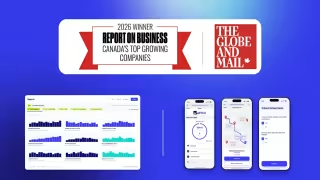
Canada – October 27, 2026 -- Service-operations software provider WaitWell grew 500% over three years and ranked No. 57 of 375 on Canada's Top Growing Companies list.
The platform has served nearly 45 million people and saved more than 12.8 million hours of waiting. Thousands of service locations across the United States and Canada have adopted it over the period.
Existing clients drive a significant share of WaitWell's growth
Growth came from two sources: new clients and existing clients that widened their use of the platform. The company says the second group accounted for a significant portion of the increase.
New clients include the Nevada DMV, Vancouver Coastal Health, SKIMS and UC Berkeley.
Clients typically expand in stages. A client may start with queue management, then add scheduling, more locations and more service types.
McKinney, Texas – October 27, 2026 -- SMS alerts, appointment scheduling, multi-language service and skill-based routing all sit above Nemo-Q's $290-per-month Essentials plan, according to a WaitWell comparison of 10 queue management alternatives. WaitWell published the guide on its own site and discloses a commercial interest in its conclusions.
Entry plan caps at one location and ten workstations
Essentials includes unlimited users, visitors and service queues, plus digital signage, real-time reporting and automated workflows. Notifications are email only. A three-branch county office or a university one-stop running fifteen advising desks exceeds the plan ceiling immediately.
Global – October 27, 2026 -- Cold chain operators should tier monitoring by shipment risk, using QR indicators, electronic data loggers and connected devices at different levels instead of one technology on every lane, according to a guide on cold chain monitoring systems.
Indicators flag exceptions with the simplest workflow
WarmMark QR monitors cumulative exposure above a specified temperature, while FreezeSafe QR identifies exposure below a specified temperature. QR-enabled documentation captures information at selected hand-offs without requiring every user to download and interpret a complete data file.
Products vulnerable in both directions need both limits covered. ColdChain Complete is aimed at shipments where upper and lower thresholds must be monitored together.
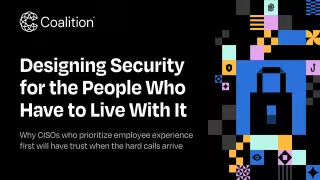
Global – October 27, 2026 -- Coalition's newly appointed Chief Information Security Officer, a 25-year InfoSec veteran, argues that security teams run on a finite supply of organizational trust, and that high-friction controls drain it and push staff toward less-protected workarounds.
Coalition's CISO treats organizational trust as a limited token budget
The executive spent five years at Coalition before taking the CISO role. The CISO describes trust as a basket of tokens: every control costs tokens, and some cost more than others. Friction belongs only where risk warrants it, while teams should look for changes that raise protection and lower cost at once. Hoarding tokens benefits attackers, the CISO writes, because a control adequate two years ago may fall short today. Coalition holds vendors and itself to the same standard.
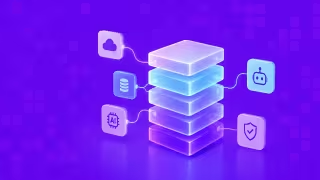
Global – – October 27, 2026 -- Enterprises deploying autonomous AI agents must extend sovereignty controls beyond data location and model hosting to cover agent identity, permissions, execution authority and oversight. Agents can interpret goals, select tools, call APIs, update applications and delegate work to other agents within a single task.
Governance shifts from controlling access to controlling actions
Traditional AI governance centers on datasets, approved models, processing locations and user access. Agentic systems make decisions inside the workflow itself, choosing which system to query, which tool to invoke and which action follows. A procurement agent investigating a supplier issue could pull supplier records, review purchase orders, analyze delivery records, compare contract terms and initiate an approval workflow. That chain spans several databases, applications, APIs, models and identity systems.
GLOBAL – October 27, 2026 -- Only 22% of organizations have applied sovereignty or residency requirements to AI models, against 60% for data, according to a global 2025 survey cited in a new analysis of sovereign AI architecture.
Sovereignty controls thin out higher in the AI stack
The same survey found that 46% of organizations applied such requirements to infrastructure and 32% to applications. The decline leaves a structural blind spot: protecting enterprise data has limited value if the model processing it operates outside the intended control framework.
Europe – October 27, 2026 -- Self-hosted LLM infrastructure tends to become the cheaper option above roughly 50 million tokens processed per day, while commercial APIs usually stay more economical below 5 million, according to AppsTek's analysis of when enterprises need a sovereign LLM. The figures are illustrative and should be checked against current provider pricing and actual workload patterns.
AppsTek's third piece in its sovereign AI series argues that the model layer is now a governance decision, not only a technology choice, as generative AI moves into regulated, revenue-bearing workflows.
Global – October 27, 2026 -- Some 89% of organizations surveyed for the World Quality Report 2025 are piloting or deploying GenAI-augmented Quality Engineering (QE), but only 15% have reached enterprise-wide implementation. Respondents reported an average productivity gain of 19%. Vendors such as AppsTek are pitching agentic QE as a way to hold down testing unit costs as release volumes grow.
Maintenance work pushes up the cost of enterprise test automation
Each release adds workflows, integrations and regression paths while QE budgets stay tightly controlled. The pressure shows up in maintenance, contractor spend, rework and cost per release.
Global – October 27, 2026 -- Two AI agent runs can return the same correct answer while carrying very different operational risk, which makes output-only checks insufficient for enterprise Quality Engineering (QE), according to a new AI agent testing framework built around four evaluation layers.
Recovered failures can look like clean successes
In the source's example, an agent retrieving an account balance queries an unnecessary privileged system, hits an authorization error, retries twice and then reaches the approved source. The user sees a correct result. An output-level assertion marks the run as a success, while a trace-level evaluation flags it as degraded.