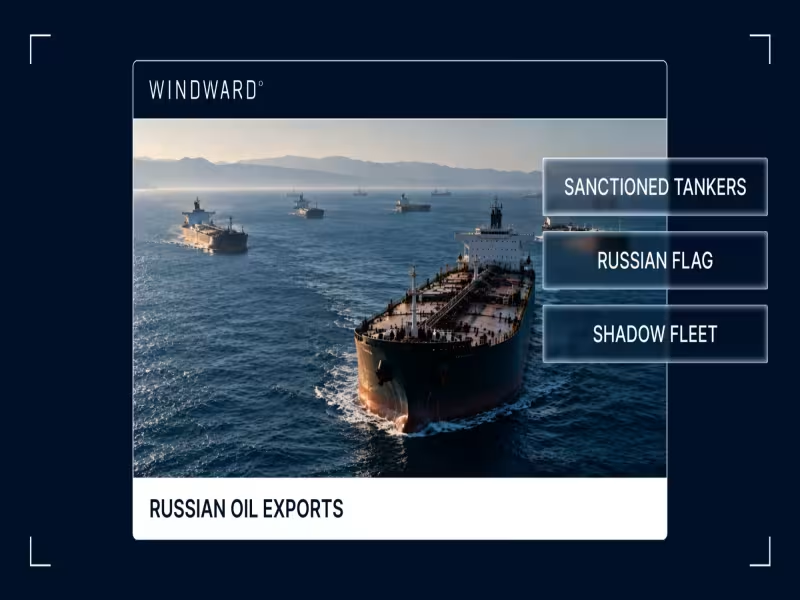
Russia – October 27, 2026 -- Sanctioned vessels carried 78 million barrels, or 55% of Russia's September oil exports, and 63% of its crude, as EU-owned tankers retreated from exposed routes, according to Windward analysis using Vortexa data.
Russia shipped 142.7 million barrels of crude and oil products in September. Crude accounted for 110.4 million barrels, about 3.7 million barrels per day and broadly level with August's 3.78 million bpd as reported by the IEA. Clean petroleum products totaled 14.9 million barrels, mostly naphtha (9.8 million), alongside 17.4 million barrels of fuel oil and feedstocks.
Falsely flagged tankers vanish as Russian flag share grows
No cargo was loaded on falsely flagged tankers for the third consecutive month, indicating Russia has discontinued their use. Tankers moved to other flags, with record numbers shifting to the Russian flag over the third quarter. Russia now flags 46 of the 101 sanctioned tankers tracked, and 43% of sanctioned volume (33.4 million barrels) moved on Russian-flagged ships. Sierra Leone, Cameroon, Oman and Equatorial Guinea flagged most of the rest.
EU-owned tankers carry 22% of volumes but only 14% of crude
EU-owned tankers lifted 31.5 million barrels, 22% of the total; the remaining 23% moved on unsanctioned shadow fleet or other tonnage. They carried 57% of fuel oil and 41% of clean products. Their share of crude was 14%, which reflects Urals trading well above the $44.10 EU and UK price cap.
EU-owned loadings fall 46% within September
Nine in ten EU-owned barrels (28.8 million of 31.5 million) loaded at Baltic ports including Primorsk, Ust-Luga, St. Petersburg and Vysotsk, where they carried 37% of all volumes. They handled 3% of Far East volumes and none of the Arctic crude.
EU-owned loadings dropped from 20.5 million barrels on September 1-15 to 11.1 million on September 16-30. Clean products fell furthest, from 5.2 million to 1.0 million barrels, amid the ongoing Russian export ban on gasoline and diesel following Ukrainian attacks on refineries. Russia banned gasoline exports in April, added jet fuel in mid-June and diesel in mid-July, with the diesel ban extended to September 30. Russia previously exported about half its diesel and gasoil, per the IEA. On Baltic crude, dark-fleet volumes rose from 3.6 million to 5.6 million barrels in the second half of the month.
Sanctioned ships lift all 4.3 million barrels of Sheskharis crude
Sanctioned tankers carried 68% of the 7.4 million barrels lifted from the Black Sea. All 4.3 million barrels of Urals and Siberian Light from Novorossiysk's Sheskharis terminal moved on sanctioned ships. EU-owned tankers carried only diesel, 1.2 million barrels in six cargoes on five medium-range tankers, and none loaded after September 12. Worsening security has left fewer EU-owned tankers willing to operate in the area.
Sanctioned ships carried 84% of Murmansk crude loadings and 61% of Far East volumes, with unsanctioned shadow fleet tankers taking 32% in the Far East. At Kozmino, 30 tankers loaded 33.4 million barrels of ESPO crude, most of it delivered to China.
Ship-to-ship transfers obscure 11.6 million barrels across 33 cargoes
Nakhodka Bay handled 8.7 million barrels via ship-to-ship transfer. All 5.7 million barrels of Sokol crude loaded at De-Kastri were transferred, with two Sovcomflot-owned shuttle tankers handing cargoes to larger ships. Port Said handled 2.3 million barrels, including almost half of the Russian crude loaded at Novorossiysk. At Ceuta, small naphtha parcels went through as many as three transfers.
Five VLCCs carried 8.5 million barrels of Russian crude, and none loaded directly at a Russian terminal. Four of the five, carrying 85% of the VLCC volume, are unsanctioned shadow fleet tankers.