Windward

Mali-Flagged Cargo Ship Goes Dark 25 Days Off Libya After Albania Sailing

Image
Mali-Flagged Cargo Ship Goes Dark 25 Days Off Libya After Albania Sailing

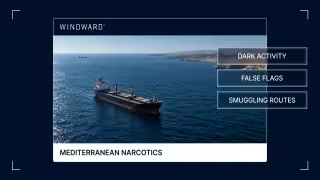
Mediterranean – October 29, 2026 -- A Mali-flagged general cargo vessel switched off its AIS transponder for 25 days and 8 hours off eastern Libya between August 28 and September 23, 2026. Windward's maritime intelligence team assesses the gap as deliberate.

Vessel reappeared at the same position and returned to Albania

The ship left an Albanian port declaring Egypt as its destination and went dark in open water. When it resumed transmitting on September 23, it was at nearly the same position where it had disappeared. It then changed its declared destination back to Albania and sailed directly there.
Windward Links 45 Shadow Fleet Tankers to One Hong Kong Nominee

Image
Windward Links 45 Shadow Fleet Tankers to One Hong Kong Nominee

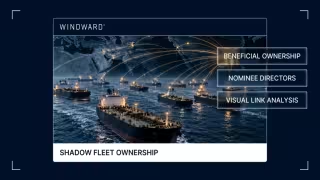
Hong Kong – October 29, 2026 -- Windward has tied 45 Russia-trading shadow fleet tankers, held through 45 single-ship Hong Kong companies, to one untraceable nominee director, and 42 of the vessels are sanctioned.

Per Windward's visual link analysis, all but three of the tankers share 19 ISM managers with addresses in one industrial cluster in Sumqayit, Azerbaijan. The three exceptions are the unsanctioned vessels, which use ISM managers in the UAE.

Aging fleet runs under two flags

The group comprises six Suezmaxes, 33 Aframaxes and six medium-range product tankers, with an average age of 22 years. Thirty-four fly the Sierra Leone flag and nine fly the Equatorial Guinea flag.

Windward Tracks Vessels Loitering Over Subsea Cables in Five Theaters

Image
Windward Tracks Vessels Loitering Over Subsea Cables in Five Theaters

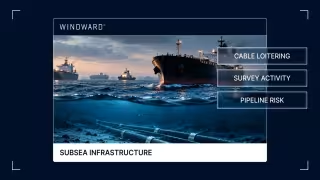
Guam – October 29, 2026 -- Windward data shows vessels linked to China and Russia loitering over subsea cable and pipeline corridors in five theaters. Activity ranges from the Guam cable hub to the Luzon Strait, Bab el-Mandeb and the gas pipelines feeding St Fergus, which supplies 25 to 50% of Britain's gas.

Chinese survey grids cover the Guam and Japan cable corridors

A Chinese-flagged fishery patrol vessel run by a state fishery research institute has worked research-pattern grids on both sides of Guam for seven weeks. Guam is the landing point for 11 subsea cables. The vessel ran a grid east of Guam between the Bulikula and SEA-US cables from August 31 to around September 20. A second grid west of Guam in the Philippine Sea was still running on September 29.

Pacific Cable Risk Hinges on Vessel Behavior, Windward Data Shows

Image
Pacific Cable Risk Hinges on Vessel Behavior, Windward Data Shows

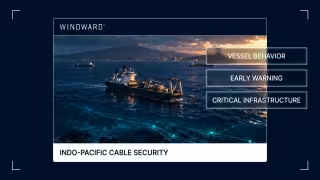
Honolulu – October 29, 2026 -- Windward recorded 27 slow-speed service and research vessel events near cable routes around Hawaii and 5 around Guam and the Northern Marianas in Q1 2026, as concentrated landing sites and a thin repair fleet leave Indo-Pacific cable security dependent on early warning.

Hawaii and Guam concentrate trans-Pacific cable exposure

Both islands anchor the trans-Pacific links connecting the continental U.S. to forces, allies and partners in the theater. A September 2026 report for the U.S.-China Economic and Security Review Commission (USCC) found that the continental U.S. connections to Hawaii and Guam are particularly vulnerable to gray-zone sabotage, with few redundancy options.

Customs Agencies Need Maritime Intelligence, Not Trade Data, Windward Says

Image
Customs Agencies Need Maritime Intelligence, Not Trade Data, Windward Says

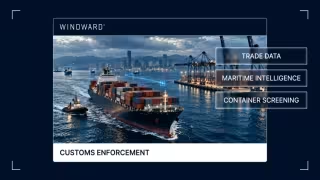
Global – October 29, 2026 -- Declaration-based trade data cannot identify the vessels customs agencies most need to stop, according to a Windward analysis that points to a UK cocaine seizure worth roughly $100 million at London Gateway as proof.

Trade data records declarations, and enforcement targets the ones that fail

Cargo manifests, customs declarations and import and export filings were built to answer commercial questions, such as crude volumes through Yanbu or dry bulk flows into Rotterdam. Enforcement asks different questions. Which of 15,000 containers arriving at a port in one day holds something undeclared? Which vessel detoured through a sanctioned port?

Windward argues the gap is structural, not a matter of coverage or refresh rate. A vessel running dark leaves no AIS record to check, and one broadcasting manipulated positions leaves a record that looks complete.

GPS Jamming Hits 124,235 Vessels, Undermining Marine Insurance Claims

Image
GPS Jamming Hits 124,235 Vessels, Undermining Marine Insurance Claims

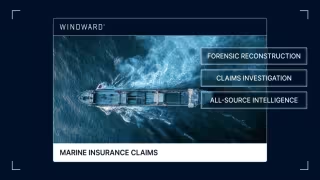
Middle East – October 29, 2026 -- GPS jamming affected 124,235 vessels worldwide in the third quarter of 2026, according to Windward's Q3 Maritime Risk Report. The AIS records marine insurers have long used to settle pay-or-reject decisions are no longer a reliable basis for loss investigation in the highest-risk regions.

Jamming runs at 5,131 incidents a day and has produced 3.35 million false meetings

Jamming averaged 5,131 incidents per day across the quarter, broadly unchanged from Q2. Since Operation Epic Fury began in February 2026, Windward has recorded more than 3.35 million false ship-to-ship meetings, in which injected coordinates made vessels appear to rendezvous when no meeting took place.

Iran Threatens Hormuz Cables as Four Gulf States Lack Bypass

Image
Iran Threatens Hormuz Cables as Four Gulf States Lack Bypass

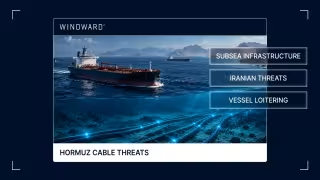
Tehran – October 29, 2026 -- Iraq, Kuwait, Bahrain and Qatar have no subsea route to the outside world that avoids the Strait of Hormuz, after an Iranian Revolutionary Guard Corps (IRGC) spokesman said on October 19 that seven major internet cables run beneath the waterway and that new targets and weapons would be unveiled.

Spokesman Hossein Mohebbi told a ceremony in Tehran that the response this time would be much harsher. Earlier in October, Supreme National Security Council secretary Mohsen Rezaei said Iran could strike U.S.-linked cables, data centers and AI facilities in a new war. In May, the IRGC said every cable crossing the strait could be placed under Iranian permits.

Port of NEOM bulk calls jump to 25 as war diverts Red Sea cargo

Image
Port of NEOM bulk calls jump to 25 as war diverts Red Sea cargo

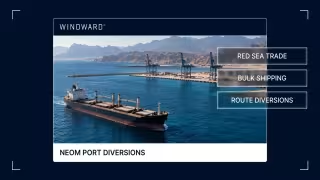
NEOM – October 27, 2026 -- Monthly RoRo vessel calls at the Port of NEOM reached 30 in September 2026, about 70% above the pre-war average of 17. War-diverted cargo is lifting traffic at a port built for a megacity that is shrinking, according to Windward maritime analysis.

The growth runs against NEOM's own trajectory. The Public Investment Fund wrote down its giga-projects by $8 billion at the end of 2024 and ordered spending cuts of more than 20%. The Line was paused in September 2025, and the $2.5 billion NEOM Stadium planned for the 2034 World Cup was shelved in early October 2026.

Gulf VLCC Rates Top $1.3M a Day as Tanker Attacks Spread

Image
Gulf VLCC Rates Top $1.3M a Day as Tanker Attacks Spread

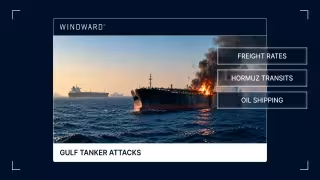
Qatar – October 27, 2026 -- The benchmark VLCC rate from Saudi Arabia to China has passed $1.3 million per day, pushing freight above 25-30% of the cost of Gulf crude versus 1-3% in normal market conditions, according to Windward. The surge follows a tanker strike off Qatar on October 7.

Tanker struck 51 nautical miles off Qatar breaks the Hormuz-only attack pattern

An unnamed tanker was hit by multiple projectiles 51 nautical miles off Madinat ash Shamal, UK Maritime Trade Operations (UKMTO) reported on October 7. It is the first attack outside the Strait of Hormuz since September 9, when a Greek-owned very large crude carrier was struck in Iraqi waters.

UKMTO has logged 16 attacks on ships in the Middle East Gulf in 10 days. Windward confirmed 12 of the vessels, 11 of them tankers. All were transiting dark through the U.S. military-assisted southern corridor.

Sanctioned Tankers Carry 55% of Russia's September Oil Exports

Image
Sanctioned Tankers Carry 55% of Russia's September Oil Exports

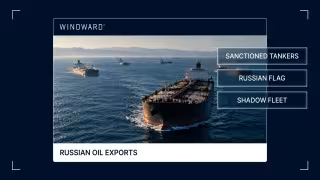
Russia – October 27, 2026 -- Sanctioned vessels carried 78 million barrels, or 55% of Russia's September oil exports, and 63% of its crude, as EU-owned tankers retreated from exposed routes, according to Windward analysis using Vortexa data.

Russia shipped 142.7 million barrels of crude and oil products in September. Crude accounted for 110.4 million barrels, about 3.7 million barrels per day and broadly level with August's 3.78 million bpd as reported by the IEA. Clean petroleum products totaled 14.9 million barrels, mostly naphtha (9.8 million), alongside 17.4 million barrels of fuel oil and feedstocks.