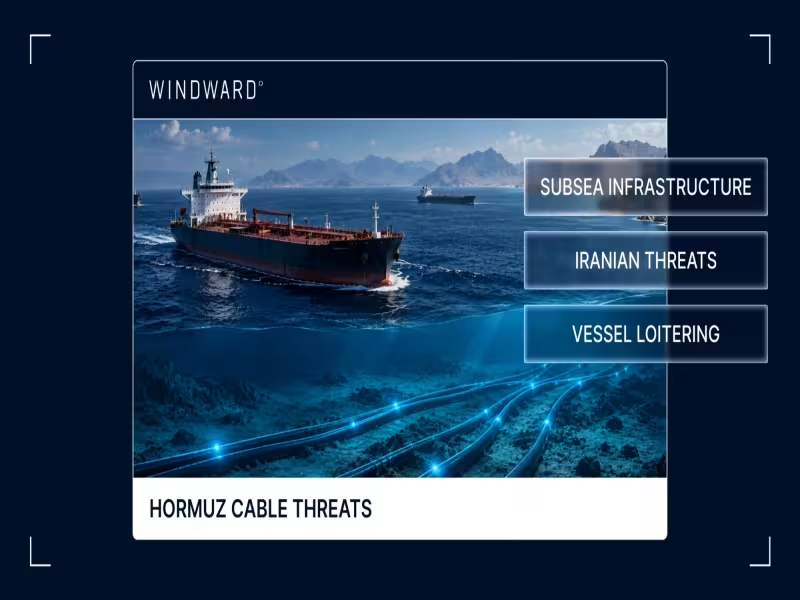
Tehran – October 29, 2026 -- Iraq, Kuwait, Bahrain and Qatar have no subsea route to the outside world that avoids the Strait of Hormuz, after an Iranian Revolutionary Guard Corps (IRGC) spokesman said on October 19 that seven major internet cables run beneath the waterway and that new targets and weapons would be unveiled.
Spokesman Hossein Mohebbi told a ceremony in Tehran that the response this time would be much harsher. Earlier in October, Supreme National Security Council secretary Mohsen Rezaei said Iran could strike U.S.-linked cables, data centers and AI facilities in a new war. In May, the IRGC said every cable crossing the strait could be placed under Iranian permits.
Six live cables cross the strait, with two more due in 2027
TeleGeography data shows six live cables crossing Hormuz: 2Africa, AAE-1, FALCON, GBI, Tata TGN-Gulf and OMRAN/EPEG. FIG and SEA-ME-WE 6 are under construction for 2027, which lifts the total to eight. Iran's figure of seven falls between the current and near-future counts.
Iraq's three cables all land at Al Faw, leaving no alternative sea path
Exposure depends on geography rather than cable count. Every cable used by Iraq, Kuwait, Bahrain and Qatar lands inside the Gulf, so all their subsea traffic must pass through Hormuz.
Iraq has three live cables, all at Al Faw. Kuwait has five, Bahrain five and Qatar seven, but FOG, Qatar-UAE and Kuwait-Iran never leave the Gulf. That leaves Kuwait with three routes out, Bahrain with four and Qatar with five. Iraq is building a land route from Al Faw to the Turkish border with Ooredoo, the only alternative any of the four states is actively building.
The UAE is better placed: six cables land on its Gulf coast, while 14 land at Fujairah and Kalba on the Gulf of Oman, outside the strait but still within Iran's reach. Oman has two cables at Khasab, 11 on the Gulf of Oman and five at Salalah and Qalhat on the Arabian Sea. Saudi Arabia has four at Al Khobar and 14 on the Red Sea, though two Red Sea cables were cut near Jeddah in September 2025.
Windward tracks two sanctioned tankers drifting over cable corridors
In the two weeks before the statement, Windward tracked two OFAC-sanctioned, Iran-linked tankers drifting for days over regional cable corridors. Both were in ballast with no commercial reason to stop.
The first, sanctioned in September 2024 for moving cargo for the IRGC Quds Force, slowed to under one knot on September 30 and drifted for 73 hours at an average of 0.6 knots with its engine off. It passed within half a nautical mile of FALCON, GBI and MENA. Four days earlier it had changed its MMSI, call sign and flag code. Earth-observation imagery placed it on station on October 1 at 06:52 UTC.
The second, sanctioned in November 2025 for carrying Iranian LPG, stopped on October 4 in the central Arabian Sea, 660 nautical miles out. It loitered for 115 hours at a median of 0.6 knots over the AAE-1, FEA, SEACOM/TGN-Eurasia, IMEWE and SeaMeWe-4 routes in roughly 3,700 meters of water. It was the longest drift on that corridor since late May.
Windward does not characterize either drift as a confirmed survey. A hull-mounted multibeam sonar covers a swath roughly 3.5 times the water depth, and whether such mapping took place is not established.
FALCON and GBI land in Iran, making the threat selective
FALCON and GBI land at Bandar Abbas and Bushehr, so cutting them would sever Iran's own links. OMRAN/EPEG, which runs between Oman and Iran, carries the same problem. 2Africa and Tata TGN-Gulf do not land in Iran, and neither do the two 2027 cables. Targeting those systems selectively would require precise knowledge of where each runs.
Windward lists three indicators to watch: further loitering by Iranian-linked vessels over cables that do not land in Iran, progress on Iraq's land route to Turkey, and any redesign of the FIG and SEA-ME-WE 6 routes, both due in 2027 and both passing through the same strait.