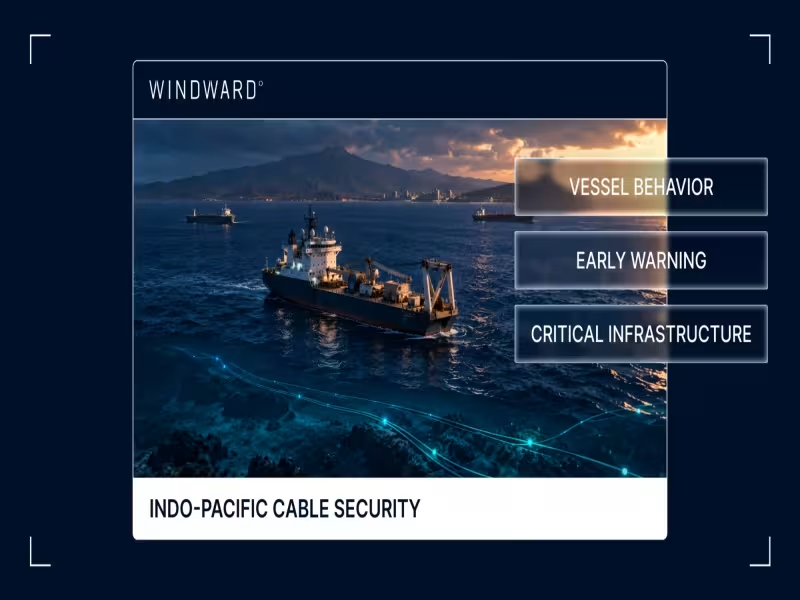
Honolulu – October 29, 2026 -- Windward recorded 27 slow-speed service and research vessel events near cable routes around Hawaii and 5 around Guam and the Northern Marianas in Q1 2026, as concentrated landing sites and a thin repair fleet leave Indo-Pacific cable security dependent on early warning.
Hawaii and Guam concentrate trans-Pacific cable exposure
Both islands anchor the trans-Pacific links connecting the continental U.S. to forces, allies and partners in the theater. A September 2026 report for the U.S.-China Economic and Security Review Commission (USCC) found that the continental U.S. connections to Hawaii and Guam are particularly vulnerable to gray-zone sabotage, with few redundancy options.
Guam was the landing point for 11 subsea cables as of 2023, and every landing site sat on its western coast. One incident in the shallow approaches could therefore touch several systems at once. The USCC report found that disruption to a single cable could overwhelm capacity on direct routes between the U.S., Taiwan, Japan and the Philippines. Several simultaneous cuts could overwhelm trans-Pacific capacity as a whole.
Accidental faults dominate, giving saboteurs cover
A March 2026 CSIS analysis found that most faults stem from natural disasters, fishing and maritime accidents. Windward's Q1 2026 Undersea Cables Risk Report ranks trawlers as the top accidental-damage risk because their steel ground gear and weighted otter boards can snag, drag or sever cables. CSIS notes that a deliberate cut is low probability but high impact, and that the volume of accidental damage gives a malicious actor plausible deniability.
In February 2025, Taiwan's coast guard detained HONG TAI 58, a Togo-flagged cargo vessel with a Chinese crew, after a cable to the Penghu Islands was disconnected near where it had dropped anchor. Prosecutors charged its captain in April 2025. Taiwan had reported five cases of seabed cable damage in 2025, against three in each of 2023 and 2024.
Behavioral history separates routine traffic from cable risk
Windward defines the first risk category as service and research vessels holding slow speed for more than an hour near a known cable route. Scrutiny rises when the vessel is tied to a state of concern or sails under a flag of convenience, and especially when activity repeats or lasts longer. The second category is fishing and trawling, where the risk is physical and usually accidental.
The Pacific logged only 19 state-of-concern service vessel events in Q1 2026, all Chinese or Russian. Yet 20% of its cable-proximate activity lasted longer than 24 hours, the highest extended-presence rate of any region. Chinese-flagged vessels accounted for 54.4% of Pacific fishing activity, operating around Kiribati, the Solomon Islands and Fiji, all of which host landing stations tied to U.S. Pacific communications.
From August 31 to roughly September 20, 2026, a Chinese-flagged fishery patrol vessel ran a grid east of Guam between the Bulikula and SEA-US cables. It then crossed the Guam and CNMI EEZ and began a second grid west of Guam, still running as of September 29. On September 13 it met a Cook Islands-flagged tanker for about six hours, likely to refuel. The vessel usually operates around China and occasionally in the Indian Ocean, and this was its first such activity in the region. Windward analysts assessed its north-to-south legs and repeated slow-speed stops as consistent with possible seabed and cable mapping, a risk indicator rather than proof of intent.
Sixteen Indo-Pacific repair ships make early warning the main defense
A May 2025 RSIS commentary, citing the International Cable Protection Committee, counts 16 specialist repair vessels based in the Indo-Pacific. About 200 cable faults occur worldwide each year, and roughly two-thirds are caused by ships. A 2024 repair to the SEA-ME-WE 5 cable was delayed two months by permitting rules alone.
CSIS counts 62 cable-laying and maintenance vessels globally, only 19 of them contracted for maintenance, and says new ships are not entering service as fast as old ones retire. Forecasts it cites expect Southwest Pacific cables to need 141 repairs in 2040, nearly half of all faults worldwide.
AIS gaps widen as falsely flagged ships reach 613
Windward's Q3 2026 Maritime Risk Report shows the IMO's list of falsely flagged ships reached 613 by the end of September, up 39% since January. In a single quarter, 84 dark fleet tankers changed MMSI numbers to reflag to Russia. In the Strait of Hormuz, Windward estimates 52% of September transits were invisible to AIS and satellite observation.
Windward argues that all-source intelligence closes this gap by fusing AIS with SAR and EO satellite imagery, RF detection and years of behavioral history. Each vessel is then read against its ownership network and the cable routes beneath it.