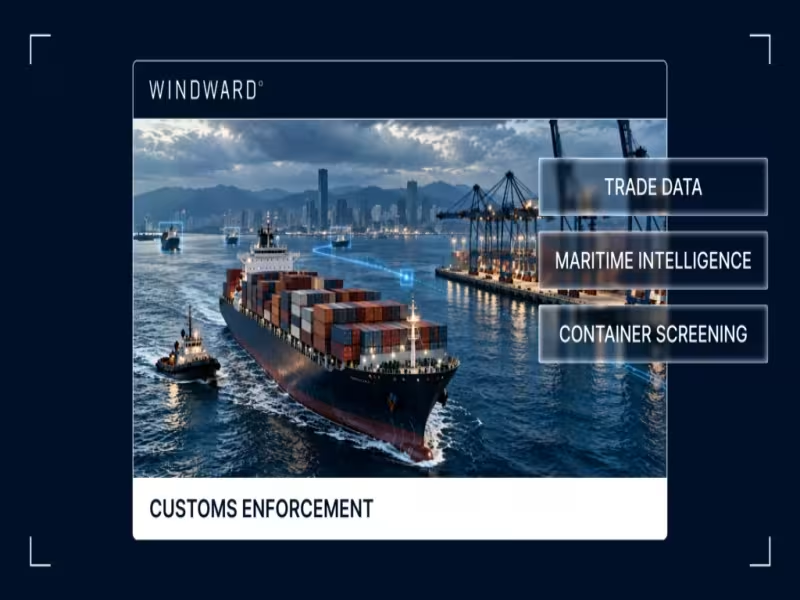
Global – October 29, 2026 -- Declaration-based trade data cannot identify the vessels customs agencies most need to stop, according to a Windward analysis that points to a UK cocaine seizure worth roughly $100 million at London Gateway as proof.
Trade data records declarations, and enforcement targets the ones that fail
Cargo manifests, customs declarations and import and export filings were built to answer commercial questions, such as crude volumes through Yanbu or dry bulk flows into Rotterdam. Enforcement asks different questions. Which of 15,000 containers arriving at a port in one day holds something undeclared? Which vessel detoured through a sanctioned port?
Windward argues the gap is structural, not a matter of coverage or refresh rate. A vessel running dark leaves no AIS record to check, and one broadcasting manipulated positions leaves a record that looks complete.
All-source intelligence fuses four layers independent of vessel declarations
Windward lists EO and SAR satellite imagery, RF detection, behavioral analytics and ownership resolution as the core layers. SAR works through cloud and darkness, and RF identifies a vessel's emissions when AIS is off. Behavioral models read routes that do not match the stated voyage, loitering in transfer-associated corridors and dark periods that begin and end in telling locations. Ownership resolution links an operator with a concealment history to its past, despite flag hopping and shell structures.
London Gateway seizure was traced from three public details
Public reporting on the seizure named only a container vessel, a Panama port call and a June arrival. Those details returned three matching vessels in the relevant window. One carried a history, surfaced through adverse media screening, of a 2016 case in which about 200 pounds of cocaine were found concealed in a container loaded at Santos.
The voyage ran from Panama in early June across the Atlantic to Antwerp on June 21, Rotterdam on June 23 and London Gateway on June 25, then onward to Germany. Each leg produced accurate paperwork. According to Windward, the vessel's routing and history carried the risk indicator, not any single filing.
Vessel behavior builds risk picture while ships are still at sea
Declarations arrive close to arrival, leaving a narrow window to act. Vessel behavior accumulates across the whole voyage, so a risk assessment can be built before the ship docks. A declaration-based model would rank a container declared as machine parts from a legitimate exporter with a clean filing history as low risk.
Windward frames the test for any enforcement data source as what it still shows when the vessel switches off. Trade data and AIS show nothing in that window, while satellite detection, RF confirmation, behavioral models and ownership intelligence still produce a picture. Windward adds that national holdings, partner reporting and industry data can be fused in alongside these layers.