Middle East – October 29, 2026 -- GPS jamming affected 124,235 vessels worldwide in the third quarter of 2026, according to Windward's Q3 Maritime Risk Report. The AIS records marine insurers have long used to settle pay-or-reject decisions are no longer a reliable basis for loss investigation in the highest-risk regions.
Jamming runs at 5,131 incidents a day and has produced 3.35 million false meetings
Jamming averaged 5,131 incidents per day across the quarter, broadly unchanged from Q2. Since Operation Epic Fury began in February 2026, Windward has recorded more than 3.35 million false ship-to-ship meetings, in which injected coordinates made vessels appear to rendezvous when no meeting took place.
Jamming is persistent in the Middle East Gulf, the Black Sea and the Mediterranean, where current marine claims concentrate. An AIS record from these areas may contain injected coordinates, missing intervals or false event records. A vessel that appears to have taken one route may have taken another, and one that shows no port calls may have made them.
Sanctions-compliance evidence rests on the same AIS record, so a claims decision built on it inherits its weaknesses.
Dark convoy passages reached 52% of Hormuz traffic in September
Windward estimates dark convoy passages made up 47% of Hormuz traffic in August and 52% in September. Some vessels switched off AIS with owner and flag state consent for safety and security reasons. Claims involving a loss, or contested activity, during such a window depend on reconstructing a period when the vessel reported nothing.
Hormuz traffic collapsed after the Iran conflict and Operation Epic Fury began on February 28, 2026. AIS-visible monthly transits fell from about 3,750 in February to 450 in March, and June remained roughly 83% below pre-conflict baselines. Traffic briefly rebounded after the June 17 Memorandum of Understanding between Iran and the U.S. and the lifting of the blockade on June 18. Iran reimposed closure on June 20 and reinstated the Persian Gulf Strait Authority toll and clearance system. Windward counted 55 AIS-visible transits between September 16 and 23, about 94% below pre-war levels.
Stranded vessels open constructive total loss and loss of hire disputes
Many war risk clauses set a 12-month detention period before a constructive total loss can be declared, and some policies use six months. Insurers must now establish detention timelines and operating conditions to decide whether vessels held in the Gulf without physical damage qualify.
Loss of hire claims have also risen from voyages that could not be completed. Not every loss of hire policy responds without physical loss or damage, so teams are working through individual policy wording.
Court of Appeal ruling in CATALAN SEA lowers the sanctions-clause threshold
On May 22, 2026, the English Court of Appeal ruled in Tonzip Maritime (Singapore) Pte Ltd v 2 Rivers Pte Ltd, The CATALAN SEA, that invoking a sanctions clause requires a reasonable judgment of a real risk of sanctions, not proof that a breach would probably occur. The case is a charterparty dispute, not an insurance case, but it bears on how insurance sanctions clauses may be read.
The lower threshold gives insurers and owners more room to decline coverage, refuse claims or terminate policies. The invoking party still needs evidence sufficient to support its judgment. A decision resting on AIS data from a jamming-affected region is more exposed to challenge than one based on multi-sensor reconstruction of actual vessel activity.
The OFAC-OFSI Comparative Overview, published June 23, 2026, documents differences between U.S. and UK frameworks in ownership calculations, terminology, jurisdictional reach and enforcement mechanics. Both regimes apply strict liability for civil penalties, so a claims decision that inadvertently touches sanctioned activity can create enforcement exposure without knowledge of the prohibition.
All-source reconstruction replaces vessel self-reporting as the evidence base
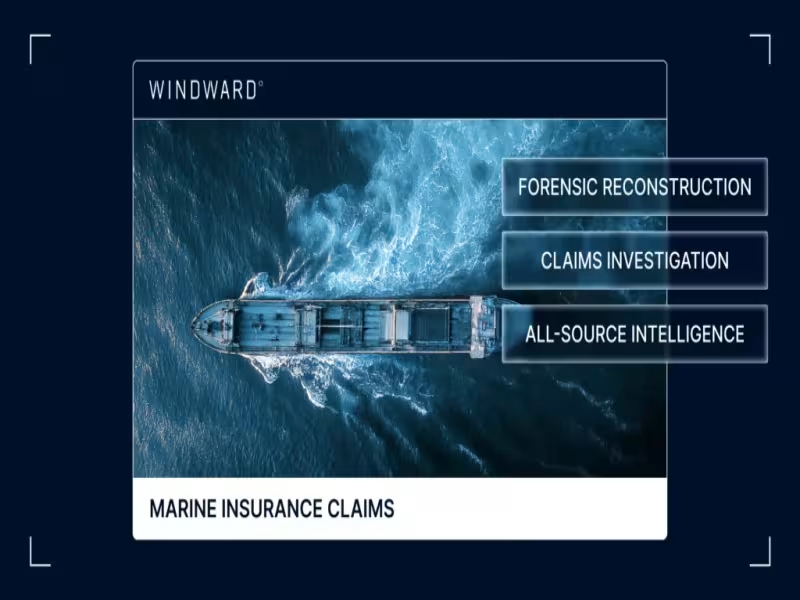
Windward describes forensic reconstruction as an all-source exercise that draws on satellite imagery, radio frequency detection, behavioral intelligence and any other independent source relevant to the question. None of these depends on the vessel's own broadcasts.