Enterprises Weigh Sovereign LLMs as EU AI Act Deadline Nears

Image
Enterprises Weigh Sovereign LLMs as EU AI Act Deadline Nears

Europe – October 27, 2026 -- Self-hosted LLM infrastructure tends to become the cheaper option above roughly 50 million tokens processed per day, while commercial APIs usually stay more economical below 5 million, according to AppsTek's analysis of when enterprises need a sovereign LLM. The figures are illustrative and should be checked against current provider pricing and actual workload patterns.

AppsTek's third piece in its sovereign AI series argues that the model layer is now a governance decision, not only a technology choice, as generative AI moves into regulated, revenue-bearing workflows.

Agentic QE Targets Testing Unit Costs as GenAI Pilots Hit 89%

Image
Agentic QE Targets Testing Unit Costs as GenAI Pilots Hit 89%

Global – October 27, 2026 -- Some 89% of organizations surveyed for the World Quality Report 2025 are piloting or deploying GenAI-augmented Quality Engineering (QE), but only 15% have reached enterprise-wide implementation. Respondents reported an average productivity gain of 19%. Vendors such as AppsTek are pitching agentic QE as a way to hold down testing unit costs as release volumes grow.

Maintenance work pushes up the cost of enterprise test automation

Each release adds workflows, integrations and regression paths while QE budgets stay tightly controlled. The pressure shows up in maintenance, contractor spend, rework and cost per release.

AI Agent Testing Must Cover Execution Paths, Not Just Answers

Image
AI Agent Testing Must Cover Execution Paths, Not Just Answers

Global – October 27, 2026 -- Two AI agent runs can return the same correct answer while carrying very different operational risk, which makes output-only checks insufficient for enterprise Quality Engineering (QE), according to a new AI agent testing framework built around four evaluation layers.

Recovered failures can look like clean successes

In the source's example, an agent retrieving an account balance queries an unnecessary privileged system, hits an authorization error, retries twice and then reaches the approved source. The user sees a correct result. An output-level assertion marks the run as a success, while a trace-level evaluation flags it as degraded.

Teekay Interns Build Earnings Forecast Model in 12-Week MPA Program

Image
Teekay Interns Build Earnings Forecast Model in 12-Week MPA Program

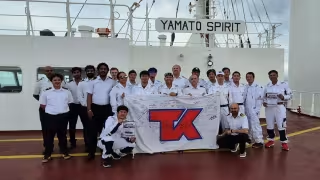
Singapore – October 27, 2026 -- Teekay hosted two interns for 12 weeks through a Maritime and Port Authority of Singapore (MPA) program, and one of them built a machine learning workflow to forecast vessel earnings from voyage, market, bunker, port and utilization data.

Intern deploys fleet procurement website in Singapore

Data analytics student Jonathon Lee worked on procurement and commercial analytics under Yi Chuen Ho, Regional Commercial Operations Manager, and Sajeev Soman, Manager, Procurements & Contracts. He built and deployed a fleet procurement website end to end, with dashboards for spares delivery and port call costs.

He also automated a previously manual charterer name-matching process.

Teekay Tankers Awards Vessel Teams for Top Hazard Reporting

Image
Teekay Tankers Awards Vessel Teams for Top Hazard Reporting

Global – October 27, 2026 -- Teekay Tankers has named this quarter's winners of its Hazard Reporting Awards, recognizing the vessel teams that reported the highest number of hazards through the company's cloud-based digital platform.

Teekay Tankers turns hazard reporting into a quarterly team contest

The company has gamified the process. Vessels are placed into teams that compete every quarter to report the most hazards. Winners are recognized publicly and receive a prize.

Seafarers log unsafe acts and conditions on a mobile-friendly platform

Crews use the platform to flag unsafe acts or unsafe conditions on board as they notice them. Early and frequent reporting lets senior management implement corrective action outside regular on-board inspections.

Governments Prioritize SATCOM Control Over Ownership, Panel Finds

Image
Governments Prioritize SATCOM Control Over Ownership, Panel Finds

Global – October 27, 2026 -- Governments are demanding full control over their satellite communication mission stacks rather than just access to capacity, according to a panel hosted by ST Engineering iDirect. Speakers from the company and PA Consulting said sovereignty is shifting toward assurance and resilience.

Control outweighs ownership in national SATCOM programs

Alison Grey, Associate Partner at PA Consulting, said full end-to-end in-country ownership is unrealistic for most nations. The practical goal is assured access, control and resilience. Keith Blanchet, Vice President, Global Government at ST Engineering iDirect, defined sovereignty as resiliency, sovereign control and interoperability, the last being essential for coalition operations.

Paradigm, iDirect Pair 450SDM Modem With PIM for Multi-Orbit SATCOM

Image
Paradigm, iDirect Pair 450SDM Modem With PIM for Multi-Orbit SATCOM

United Kingdom – October 27, 2026 -- ST Engineering iDirect's 450SDM software-defined modem is 30% smaller than its predecessor, and Paradigm is integrating it into its PIM-based tactical terminals for government and defense users, according to Paradigm founder Ulf Sandberg.

PIM architecture links iDirect modems to lightweight terminals

Paradigm's Paradigm Interface Module (PIM) integrates the iDirect 950mp and the new 450SDM into a single platform, yielding the PIM950 and PIM450 configurations. Users can switch between software-defined profiles at the touch of a button. Sandberg said the 450SDM's compact form factor suits lightweight systems such as the backpack-ready RAGNO terminal, and that it supports multi-orbit and multi-waveform operation. The single-case HORNET terminal uses the same approach.

iDirect Previews Munich Defence Tech Day With SATCOM Podcast

Image
iDirect Previews Munich Defence Tech Day With SATCOM Podcast

Munich – October 27, 2026 -- ST Engineering iDirect will hold its Defence Technology Day in Munich on June 10, and a new podcast from the company previews the satellite communications (SATCOM) topics on the agenda.

Dave Davis, Senior Technical Director of Global Government at ST Engineering iDirect, hosts the discussion. His guests are Joey Williamson of Airbus Defence and Space and Henry Nelson of Marconi Technologies UK, formerly Ultra I&C.

Ukraine war and LEO constellations change how governments buy SATCOM

The panel examines how geopolitical tensions have shifted SATCOM demand. It cites the war in Ukraine and the rise of low Earth orbit (LEO) constellations as the two developments that changed how governments approach satellite communications.

Europe's MILSATCOM Leaders Demand Resilience-by-Design in Munich

Image
Europe's MILSATCOM Leaders Demand Resilience-by-Design in Munich

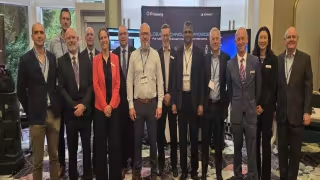
Munich – October 27, 2026 -- More than 100 military satellite communications (MILSATCOM) leaders gathered in Munich for ST Engineering iDirect's biennial Defence Technology Day, where speakers agreed that European sovereign networks must be built to withstand cyberattacks, jamming and physical damage from the outset. Defence agencies, operators, integrators and technology partners attended, and 12 partners exhibited.

Ukrainian officer: resilience cannot be retrofitted

Major Andrii Kovalchuk of the Armed Forces of Ukraine said modern SATCOM systems must survive cyberattacks, radio frequency interference and infrastructure damage at the same time. Speakers throughout the day echoed that resilience has to be embedded in architectures, terminals, waveforms, operational planning and procurement decisions.

Foresight Targets Satellite Network Fragmentation With AI Operations

Image
Foresight Targets Satellite Network Fragmentation With AI Operations

GLOBAL – October 27, 2026 -- Foresight, a network operations platform, lets satellite operators add AI-driven management without replacing the infrastructure they have already invested in, according to a recent Via Satellite webinar.

Fragmented tools slow troubleshooting across multi-orbit networks

Multi-orbit environments, rising service expectations and expanding infrastructure have made traditional network operations harder to scale. Many operators still work across fragmented tools, disconnected data sources and siloed management systems. The result is slower troubleshooting and harder optimization.