OPC UA Historians Should Store Source Time and Receipt Time

Image
OPC UA Historians Should Store Source Time and Receipt Time

Global – October 29, 2026 -- Choosing the wrong OPC UA timestamp can reorder events, hide network delay or place valid data outside the historian query window, so most process analysis should use a trustworthy SourceTimestamp as event time and keep collector receipt time as a separate field.

SourceTimestamp stays fixed as data passes through servers

The OPC UA specification defines SourceTimestamp as the time a data source applies to a value, ideally the last change of the value or status, generated as close to the source as possible. It does not change when the value passes through another OPC UA server. That makes it the best fit for sequence-of-events work, batch analysis and calculations tied to when the process changed.

TDengine Maps Three OPC UA Collection Modes to Historian Needs

Image
TDengine Maps Three OPC UA Collection Modes to Historian Needs

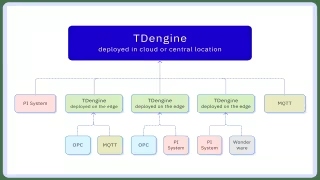
Global – October 29, 2026 -- Industrial historians should default to data-change subscriptions for continuously monitored OPC UA process variables and reserve polling for explicitly periodic records, according to collection guidance tied to TDengine TSDB-Enterprise.

Polling leaves a blind spot between reads

A polling client issues Read requests at a fixed interval, so a ten-second poll fetches the latest value every ten seconds whether or not it changed. If a motor status flips from 0 to 1 and back to 0 inside that window, both surrounding polls return 0. A shorter interval cuts the risk but raises load, and it never removes the gap between samples.

Polling fits periodic reporting, slow-changing values that need regular records, and servers with weak subscription support. A quality report requiring one temperature record per minute, including unchanged periods, is a polling case.

Akari Therapeutics Hires Vatnak Vat-Ho as Chief Business Officer

Tampa, FL and London – October 29, 2026 -- Akari Therapeutics (Nasdaq: AKTX) has appointed Vatnak Vat-Ho as Chief Business Officer, adding an executive who has held senior roles in oncology transactions totaling more than $25 billion in aggregate value.

Vat-Ho will run corporate strategy, partnering, licensing and investor engagement

Vat-Ho will lead corporate and business development at the oncology biotech, which is developing antibody drug conjugates (ADCs) built on a novel RNA splicing-disrupting payload called PH1. His remit covers corporate strategy, partnering and licensing, and investor engagement as the company advances its lead TROP2-targeted ADC, AKTX-101, toward the clinic.

He brings more than 20 years of experience across oncology business development, biopharmaceutical strategy, equity research and healthcare investing. His transaction record involves Pfizer, Exelixis, BioNTech, Merck KGaA, Roivant and Roche/Genentech.

Akari Files PCT Application Covering PH1 Splicing Payload Pathways

TAMPA – October 29, 2026 -- Akari Therapeutics (Nasdaq: AKTX) has filed international patent application PCT/US2026/45955, adding claims on how its PH1 payload modulates alternative splicing across multiple cancer-driving genes.

The filing expands the company's intellectual property around PH1, a splicing-modulating payload derived from its proprietary Thailanstatin platform, and around PH1-based antibody drug conjugates (ADCs). Akari contrasts PH1 with conventional ADC payloads that rely on tubulin inhibition, such as vedotin, or DNA damage, such as topoisomerase I inhibitors.

Application claims PH1 shifts VEGF-A splicing to block tumor blood supply

The claims cover PH1 altering VEGF-A splicing in cancer cells. The shift moves from a pro-angiogenic isoform to the anti-angiogenic VEGF-165b isoform, which prevents blood vessel recruitment to tumors.

Akari Therapeutics Books Five September ADC Conferences in US, China

TAMPA – October 29, 2026 -- Akari Therapeutics (Nasdaq: AKTX) will present its PH1 antibody drug conjugate (ADC) payload at five oncology, ADC and investor conferences in the United States and China during September 2026, as it looks for pharma partners and investors ahead of a planned first-in-human trial by mid-2027.

CEO Abizer Gaslightwala will deliver a keynote and featured presentations. The company says it will discuss global R&D collaboration, platform partnerships and pipeline expansion.

Akari fills a September calendar across Boston, Shanghai, WuXi and New York

The schedule runs from September 9 to September 29:

Volatus Aerospace Adds Veteran Rotor Wing Pilot in Alberta

Image
Volatus Aerospace Adds Veteran Rotor Wing Pilot in Alberta

Villeneuve – October 29, 2026 -- Volatus Aerospace has added Maria Romero Abella, an aviation professional with about 10 years of experience, as Rotor Wing Technician and Pilot at its Villeneuve, Alberta, operations. She joined in March 2026.

Romero Abella moves from aviation support roles into helicopter operations

Romero Abella says her decade in aviation spanned several roles before developing into flying and helicopters. She cites the versatility of the helicopter and its wide range of applications as the draw.

At Volatus, she is building her flight experience through operational work rather than hour-building alone. In her words, every flight has a purpose beyond logging hours.

Volatus Completes C$4.5M NATO Drone Training Fleet Delivery

Image
Volatus Completes C$4.5M NATO Drone Training Fleet Delivery

Mirabel – October 29, 2026 -- Volatus Aerospace Inc. (TSX: FLT) has delivered the full uncrewed aircraft fleet under the initial C$4.5 million tranche of its ISR training system contract with a NATO partner, and the customer has started exercising the second-tranche option.

NATO customer begins exercising second-tranche option on a contract worth up to C$9 million

The contract was announced on December 15, 2025, and carries a potential aggregate value of up to C$9 million. Volatus has received additional orders under the agreement. The unexercised balance stays available at the customer's option through the end of 2027.

Delivery closes out shipment delayed by supply-chain disruptions

The shipment completes the initial fleet delivery following supply-chain disruptions that Volatus previously disclosed in its quarterly reporting. The source gives no further detail on the length or cause of the delay.

Volatus Wins Five-Year Canadian Armed Forces Tactical ISR Drone Deal

Image
Volatus Wins Five-Year Canadian Armed Forces Tactical ISR Drone Deal

MIRABEL – October 29, 2026 -- Volatus Aerospace (TSX: FLT) has won a five-year Government of Canada contract to supply low-cost tactical intelligence, surveillance and reconnaissance (ISR) uncrewed aircraft systems to the Canadian Armed Forces (CAF). The initial order covers 100 systems, with options for up to 4,900 more, for a potential total of 5,000.

Ottawa caps unit price at C$5,000 within a C$25 million envelope

The government's procurement framework set a maximum price of C$5,000 per system and a maximum procurement envelope of C$25 million. Volatus' contracted pricing is commercially confidential. Canada can exercise the 4,900 optional systems at its sole discretion.

NDAA Section 848 Extends Drone Compliance Beyond Country of Origin

Image
NDAA Section 848 Extends Drone Compliance Beyond Country of Origin

United States – October 29, 2026 -- Section 848 of the FY2020 National Defense Authorization Act restricts the U.S. Department of Defense from operating or procuring certain drones tied to China, Russia, Iran and North Korea, and its reach extends past the aircraft's assembly location to components, software and data services.

Section 848 covers flight controllers, radios, cameras and data storage

A drone assembled in the United States or another approved country is not automatically NDAA compliant. Restricted components, software or data services used elsewhere in the system can disqualify it. Buyers must trace the origin of flight controllers, radios, data-transmission devices, cameras and gimbals. Ground-control systems, operating software, network connectivity and data storage also affect compliance.

IntelePeer: Seven Myths Stall Healthcare AI as Medical Debt Tops $220B

Image
IntelePeer: Seven Myths Stall Healthcare AI as Medical Debt Tops $220B

United States – October 29, 2026 -- U.S. medical debt exceeds $220 billion, patient collection rates sit at 48% and health systems lose one in three calls after hours, according to a new IntelePeer whitepaper. The vendor argues that healthcare AI adoption is stalling on seven misconceptions, not on technology limits.

IntelePeer says enterprise AI buying decisions will be made within 12 to 18 months

The company says category leaders in healthcare AI are forming now. In its view, the organizations pulling ahead are not better resourced, only better informed about the evidence behind each objection.

Whitepaper covers seven misconceptions, from safety trade-offs to staff resistance

Named topics are safety, workflow complexity, patient preference, sensitive-conversation handling, EHR and scheduling integration, and staff resistance. A seventh is left undisclosed. Each is paired with a documented deployment.