Keio Study: Happiness Passes Between Generations More Than Health

TOKYO – October 31, 2026 -- Happiness shows the strongest parent-child link among three well-being measures in Japan, with a rank-rank slope of 0.25, according to Keio University researchers. Self-reported general health followed at 0.22, and mental health was weakest at 0.13. All three associations were statistically significant.

The study by Kayoko Ishii, Zhi-xiao Jia and Isamu Yamamoto appeared in the journal Review of Economics of the Household. It uses data from the Japan Household Panel Survey, run in association with Keio's Panel Data Research Center.

Panel data tracks two generations within the same families

The survey began in 2004 and has followed the same individuals for more than 20 years. It was later extended to participants' adult children, including those no longer living with their parents, so the team could link parent and child records.
Silver Grades Range From 12.63 g/t to 867 g/t Across Working Mines

Image
Silver Grades Range From 12.63 g/t to 867 g/t Across Working Mines

Global – October 31, 2026 -- Reserve grades at producing silver mines span from about 12.63 g/t Ag at Coeur Mining's Rochester in Nevada to roughly 867 g/t at Hecla's Keno Hill, which shows that no single threshold defines "high-grade" silver.

Fresnillo reported a 2024 silver ore grade of 468 g/t at Juanicipio, an underground operation in Mexico. Hecla's year-end 2025 Keno Hill reserves stood at 25.28 ounces of silver per ton. Rochester's 2025 proven and probable reserves come from a large-tonnage open-pit heap-leach operation.

Grade does not equal recovered metal, and mines sell only recovered metal

A tonne carrying 500 g/t contains five times the silver of a 100 g/t tonne before recovery losses. Mines sell recovered metal, however, not grade. A narrow, discontinuous or hard-to-reach zone can leave a striking assay with limited economic value. Dilution from waste rock can also cut the grade delivered to the plant.

Industrial Silver Demand Falls 3% as Solar Thrifting Bites

Image
Industrial Silver Demand Falls 3% as Solar Thrifting Bites

Global – October 31, 2026 -- Industrial fabrication consumed 657.4 million ounces of silver in 2025, down 3% from the 2024 record of 680.5 million ounces, according to the World Silver Survey 2026. Metals Focus forecasts a further decline of roughly 3% in 2026, to 639.6 million ounces.

Industrial use remains the largest broad component of silver demand. It accounted for well over half of the approximately 1.13 billion ounces of total demand in 2025, so shifts in industrial consumption can alter the wider supply-demand balance.

Solar thrifting drives the decline as installations keep growing

Photovoltaic demand reached a record 197.6 million ounces in 2024, about 29% of industrial silver demand, up from roughly 11% a decade earlier. The World Silver Survey 2026 attributes much of the 2025 reversal to changing silver use within solar manufacturing, not to weakness in electrification or electronics.

Sandvik Q3 Adjusted EBITA Jumps to SEK 8.5bn on 25% Organic Growth

Image
Sandvik Q3 Adjusted EBITA Jumps to SEK 8.5bn on 25% Organic Growth

Stockholm – October 31, 2026 -- Sandvik lifted third-quarter adjusted EBITA to SEK 8,477 million from SEK 5,539 million a year earlier, a gain of about 53%, as revenues rose to SEK 37,728 million from SEK 29,218 million.

Revenue grows 25% organically while margins widen

At fixed exchange rates, revenue growth reached 26%, of which 25% was organic. The adjusted EBITA margin improved to 22.5% from 19.0%. Adjusted EBIT rose to SEK 7,997 million from SEK 5,103 million, lifting the adjusted EBIT margin to 21.2% from 17.5%.

Order intake climbs 17% organically to SEK 36,948 million

Order intake increased to SEK 36,948 million from SEK 30,769 million. At fixed exchange rates it grew 17%, and the organic increase was also 17%. Order intake was slightly below quarterly revenues of SEK 37,728 million.

Sales Outpaces Customer Success on AI Adoption, ChurnZero Study Finds

Image
Sales Outpaces Customer Success on AI Adoption, ChurnZero Study Finds

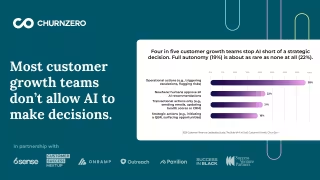
Global – October 31, 2026 -- Only 21% of customer success (CS) leaders can tie AI to revenue outcomes, versus 57% of sales leaders, according to ChurnZero's 2026 Customer Success Leadership Study of 580 CS and revenue leaders.

Sales teams reach for AI first and measure it more consistently

Some 48% of sales teams turn to AI first when solving a problem, compared with 32% of CS teams. CS leaders also trail sales on measuring AI by function, including time saved and team efficiency.

Measurement is the widest gap: 63% of CS leaders have no consistent method to measure AI success, versus 20% of sales leaders.

Pressure to adopt AI reaches 91% of CS and support leaders

A recent Gartner survey cited in the study found 91% of customer success and support leaders are under pressure to implement AI. ChurnZero warns that this pressure can push teams to automate too many processes too quickly, without a strategy or a way to measure results.

AI Saves CS Teams Time, but SaaS NRR Stays Flat, ChurnZero Finds

Image
AI Saves CS Teams Time, but SaaS NRR Stays Flat, ChurnZero Finds

Global – October 31, 2026 -- Net revenue retention (NRR) in SaaS has not improved in three years, even though 81% of customer success (CS) leaders say AI cuts the time their teams spend on manual tasks, according to ChurnZero's 2026 Customer Success Leadership Study.

The survey polled almost 580 CS leaders. Respondents named logging tasks, summarizing leads and calls, and account research as the main workloads AI now handles. NRR remained flat from 2024 through 2026.

Teams with mature AI report higher retention: 64.6% versus 39.4%

AI maturity, not time savings, tracks with results. Among strategic, AI-driven teams, 64.6% reported NRR of 100% or higher. Among teams with underdeveloped AI, the share was 39.4%.

AI-Mature CS Teams Lead on NRR as SaaS Retention Stays Flat

Image
AI-Mature CS Teams Lead on NRR as SaaS Retention Stays Flat

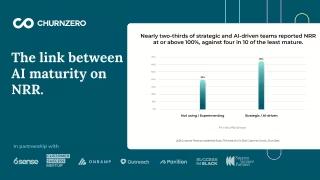
Global – October 31, 2026 -- Sixty-five percent of strategic and AI-driven customer success teams report net revenue retention (NRR) of 100% or higher, versus 39% of the least mature AI teams, according to ChurnZero's 2026 Customer Success Leadership Study.

SaaS NRR stays flat from 2024 through 2026

ChurnZero polled nearly 600 customer success (CS) and revenue leaders. Reported NRR has not moved across the three-year period, while the 26-point gap between the most and least mature AI teams on the 100% threshold stands out.

ChurnZero notes that other factors may contribute to the gap, including stronger data, advanced products and services, or better-funded CS teams with more resources.

Expansion Hits 40% of New ARR as CS Teams Weigh AI Time Gains

Image
Expansion Hits 40% of New ARR as CS Teams Weigh AI Time Gains

Online – October 31, 2026 -- Expansion ARR now accounts for 40% of total new ARR, up five points year on year, according to a 2025 Benchmarkit SaaS report cited at a ChurnZero webinar. The figure sharpens a decision facing customer success (CS) leaders planning for 2027: whether their teams own retention, expansion, or both.

Unanet ties CSM performance to net bookings across both revenue streams

Unanet's CS team owns retention and expansion, and CSMs are measured on a net bookings basis, said Jeff Davison, the company's Chief Customer Officer. His reasoning: accounts cannot grow unless the company retains them.

63% of CS Leaders Cannot Track AI Performance, ChurnZero Study Finds

Image
63% of CS Leaders Cannot Track AI Performance, ChurnZero Study Finds

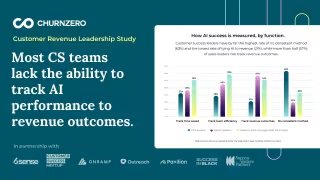
Global – October 31, 2026 -- Nearly two-thirds (63%) of customer success (CS) leaders have no consistent method to track AI performance, according to ChurnZero's 2026 Customer Success Leadership Study, which surveyed nearly 600 CS and revenue leaders.

Only 21% of CS leaders link AI to revenue, versus 57% in sales

Almost all respondents use AI to automate administrative work such as logging tasks, summarizing calls and researching accounts. Yet only 21% of CS leaders can tie AI to revenue outcomes, compared with more than half (57%) of sales leaders.

The gap carries an operational cost. CS teams that cannot measure AI impact are four times more likely to require manual sign-off on every AI recommendation, which leaves staff less time for strategic work. Without performance data, leaders also struggle to justify AI spend.

reTOUCH Socket Beats BS 1363 Limits in SIRIM-Verified Tests

Image
reTOUCH Socket Beats BS 1363 Limits in SIRIM-Verified Tests

Kuala Lumpur – October 31, 2026 -- Malaysian electrical accessories brand reTOUCH has recorded SIRIM-verified results for its BS 1363 13A double-pole socket of 69,400 plug cycles against a 15,000-cycle standard, the highest margin of three tests in which it exceeded requirements. ASEAN Records recognised Broadlink Marketing Sdn Bhd, the company behind the brand, for the results.

Socket exceeds standard thresholds in fire, voltage and endurance tests

In the glow-wire test, the socket reached 960°C against the 850°C standard, a 110°C margin.

For electrical strength, it withstood 4kV a.c. dielectric strength for one minute, twice the 2kV requirement.

In plug endurance testing, it completed 69,400 cycles, about 4.6 times the 15,000-cycle benchmark. ASEAN Records describes the product as the first BS 1363 13A double-pole socket verified beyond standard in all three areas.