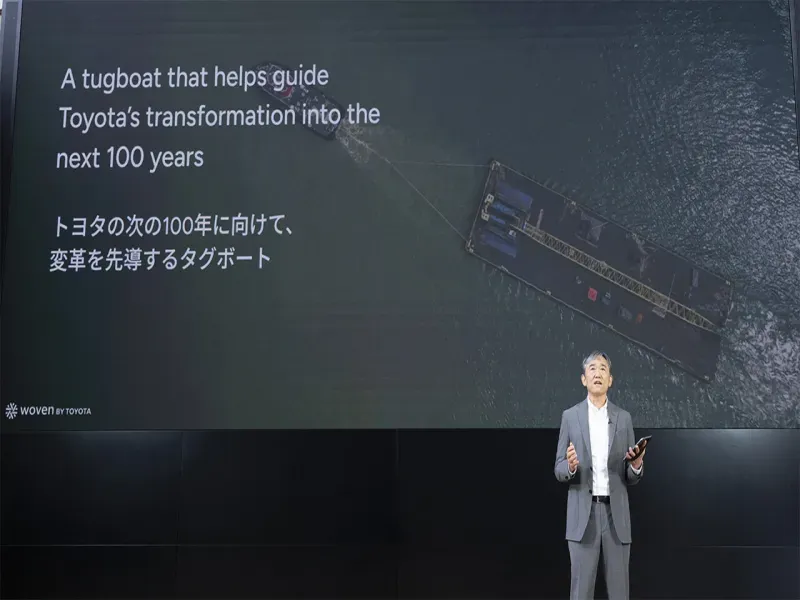
SHERIDAN, WYOMING -- June 1, 2026 -- Woven by Toyota (WbyT) has articulated its strategic role in Toyota's transformation toward software-defined and automated mobility, presenting its four core technology pillars - the Arene vehicle software platform, automated driving systems, Woven City, and Cloud & AI infrastructure - at the KAKEZAN 2026 media event held at Woven City's Inventor Garage. CEO Hajime Kumabe framed the company as a catalytic force within Toyota's broader transformation, describing WbyT's operational philosophy as combining diverse technological and institutional strengths to advance toward a stated goal of zero traffic accidents in society.
Inventor Garage as Cross-Industry Development Hub
The KAKEZAN 2026 event took place at the Inventor Garage, a facility within Woven City that celebrated its completion on April 3. The venue is designed as a collaborative development space for Inventors - the term used internally for WbyT's development community - enabling cross-sector collaboration with Weavers, the residents and visitors of Woven City. Exhibits at the event included Arene, currently in active development; an AI system that analyzes camera footage to understand the behavior of people, objects, and mobility products; and Akio Toyoda AI. The Inventor Garage represents the operational materialization of WbyT's Kakezan philosophy: value creation through the intersection of different fields, disciplines, and cultures.
Arene: Vehicle Software Platform Positioned for Broader Connectivity
Arene is WbyT's vehicle software platform, currently under development. Its stated design objective is to accelerate automotive software development - from initial development and testing through to deployment and iterative improvement - making the process faster, more seamless, and more continuous. WbyT has indicated that Arene's intended scope extends beyond vehicle-level software. Over time, the platform is envisioned as a broader foundation connecting people, mobility systems, and infrastructure, with implications for operators, fleet managers, and institutional stakeholders building on software-defined vehicle frameworks.
Automated Driving and the Active Learning Loop
WbyT's automated driving work centers on core technologies spanning the full range of automated driving and driver assistance functions. The company is developing what it describes as Physical AI combined with a proprietary Active Learning Loop, drawing on Toyota-scale driving data in collaboration with partners. The stated objective is mobility that delivers greater safety and peace of mind. No deployment timelines, specific partner names, or certification milestones were stated in the source material. The automated driving effort sits alongside Arene and Woven City as one of four interlocking technology pillars in WbyT's current operational structure.
Cloud and AI Infrastructure Enabling Cross-Regional Engineering
The fourth pillar in WbyT's technology framework is its Cloud & AI infrastructure. This layer is described as providing the foundational infrastructure that supports all other WbyT operations, while also functioning as a collaboration environment for engineers across regions, companies, and industries. For operators and institutional buyers evaluating platform partnerships or software integration points, this infrastructure layer represents the operational backbone connecting Arene, automated driving, and Woven City capabilities. The framing suggests an intentional open-architecture approach to cross-institutional development, consistent with WbyT's broader Kakezan philosophy.
Kakezan as Operational and Strategic Framework
SVP Daisuke Toyoda outlined the Kakezan concept - described as invention through multiplication - as foundational to how WbyT organizes its development and partnership activity. The principle holds that weaving together different fields and cultures generates new ideas and value, which in turn expands outward in a compounding manner. CEO Kumabe reinforced this at the event, noting that WbyT's vision of zero traffic accidents cannot be realized by one company or one technology alone, and that achieving it requires Kakezan across society, industries, and borders. This framing signals a platform and ecosystem orientation rather than a closed proprietary development model.
Corporate Identity and 100-Year Strategic Framing
WbyT also unveiled a new company logo at KAKEZAN 2026. The logo retains a hexagonal silhouette, with six lines representing three paths - people, mobility technologies, and infrastructure - intersecting at the center. Color elements include red as a reference to Toyota heritage, gray representing the unification of diverse voices, and black representing execution. The logo was developed with input from all employees, with individual threads drawn by staff and woven into the final design. The unveiling was positioned within a 100-year anniversary narrative: 2025 marks 100 years since the founding of Toyota Industries, and CEO Kumabe explicitly framed WbyT's mission as translating Toyota's foundational values into the next century of mobility innovation.