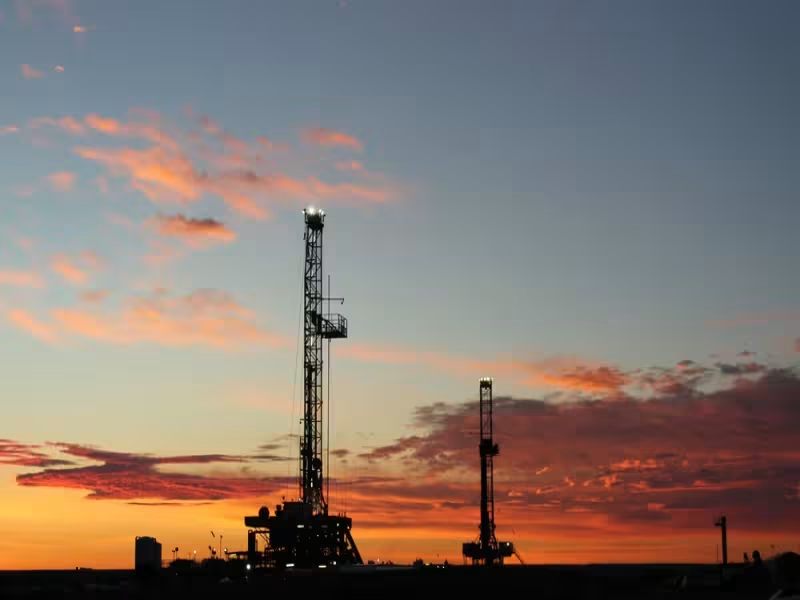
UGANDA -- November 24, 2026 -- Uganda has pushed its first commercial oil production and crude exports back to before the end of June 2027, the Uganda National Oil Company (UNOC) and the Petroleum Authority of Uganda (PAU) said. That is about 21 years after commercial reserves were discovered in 2006.
Finance Minister Henry Musasizi told parliament in June that the Ush 84.39 trillion budget for FY2026/27 assumed petroleum revenue of Ush 1.44 trillion (about $380 million). By our calculation, that is roughly 1.7% of total planned spending. Officials did not say whether the projection will be revised.
The PAU blames international supply chain bottlenecks and disruption linked to the war in Iran. It says the Middle East conflict delayed deliveries of parts for metering, electrical instrumentation and telecommunications systems needed to finish the production and evacuation infrastructure.
EACOP is more than 90% built, but pump stations and control systems are unfinished
Ugandan officials say construction of the $5.6 billion East African Crude Oil Pipeline (EACOP) is more than 90% complete. Pump stations three and four, plus the electrical, instrumentation, telecommunications and security systems, are still incomplete. Testing and commissioning must be coordinated across EACOP, Tilenga, Kingfisher and Tanga.
Lawmakers put Tilenga at 78% complete and Kingfisher at 90% in October. The Central Processing Facilities that treat and stabilize raw crude are still in final installation and pre-commissioning. The 1,443-kilometre heated pipeline from western Uganda to Tanga Port in Tanzania must also be thermally integrated before any oil moves, because Ugandan crude is waxy.
Kingfisher will start at 25,000 barrels per day, 63% of its capacity
Production is expected to begin at about 25,000 barrels per day from CNOOC's Kingfisher field. Kingfisher's capacity is 40,000 barrels per day, so the starting rate is about 63% of the ceiling. TotalEnergies' Tilenga is to ramp up toward 190,000 barrels per day. Combined peak output is about 230,000 barrels per day, of which Tilenga would supply about 83%.
The PAU says the government could earn $1.5 billion to $2.5 billion a year once production starts. Against the $380 million budget line, that is roughly four to 6.6 times as much. It is also equivalent to about 11% to 19% of the roughly $13.4 billion in merchandise export earnings Uganda recorded in 2025. Uganda holds about 6.65 billion barrels of oil in place, of which about 1.65 billion barrels, or roughly 25%, is estimated as recoverable.
S&P revises Uganda's B- outlook to stable and cuts fiscal 2027 growth to 5.8%
S&P Global Ratings revised the outlook on Uganda's B- sovereign rating from positive to stable. It projects a fiscal deficit of 6.0% of GDP in fiscal 2027. S&P lowered its fiscal 2027 growth forecast to 5.8%, from earlier projections of 7.0% to 7.5%, a cut of 1.2 to 1.7 percentage points. Growth was 6.4% in fiscal 2026. S&P cites regional spillovers from Middle East disruptions, softer agricultural prices and an Ebola-related slowdown in tourism.
Domestic borrowing, which Uganda relies on to cover budget gaps, is costlier. The Bank of Uganda raised its benchmark rate by 225 basis points to 12.0% at an emergency meeting in mid-October 2026, from 9.75% by our calculation, as the shilling slid. Interest payments already exceed a quarter of government revenue, and S&P projects the share will approach 30%. Higher global energy prices and lower coffee prices have weakened the terms of trade.
Neighboring Tanzania is also trying to commercialize its resources. Shell, Equinor and ExxonMobil are partnering with the Tanzania Petroleum Development Corporation on a $42 billion LNG export terminal in Lindi, to monetize 47.13 trillion standard cubic feet of deepwater gas. Host government agreements are still being finalized and a final investment decision is pending.