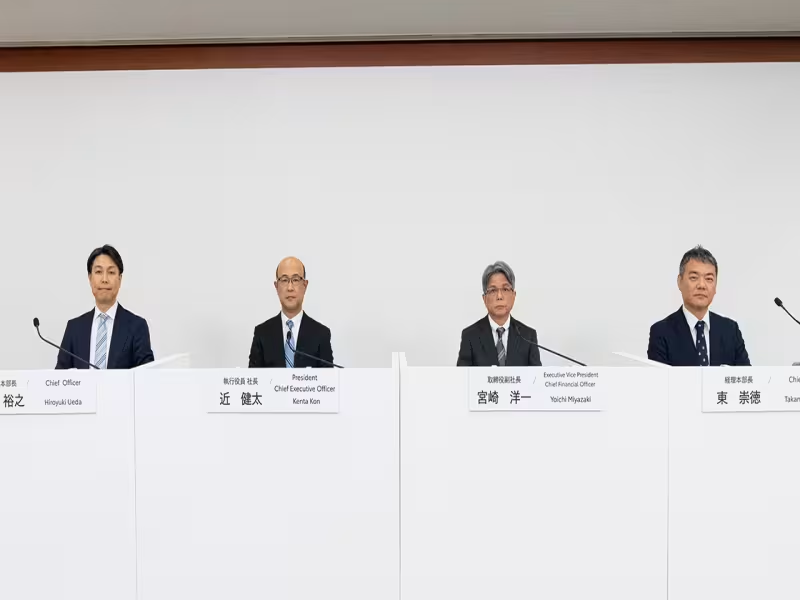
SHERIDAN, WYOMING -- May 31, 2025 -- Toyota Motor Corporation reported operating income of approximately 3.8 trillion yen for fiscal year 2026, making it the first Japanese company to surpass 50 trillion yen in annual operating revenue, even as U.S. tariffs and rising material costs weighed on results. Alongside the financial disclosure, newly appointed President Kenta Kon outlined a reform agenda focused on lowering the company's breakeven volume, rationalizing its vehicle lineup, and sustaining the growth investments that underpin Toyota's multi-pathway electrification strategy. For FY2027, the company forecasts a third consecutive year of profit decline, citing ongoing pressure from the Middle East situation that improvements are not expected to fully offset.
FY2026 Performance: Scale Under Pressure
Toyota's FY2026 results reflect the resilience of a production and sales base built over decades, according to President Kon, who took office only the month before the May 8 briefing. The 3.8 trillion yen operating income figure was achieved despite significant shifts in the external business environment, including tariff headwinds in the United States and upward pressure on raw material costs. Kon characterized the results as the accumulation of long-term collaboration with suppliers, dealers, and other stakeholders, rather than the product of any single fiscal year's effort.
Executive Vice President Yoichi Miyazaki noted that the 50 trillion yen operating revenue milestone was not a target Toyota had been managing toward explicitly. He attributed the figure to the steady delivery of vehicles to individual customers, supported by dealer networks and a broadening hybrid lineup that has contributed meaningfully to overall volume growth.
Breakeven Volume: Trend Still Moving in the Wrong Direction
President Kon acknowledged that Toyota's breakeven volume continues to trend upward, though he stressed that the situation has not reached the severity seen during the global financial crisis, when volumes exceeded eight million units by a wide margin. Short-term countermeasures introduced at the start of the current fiscal year are already underway, and Kon indicated these will continue across the remaining eleven months of the year.
Medium- and long-term structural measures are also in progress, though some have only recently been initiated and their effects have not yet fully appeared in reported results. Kon expressed confidence that sustained execution will yield tangible outcomes, framing the current position as one where the company can continue making growth investments rather than applying broad cost brakes.
Lineup Rationalization and Cost Structure Reform
A central element of Toyota's breakeven reduction strategy involves reviewing and reducing the number of vehicle variants across its lineup. President Kon identified the proliferation of vehicle types - a consequence of the company's multi-pathway product approach - as a factor increasing parts complexity, specification counts, and ultimately making it harder for customers to navigate the range. Rationalizing variants is expected to generate cost benefits while improving clarity for buyers and operators.
On supplier relations, Kon described the current phase as one focused on translating previously established foundational work into concrete productivity improvements. Discussions with suppliers are ongoing, with acknowledgment that some may still require additional support before productivity gains can be extracted. The approach is sequential: where the foundation is in place, Toyota will address inefficiencies one by one; where it is not, communication and support continue.
Hybrid and BEV Strategy: Delivering What Customers Choose
Electrified vehicles now account for approximately 50% of Toyota's sales in Japan, with Vice President Miyazaki noting that customer demand currently outpaces delivery capacity in that market. The immediate operational priority is clearing the existing order backlog for hybrid vehicles - described as Toyota's most important near-term mission as an automaker. Hybrid models are now available across nearly the full lineup, and Miyazaki pointed to production and delivery system capacity as the key constraint to be addressed going forward.
On the battery EV front, President Kon acknowledged that market conditions vary significantly by country and region, making precise forecasting difficult. The stated commitment remains unchanged: to listen carefully to customer needs in each market and reflect those in product and supply decisions. For customers seeking battery EVs, Toyota's intention is to deliver high-quality battery EVs. The multi-pathway strategy - encompassing hybrids, plug-in hybrids, and full EVs - remains the operative framework.
Earning Power and the Discipline of Affordable Vehicle Delivery
Vice President Miyazaki drew a direct line between earning power and the company's commitment to affordable vehicles, referencing the period prior to Chairman Akio Toyoda's presidency in 2009 as a cautionary reference point.
"We must never return to an era driven solely by volume. This is something all employees share and understand. Within that framework, we hope to steadily build earning power by delivering products that bring smiles to each individual customer."
The emphasis on affordability and individual customer relevance runs through Toyota's stated reform logic: rather than targeting a specific breakeven volume number, the goal is to rebuild the earnings structure in a way that enables the next stage of growth. Kon framed this as a shift from foundation-building to results realization - a stage at which steady operational accumulation should begin to show up in financial performance.
FY2027 Outlook and the Investment Continuity Imperative
Toyota's forecast of a third consecutive year of profit decline for FY2027 reflects the expectation that Middle East-related pressures will not be fully offset by operational improvements within the year. Despite this, management's stated posture is one of continued investment rather than retrenchment. Kon described the company's current financial position as one that allows it to identify unnecessary processes and inefficiencies selectively, reform structure incrementally, and sustain forward investment momentum without a broad-based pullback.
For operators, dealers, and institutional buyers tracking Toyota's supply reliability and product roadmap, the key signals from the FY2026 briefing are: hybrid supply normalization as the near-term operational priority, variant rationalization as a medium-term cost lever, and continued electrification investment as a long-term structural commitment.