Ai_Governance

Only 18% of Chief AI Officers control AI investment, IBM study finds

Image

Only 18% of Chief AI Officers control AI investment, IBM study finds

ARMONK, N.Y. -- November 24, 2026 -- Only 18% of Chief AI Officers say they have full control over AI investment decisions, according to an IBM Institute for Business Value study of 1,667 enterprise AI leaders. By our calculation, that is about 300 respondents with full control and about 1,370 without it.

The survey was run with Oxford Economics from April to June 2026 across 33 geographies and 20 industries. IBM groups Chief AI Officers, Chief Data and AI Officers, Heads of AI and equivalent leaders under the single label "CAIOs". Joanne Wright, IBM's Senior Vice President, Transformation and Operations, writes in the foreword that successful AI leadership "requires gathering evidence, influencing decisions, and measuring success."

Post-trade AI survey finds only 11% run agentic AI in production

Image
Post-trade AI survey finds only 11% run agentic AI in production

NEW YORK -- November 24, 2026 -- Only 11% of respondents to a post-trade AI survey report agentic AI in production, against 49% for generative AI, a gap of 38 percentage points. Generative AI is therefore about 4.5 times as common as agentic AI in live use, by our calculation. Broadridge (NYSE: BR), The ValueExchange, the International Securities Services Association (ISSA) and DeepSee released the study, AI in the Real World 2026: From AI Tools to Controlled Delegation in Post-Trade Operations, on Nov. 17.

Autonomy is limited. 78% of respondents say no more than one in ten of their AI use cases operates autonomously. The ValueExchange ran the survey in the second quarter of 2026 and received approximately 205 responses, supplemented by interviews. Broadridge and DeepSee sponsored the research. The release does not break down respondents by type, so the weight of technology vendors in the sample is unknown.

Validix unveils Atomic Claim Architecture to verify AI output

ZUG -- November 24, 2026 -- Validix AG, a Swiss software company, unveiled its patent-pending Atomic Claim Architecture on Nov. 17. The governance layer checks AI-generated content against source evidence before release. The company says it is already in live use at one pharmaceutical company after a pilot.

The architecture sits outside the large language model and does not modify it, according to Validix. Companies can therefore apply it to AI tools they already run. The commercial platform is not yet on sale, and the single live deployment is the only customer use the company reports.

Validix splits evidence into "Atoms" and withholds claims it cannot trace

The system breaks evidence into small units the company calls "Atoms", each traceable to its source. Every claim is assembled from these Atoms. Content that cannot meet that standard is withheld or sent to a human reviewer.

Capgemini: 1,200 AI agents and systems mean nearly 720,000 pairs

BERLIN -- November 24, 2026 -- Capgemini says the number of possible interactions between AI agents grows faster than companies can test them. In its "TechnoVision Top 5 Tech Trends to Watch in 2027", the consultancy calculates that a company running 15 AI agents already faces 105 possible agent pairs.

At 1,000 agents plus 200 agentic systems, the figure rises to almost 720,000 pairs. By our calculation, that is 80 times as many actors (1,200 versus 15) but about 6,850 times as many pairs. Capgemini concludes that testing every interaction before deployment becomes impossible, and that unintended behavior at system level can follow even when each agent decides correctly on its own.

Expleo AI Pulse: 38% of executives turn negative on AI-using firms

COLOGNE -- November 24, 2026 -- Reports about AI systems that act independently, face little human oversight and sometimes deliver unexpected results have left more executives with a negative view of AI-using companies than a positive one. In the Expleo AI Pulse survey of 800 executives, 38% said their view became more negative and 31% said it became more positive, a net balance of minus 7 points by our calculation.

Another 26% said their attitude did not change. The three answers add up to 95%, and the release does not say how the remaining 5% responded. On the 800-person sample, the split works out to roughly 304 executives more negative, 248 more positive, 208 unchanged and 40 unaccounted for.

Appian adds AI agent control plane as RBI reports 80% cut in tokens

Image
Appian adds AI agent control plane as RBI reports 80% cut in tokens

LONDON -- November 24, 2026 -- Appian (Nasdaq: APPN) has made part of its new AI agent control plane available now, with more capabilities due to start shipping in 2026, the company said at its Appian Europe conference in London on November 17, 2026. By our calculation, that leaves fewer than seven weeks of the year for the additional features.

Raiffeisen Bank International (RBI) supplied the headline figure. Claus Mitterlehner, RBI's Head of Smart Automation, said a hybrid design of AI agents and rules-based automation cut token consumption and processing time by 80% in testing. That works out to roughly one-fifth of the original load.

Control plane tracks, orchestrates and measures agents in three layers

Appian says the control plane works inside deterministic business processes, where each step goes to the best-suited worker: an agent, person, system or rule.

Shadow AI: 91% of 115 contact-center pros see major risk

ZURICH -- November 24, 2026 -- Shadow AI, the use of AI tools without company approval, is a considerable danger, according to 91% of 115 contact-center professionals surveyed by Swiss AI vendor Spitch. The same respondents describe AI as already routine: 44% say it is standard in their contact center today, and another 30% expect it to be by 2030, a combined 74% by our calculation.

No respondent strongly disagrees that shadow AI is a risk

In the survey, 57% fully agree that shadow AI is a considerable risk and 35% see at least some risk. No one rejects the statement outright, Spitch says. On data protection and compliance the result is firmer: two-thirds fully agree and a further 30% partly agree, with no dissent. That adds up to about 96%, the figure Spitch reports for respondents who see serious risks in that area.

Sumsub: Only 9% of US, Canadian firms can suspend an AI agent

Image
Sumsub: Only 9% of US, Canadian firms can suspend an AI agent

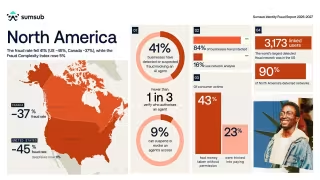
MIAMI -- November 24, 2026 -- Only 9% of U.S. and Canadian businesses can suspend an AI agent's access, while 84% say they feel fairly or very protected against fraud, according to the sixth annual Identity Fraud Report from verification provider Sumsub. The gap is 75 percentage points, by our calculation. In the same group, 41% detected or suspected fraud involving an AI agent, against 53% of businesses globally.

Sumsub published the report on Nov. 17. The global fraud rate on its platform fell for a second consecutive year to 1.6%, and the U.S. rate dropped 45% year over year. Sumsub's new Fraud Complexity Index (FCI), a proprietary measure of how sophisticated confirmed fraud is, rose in every region analyzed. Deepfakes rose 31%. Sumsub did not disclose the U.S. fraud rate level or any FCI scores.