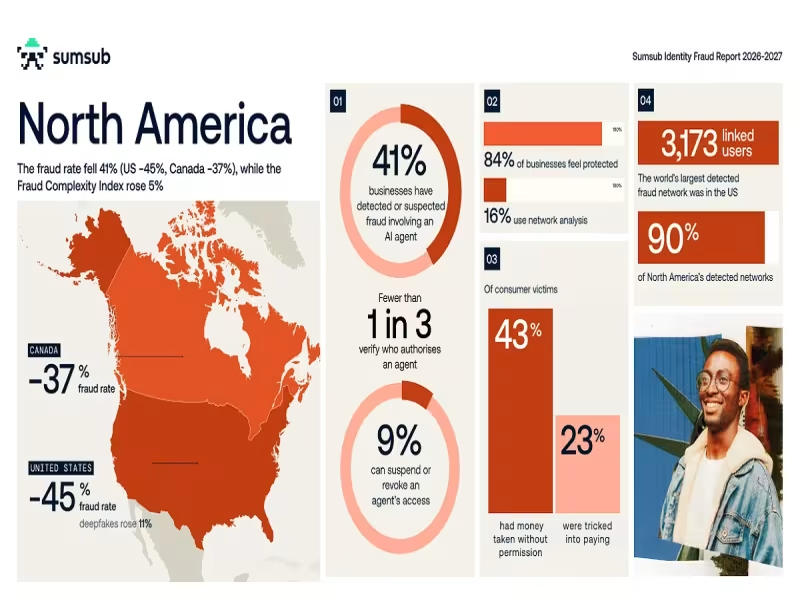
MIAMI -- November 24, 2026 -- Only 9% of U.S. and Canadian businesses can suspend an AI agent's access, while 84% say they feel fairly or very protected against fraud, according to the sixth annual Identity Fraud Report from verification provider Sumsub. The gap is 75 percentage points, by our calculation. In the same group, 41% detected or suspected fraud involving an AI agent, against 53% of businesses globally.
Sumsub published the report on Nov. 17. The global fraud rate on its platform fell for a second consecutive year to 1.6%, and the U.S. rate dropped 45% year over year. Sumsub's new Fraud Complexity Index (FCI), a proprietary measure of how sophisticated confirmed fraud is, rose in every region analyzed. Deepfakes rose 31%. Sumsub did not disclose the U.S. fraud rate level or any FCI scores.
Few North American firms can verify or switch off the agents they deploy
Fewer than 1 in 3 U.S. and Canadian businesses (29%) verify who authorizes an AI agent. The 29% is 55 points below the 84% who feel protected.
Globally, 49% of the businesses that detected or suspected agent-related fraud said a legitimate agent had been manipulated by malicious instructions. In 30% of those cases, an agent initiated a purchase, payment or transfer. Applied to the 53% global base, that works out to about 26% and 16% of all businesses respectively, assuming both shares refer to the same respondent pool.
Sumsub says its expanded Know Your Agent framework links each agent to a verified human and requires a human check when an agent tries to exceed its permissions.
Fraud rates fall while networks grow larger in the U.S.
The largest single fraud network Sumsub detected in any country was in the U.S. It linked 3,173 users. Among businesses that experienced fraud, 33% said at least 25% of their confirmed cases were tied to a wider network of accounts, devices or payment instruments. Some of these networks form after an account passes verification and is sold or taken over.
Only 16% of U.S. and Canadian businesses use fraud network analysis, and 21% use transaction monitoring. Erin West, founder of Operation Shamrock and a former deputy district attorney, says network accounts are verified and documents are real because the holders were recruited, paid or coerced. As a result, no single check raises an alert.
Most consumer fraud victims in the U.S. and Canada had money taken, not handed over
Of U.S. and Canadian consumers who experienced fraud, 43% had money taken from an account or card without permission. Another 23% were tricked into paying. Taken funds outnumber tricked payments by about 1.9 to 1, by our calculation.
Americans reported a record $15.9 billion in fraud losses to the Federal Trade Commission in 2025, the report states. Danielle Labarbera, Sumsub's U.S. vice president of sales, said the North American rate is lower than in other regions but the scale of the market keeps absolute losses large. "The remaining risk can be highly concentrated and very expensive when it gets through," she said.
Ten senators back the SCAM Act as a January change in Congress approaches
The SCAM Act would require ad-selling platforms to verify advertisers and guard against false, stolen or synthetic identities. It has gained 10 Senate sponsors from both parties since February and remains in committee. The Senate's Kids Online Safety Act has 76 co-sponsors and awaits a floor vote after an attempt to fast-track it was blocked in September. The House passed its KIDS Act package in June.
In Canada, Bill C-277, the proposed Regulating the Online Use of Deepfakes Act, would require platforms to detect, label and remove harmful deepfakes, including those causing financial damage or identity theft.
The report says Democrats will take control of both U.S. chambers in January, so bills that do not pass this session must be reintroduced. It names the AI Kill Switch Act as one proposal with bipartisan support. The bill would require developers of the most advanced AI systems to keep the ability to suspend or shut them down.
The report analyzes more than 5.8 million fraud samples from Sumsub's platform, comparing 2025 and 2026 data. Its survey ran in August 2026 among more than 1,400 fraud and risk professionals and more than 1,500 consumers across 21 markets.