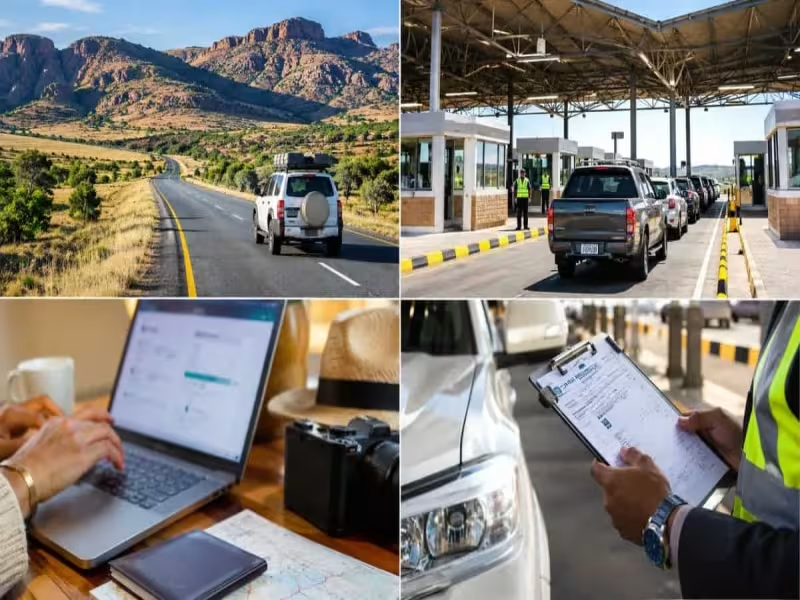
SOUTHERN AFRICA -- November 19, 2026 -- Cross-border road travel between South Africa, Namibia, Botswana and Zimbabwe now involves a compulsory online customs declaration in South Africa, in force since 1 July 2026, and tighter vehicle-permit checks in Zimbabwe, in force since 21 October 2026. The rules apply to a large flow of visitors. South Africa recorded 7,581,455 international tourist arrivals in January-August 2026, up 11.7% year on year, according to its Department of Tourism. By our calculation, that is about 794,000 more arrivals than in the same months a year earlier (about 6.79 million).
South Africa requires a declaration but does not turn travellers away without one
According to the South African Revenue Service, travellers entering or leaving through land, air, sea and rail ports must complete an online customs traveller declaration. The process runs on the South African Traveller Management System and covers goods and relevant currency information. Declarations may be submitted no more than 24 hours before departure from the country concerned, and parents or guardians can file for children.
Travellers who have not completed the declaration are not automatically refused entry or departure solely for that reason. Customs assistance and self-service facilities are available at the border. Tour operators must make clear to customers that customs declarations and immigration permission are separate requirements.
Zimbabwe's Public Notice 60 of 2026 adds document checks for foreign-registered vehicles
The Zimbabwe Revenue Authority issued the notice on 21 October 2026, about four weeks before this report. It requires a valid passport and the original vehicle registration document for a Temporary Import Permit. Drivers who do not own the vehicle must also present a letter of authority or an affidavit, and ZIMRA may carry out additional verification in those cases.
Ordinary permits run for no more than 30 days. Longer stays are considered individually, up to a total of three months, roughly three times the ordinary limit. Extension applications must be filed before the existing permit expires. The notice also identifies carbon tax and third-party insurance charges, with additional crossing-related fees at Beitbridge. The charge amounts were not disclosed.
Rental vehicles, guided safaris and overland tour fleets are directly affected. Immigration permission does not replace the legal documents needed to bring a vehicle into Zimbabwe.
Namibia and Botswana set different vehicle rules and border hours
The Namibia Revenue Agency exempts qualifying tourists from Southern African Customs Union countries, including South Africa and Botswana, from its normal temporary vehicle import permit. Tourists arriving with vehicles from non-SACU countries generally need a permit, which matters for Zimbabwe-registered vehicles.
Namibia's revised visa arrangements took effect on 1 April 2025. Eligible travellers can obtain electronic visas or visas on arrival at five designated points: Noordoewer, Ariamsvlei, Mohembo, Ngoma and Trans-Kalahari. Other crossings process electronic visas only. Nationals of South Africa, Botswana and Zimbabwe are exempt from Namibian holiday visas. Namibia's 2024 tourism statistical report counted 1,257,093 international tourist visits, 77.6% of them by road. That works out to about 975,000 road arrivals.
The Government of Botswana confirmed in September 2026 that the Mamuno crossing with Namibia had introduced 24-hour operations. Tlokweng, the crossing with South Africa, was expected to start 24-hour operations in December 2026. That remained a target as of 14 November. Botswana's official tourism border directory lists restricted hours at several Zimbabwe crossings, including Ramokgwebana and Kazungula Road. For safari businesses, those limits affect departure times, overnight stops and same-day transfers.
No four-country tourist visa exists, and regional border guidelines are still being drafted
The SADC Secretariat confirmed that a proposed Tourism UNIVISA agreement was under consideration in June 2026. It is not an implemented entry system, so visa validity and entry conditions must be checked for each traveller, including business visitors and conference delegates.
The Southern African Development Community held a workshop in Victoria Falls on 28-29 July 2026, with representatives from six countries. It covered immigration, customs, border management, health controls and customer service, and will inform guidelines for tourist-friendly border posts.
Namibia and Zimbabwe share no direct road crossing. Journeys between them normally pass through Botswana or Zambia. The Botswana-Zimbabwe Kazungula Road crossing is separate from the Botswana-Zambia Kazungula Bridge, and the two have different procedures.
The Walvis Bay Corridor Group describes the Trans-Kalahari Corridor as about 1,900 kilometres long. It says the corridor is about 400 kilometres shorter than the traditional route through southern Namibia towards Gauteng, equal to roughly a fifth of the corridor's length. These are freight estimates, not confirmed driving times for holidaymakers.
The Zimbabwe Tourism Authority reported 1,777,569 international tourist arrivals in 2025, growth of approximately 10%. The South African, Namibian and Zimbabwean figures cover different periods and are not directly comparable.