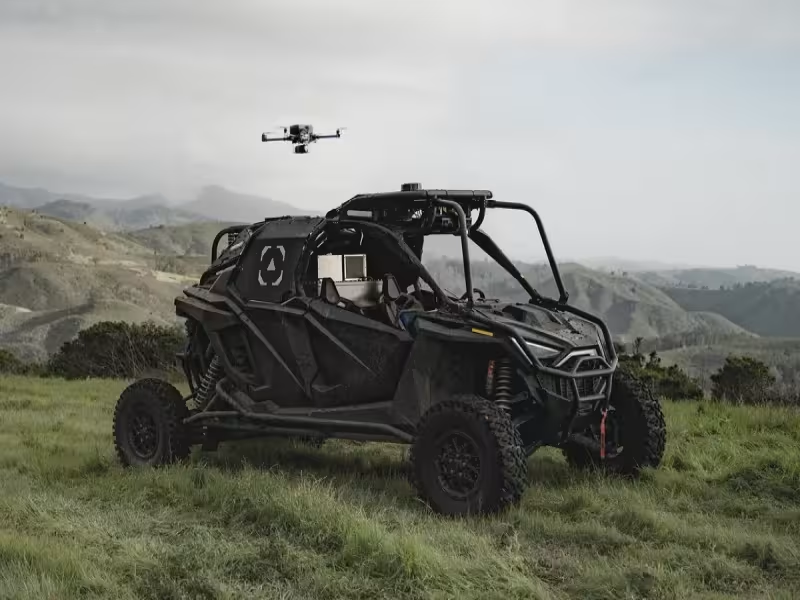
SHERIDAN, WYOMING - April 14, 2026 - Scout AI Inc. has publicly introduced FURY, a vision-language-action (VLA) foundation model designed for multi-domain defense robotics, positioning the company as a developer of generalized autonomous AI for military platforms. VLA models process real-time camera data alongside text prompts to generate robot actions, connecting visual and language inputs to physical outputs without relying on platform-specific programming. Scout AI secured a U.S. Army Unmanned Systems (UxS) Autonomy Contract in August 2025, and announced a partnership with Hendrick Motorsports on a program called NOMAD in September 2025. The combination of a government contract award and an applied engineering partnership indicates the company has moved beyond research-stage positioning into active program delivery.
Business Impact
The Army UxS Autonomy Contract award provides direct government validation for Scout AI's architecture and signals readiness for procurement-track development. FURY's platform-agnostic design - a single trained model deployable across ground, air, and other robotic domains - lowers per-platform integration cost and supports scalable procurement across diverse fleet configurations. This is commercially significant in defense markets where interoperability and total cost of ownership are primary acquisition criteria. The Hendrick Motorsports partnership on NOMAD connects Scout AI to a high-performance engineering environment optimized for rapid iteration, a competency directly relevant to compressed defense development timelines.
Collaborative Autonomy and Command Interface
FURY supports robot-to-robot communication using a natural language protocol engineered for swarm coordination, enabling multi-unit autonomous operations under a unified command structure. Operators can issue commands through voice, text, or map-based inputs; the model is designed to interpret commander intent rather than require precise technical syntax or specialized operator training. One-to-many human-to-robot coordination is enabled through VLA training on human imitation and simulation data, grounding AI behavior in observed human decision patterns. This approach meaningfully reduces the operator skill threshold and could compress personnel training requirements for units working alongside autonomous ground vehicles.
Platform and Hardware Design
Scout AI has built FURY's hardware integration layer entirely from commercial off-the-shelf (COTS) components, which the company states enables high-rate, low-cost manufacturing pipelines. The foundation model family supports varying compute and power configurations, with optimization for low-power inference and lightweight sensor setups across different deployment contexts. Most operationally notable is the vision-based passive sensing architecture: FURY can function with as little as one RGB or thermal camera stream, eliminating reliance on active sensors such as LIDAR or radar. Removing active sensors reduces electromagnetic signature and power draw - both tactically significant factors in contested or denied environments.
Edge Deployment and Adaptive Learning
FURY operates in communications- and GPS-denied environments without dependency on external connectivity or cloud infrastructure, addressing a persistent operational gap for autonomous systems in degraded theaters. The model supports adaptive retraining directly at the tactical edge, allowing updates to be applied in the field without full redeployment cycles. Secure over-the-air (OTA) model deployments further support lifecycle management for fielded units. These capabilities collectively address one of the core integration challenges in defense autonomy: maintaining system effectiveness when network access is unavailable, actively jammed, or operationally unsafe to use.
Key facts:
- Scout AI was awarded a U.S. Army UxS Autonomy Contract in August 2025
- FURY is described as a first-of-its-kind foundation model for multi-domain defense robotics
- Scout AI announced a partnership with Hendrick Motorsports on a program called NOMAD in September 2025
- FURY is built entirely from COTS hardware and requires as little as one RGB or thermal camera stream to operate
- The system supports edge-based adaptive retraining and secure OTA deployments in comms- and GPS-denied environments