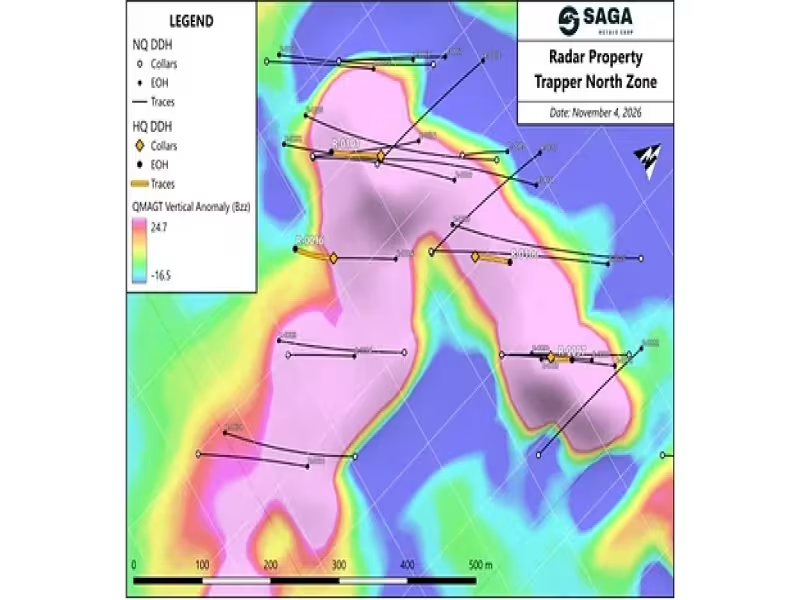
Vancouver – November 04, 2026 -- SAGA Metals Corp. (TSXV: SAGA) has completed a four-hole, 1,010-metre HQ diamond drill program at Trapper North on its Radar Titanium-Vanadium-Iron Project near Cartwright, Labrador. The core is intended as feed for metallurgical test work and downstream pilot studies tied to PEA/PFS-level evaluation.
Four HQ holes drilled in October target about 500 m of semi-massive oxide core
Holes R-0096, R-0097, R-0100 and R-0101 were collared on sections N09, N10 and N11, in the part of Trapper North drilled on 100 m sections during the resource drilling. Three holes were drilled from existing MRE pads (those of R-0086, R-0087 and R-0092), and R-0100 from a new pad on section N10. R-0096, R-0097 and R-0100 were drilled at about -80° and R-0101 at -70°. All core was oriented.
HQ core is 63.5 mm in diameter and yields about 1.8 times as much core per metre as the 47.6 mm NQ core used in the Company's 85-hole, 22,432-metre MRE program, completed in August 2026. The program aimed to recover roughly 500 m of semi-massive oxide core.
R-0096 logs 259.9 m of oxide units; assays remain pending
R-0096 logged 259.9 m of oxide units over its 341 m length, including 222.5 m of semi-massive oxide. R-0097 logged 125.9 m over 161 m, of which 45.2 m is semi-massive oxide. Both holes intersected the semi-massive and rhythmic (intercumulate) oxide gabbronorite units that host titanomagnetite and ilmenite mineralization. Logging of R-0100 and R-0101 is in progress.
The logged lengths are visual observations, not grades. Assays are pending at Impact Global Solutions in Quebec.
Temas' chloride-leach Stage 2 optimization is about halfway complete
Processing of the Radar oxide mineralization is being run by Temas Resources Corp. using its proprietary Regenerative Chloride Leach (RCL) technology. The HQ core will supply magnetic concentrate for downstream testing after Stage 2 bench-scale optimization, which is roughly half-way through its planned timeline.
Stage 2 tests two run-of-mine massive oxide samples side by side. It compares titanium, vanadium and iron extraction, reagent consumption, leach kinetics, solution quality, residue characteristics and grinding requirements. Optimization targets hydrochloric acid and magnesium chloride concentrations, temperature, oxidation-reduction potential, retention time, solids concentration and particle size.
The phase also develops a solvent extraction circuit for iron, titanium and vanadium, including McCabe-Thiele isotherms. The aim is to generate enough pregnant leach solution to recover first samples of high-purity titanium dioxide, vanadium and iron. SAGA cites potential end uses in pigment, titanium sponge feed, steel and energy storage.
Ten-week Phase 2 pilot study depends on Phase 1 results and SAGA approval
Phase 1, comprising Stages 1 and 2, is expected to deliver comparative leaching results, optimized RCL and solvent extraction conditions, the McCabe-Thiele isotherms, a preferred feed material and a recommendation on mini-pilot readiness. If Phase 1 succeeds and SAGA approves, Phase 2 would run over 10 weeks. It would generate continuous operating data, process design criteria, product samples and the basis for preliminary CAPEX and OPEX evaluation. Final scope and budget will be set after Phase 1.
Michael Garagan, Chief Geological Officer, said the HQ material is the bridge between defining the resource and determining which high-purity titanium, vanadium and iron products can be delivered.
Next steps: core delivery to IGS, HQ assays and pilot start
SAGA will finish logging and sampling R-0100 and R-0101, deliver the HQ core to IGS for analysis and concentration, and report assays when received. It will then complete Stage 2 and start the pilot program using concentrate from the HQ holes.
The Radar Property covers 690 mineral claims across 9 licenses, about 24,175 hectares, roughly 10 km south of Cartwright. It encloses the Dykes River Intrusive Complex and a 29 km2 oxide-bearing lopolith hosting the Trapper, Falcon and Hawkeye Zones. Infrastructure includes the Cartwright deep-water port, Cartwright Airport and proximity to Muskrat Falls and Churchill Falls hydroelectric power.