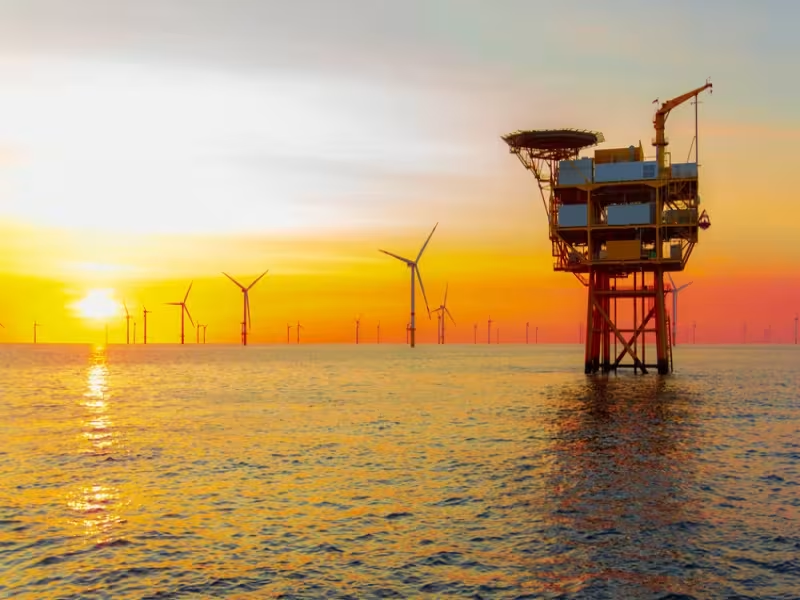
UNITED STATES -- November 19, 2026 -- Ørsted's $6.2-billion Revolution Wind offshore wind farm came online in November and became the third utility-scale offshore wind project to reach full commercial operations in the United States, according to an Oilprice.com report. At 704 MW across 65 turbines, it is about 23 times the size of the 30-MW Block Island Wind Farm and about 5.3 times the 132-MW South Fork Wind, by our calculation.
The project sits behind South Fork Wind, which began operating off New York in 2024, and Vineyard Wind near Massachusetts.
Revolution Wind costs about 12% less per megawatt than Block Island
The $6.2-billion price tag works out to roughly $8.8 million per MW of capacity. Block Island, the first major US offshore wind farm, cost $300 million for 30 MW, or $10 million per MW. These are nominal dollar figures, not adjusted for inflation or project scope.
Turbine size also changed. Revolution Wind averages about 10.8 MW per turbine (704 MW across 65 units). Block Island's five turbines average 6 MW each, and South Fork's 12 turbines average 11 MW each.
Ørsted has agreed to sell the power to three utilities: Rhode Island Energy, Eversource Energy and United Illuminating. The company says the output can supply the equivalent of more than 350,000 New England homes. The report does not give the contract prices or the volume allocated to each utility.
BNEF cut its 2035 US offshore wind forecast from 39 GW to 5.9 GW
BloombergNEF had projected 39 GW of US offshore wind by 2035 before President Donald Trump's second term began in January 2025. It has since lowered the figure to 5.9 GW, which reflects only projects completed or under construction at the start of 2025. The cut is 33.1 GW, or about 85%.
Revolution Wind alone accounts for about 12% of the revised 5.9 GW. The forecast is also about one-fifth of the Biden administration's target of 30 GW by 2030, though the two figures cover different years. It equals roughly 0.15% of the 4,000 GW of technical resource potential the US Department of Energy puts on federal waters and the Great Lakes.
The Biden administration approved 11 commercial-scale projects in federal waters, which would deliver 19 GW if all were built. BNEF's 5.9 GW equals about 31% of that approved total.
Federal courts have let five East Coast wind farms keep building
Trump has issued orders halting the development or operation of individual wind projects, prompting numerous lawsuits. Several courts have entered suspension orders against operators. Others have let construction continue. Earlier this year a federal judge ruled against the administration and allowed developers of five permitted East Coast wind farms to keep building.
The investment pledges came under the Biden administration, after the Inflation Reduction Act of August 2022 introduced incentives for offshore wind. Ørsted, Iberdrola and Equinor were among the international developers that began US projects in that period, committing billions of dollars. The Oilprice.com report states that no new license approvals can be expected while Trump remains in office.