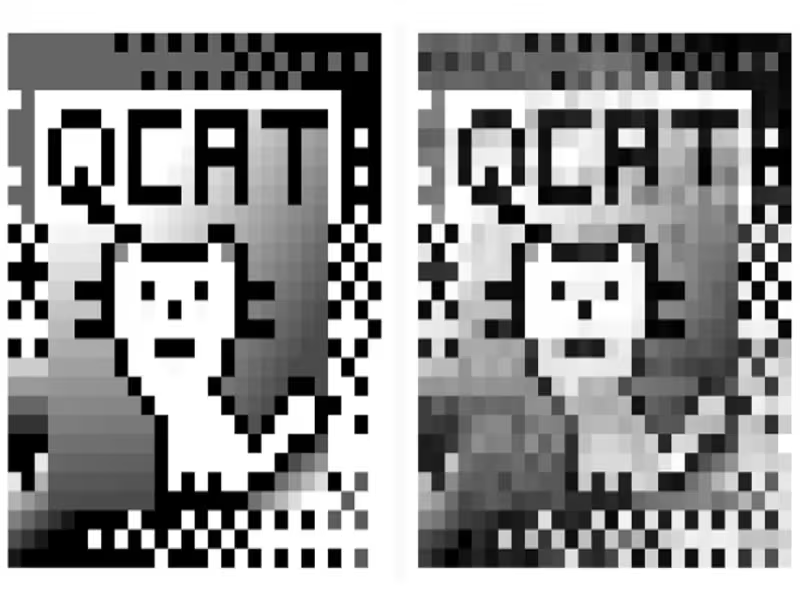
LONDON -- November 24, 2026 -- Moth, a London quantum software company, says its Tessa method encoded 1,568 numbers across all 120 qubits of an IBM Quantum Nighthawk r2 processor and read them back, about 12 times the previous largest comparable experiment. By Moth's account, that earlier experiment recovered 128 values, so 1,568 is 12.25 times as many by our calculation.
The 1,568 numbers were enough to represent a small colour picture, which Moth recovered from the chip. The load works out to roughly 13 values per qubit (1,568 divided by 120).
Moth says encoding is a bottleneck for quantum machine learning
Quantum computers have no equivalent of classical memory, Moth says. Data must be written into qubit states through a sequence of operations, and each operation adds noise and lowers fidelity. On IBM-type processors each qubit is wired only to its nearest neighbours, which the company says makes encoding slow.
Daniel Bultrini, the Moth researcher who developed Tessa, said: "Every quantum computer has to get data in before it can do anything useful with it." He described the step as a bottleneck for fields such as quantum machine learning.
Tessa also encoded DNA and protein sequences, but the hardware returned them imperfectly
The method works with any data that can be written as a list of numbers. Moth also used it on DNA and protein sequences, including p53, a protein associated with cancer prevention. The company acknowledges that current quantum hardware returns genetic data imperfectly. Readback fidelity for the image and the sequences was not disclosed.
For developers working on IBM hardware, the result concerns the whole-chip load, not a subset of qubits. Moth used IBM Quantum Credits from the IBM Quantum Startups Program for the work. The authors state that their views do not reflect IBM's position.
Moth ties Tessa to its creative-industry products and opens an image tool to users
Moth builds quantum applications for the creative industries and consumers. It says encoding is a foundation for tools it is developing in gaming, visual media and music. Harry Kumar, Moth's founder and CCO, said quantum applications that work closely with AI will depend on advances such as Tessa.
The paper, titled "Encoding Classical Data Across an Entire Quantum Processor", is on arXiv. Tessa for image processing is available to test on Moth's Atlas platform.
Moth's release also cites Quantinuum's confirmation, the week before the release, that it is on track to deliver fault-tolerant quantum computers by 2029.