Events

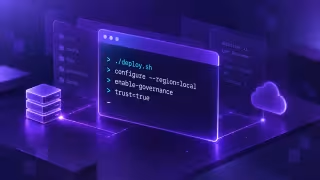
Agentic AI Forces Enterprises to Extend Sovereignty to Agent Actions

Image
Agentic AI Forces Enterprises to Extend Sovereignty to Agent Actions

Global – – October 27, 2026 -- Enterprises deploying autonomous AI agents must extend sovereignty controls beyond data location and model hosting to cover agent identity, permissions, execution authority and oversight. Agents can interpret goals, select tools, call APIs, update applications and delegate work to other agents within a single task.

Governance shifts from controlling access to controlling actions

Traditional AI governance centers on datasets, approved models, processing locations and user access. Agentic systems make decisions inside the workflow itself, choosing which system to query, which tool to invoke and which action follows. A procurement agent investigating a supplier issue could pull supplier records, review purchase orders, analyze delivery records, compare contract terms and initiate an approval workflow. That chain spans several databases, applications, APIs, models and identity systems.

Only 22% of Firms Apply Sovereignty Rules to AI Models

Image
Only 22% of Firms Apply Sovereignty Rules to AI Models

GLOBAL – October 27, 2026 -- Only 22% of organizations have applied sovereignty or residency requirements to AI models, against 60% for data, according to a global 2025 survey cited in a new analysis of sovereign AI architecture.

Sovereignty controls thin out higher in the AI stack

The same survey found that 46% of organizations applied such requirements to infrastructure and 32% to applications. The decline leaves a structural blind spot: protecting enterprise data has limited value if the model processing it operates outside the intended control framework.

Enterprises Weigh Sovereign LLMs as EU AI Act Deadline Nears

Image
Enterprises Weigh Sovereign LLMs as EU AI Act Deadline Nears

Europe – October 27, 2026 -- Self-hosted LLM infrastructure tends to become the cheaper option above roughly 50 million tokens processed per day, while commercial APIs usually stay more economical below 5 million, according to AppsTek's analysis of when enterprises need a sovereign LLM. The figures are illustrative and should be checked against current provider pricing and actual workload patterns.

AppsTek's third piece in its sovereign AI series argues that the model layer is now a governance decision, not only a technology choice, as generative AI moves into regulated, revenue-bearing workflows.

Agentic QE Targets Testing Unit Costs as GenAI Pilots Hit 89%

Image
Agentic QE Targets Testing Unit Costs as GenAI Pilots Hit 89%

Global – October 27, 2026 -- Some 89% of organizations surveyed for the World Quality Report 2025 are piloting or deploying GenAI-augmented Quality Engineering (QE), but only 15% have reached enterprise-wide implementation. Respondents reported an average productivity gain of 19%. Vendors such as AppsTek are pitching agentic QE as a way to hold down testing unit costs as release volumes grow.

Maintenance work pushes up the cost of enterprise test automation

Each release adds workflows, integrations and regression paths while QE budgets stay tightly controlled. The pressure shows up in maintenance, contractor spend, rework and cost per release.

AI Agent Testing Must Cover Execution Paths, Not Just Answers

Image
AI Agent Testing Must Cover Execution Paths, Not Just Answers

Global – October 27, 2026 -- Two AI agent runs can return the same correct answer while carrying very different operational risk, which makes output-only checks insufficient for enterprise Quality Engineering (QE), according to a new AI agent testing framework built around four evaluation layers.

Recovered failures can look like clean successes

In the source's example, an agent retrieving an account balance queries an unnecessary privileged system, hits an authorization error, retries twice and then reaches the approved source. The user sees a correct result. An output-level assertion marks the run as a success, while a trace-level evaluation flags it as degraded.

Teekay Interns Build Earnings Forecast Model in 12-Week MPA Program

Image
Teekay Interns Build Earnings Forecast Model in 12-Week MPA Program

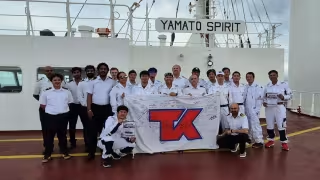
Singapore – October 27, 2026 -- Teekay hosted two interns for 12 weeks through a Maritime and Port Authority of Singapore (MPA) program, and one of them built a machine learning workflow to forecast vessel earnings from voyage, market, bunker, port and utilization data.

Intern deploys fleet procurement website in Singapore

Data analytics student Jonathon Lee worked on procurement and commercial analytics under Yi Chuen Ho, Regional Commercial Operations Manager, and Sajeev Soman, Manager, Procurements & Contracts. He built and deployed a fleet procurement website end to end, with dashboards for spares delivery and port call costs.

He also automated a previously manual charterer name-matching process.

Teekay Tankers Awards Vessel Teams for Top Hazard Reporting

Image
Teekay Tankers Awards Vessel Teams for Top Hazard Reporting

Global – October 27, 2026 -- Teekay Tankers has named this quarter's winners of its Hazard Reporting Awards, recognizing the vessel teams that reported the highest number of hazards through the company's cloud-based digital platform.

Teekay Tankers turns hazard reporting into a quarterly team contest

The company has gamified the process. Vessels are placed into teams that compete every quarter to report the most hazards. Winners are recognized publicly and receive a prize.

Seafarers log unsafe acts and conditions on a mobile-friendly platform

Crews use the platform to flag unsafe acts or unsafe conditions on board as they notice them. Early and frequent reporting lets senior management implement corrective action outside regular on-board inspections.

Governments Prioritize SATCOM Control Over Ownership, Panel Finds

Image
Governments Prioritize SATCOM Control Over Ownership, Panel Finds

Global – October 27, 2026 -- Governments are demanding full control over their satellite communication mission stacks rather than just access to capacity, according to a panel hosted by ST Engineering iDirect. Speakers from the company and PA Consulting said sovereignty is shifting toward assurance and resilience.

Control outweighs ownership in national SATCOM programs

Alison Grey, Associate Partner at PA Consulting, said full end-to-end in-country ownership is unrealistic for most nations. The practical goal is assured access, control and resilience. Keith Blanchet, Vice President, Global Government at ST Engineering iDirect, defined sovereignty as resiliency, sovereign control and interoperability, the last being essential for coalition operations.

Paradigm, iDirect Pair 450SDM Modem With PIM for Multi-Orbit SATCOM

Image
Paradigm, iDirect Pair 450SDM Modem With PIM for Multi-Orbit SATCOM

United Kingdom – October 27, 2026 -- ST Engineering iDirect's 450SDM software-defined modem is 30% smaller than its predecessor, and Paradigm is integrating it into its PIM-based tactical terminals for government and defense users, according to Paradigm founder Ulf Sandberg.

PIM architecture links iDirect modems to lightweight terminals

Paradigm's Paradigm Interface Module (PIM) integrates the iDirect 950mp and the new 450SDM into a single platform, yielding the PIM950 and PIM450 configurations. Users can switch between software-defined profiles at the touch of a button. Sandberg said the 450SDM's compact form factor suits lightweight systems such as the backpack-ready RAGNO terminal, and that it supports multi-orbit and multi-waveform operation. The single-case HORNET terminal uses the same approach.

iDirect Previews Munich Defence Tech Day With SATCOM Podcast

Image
iDirect Previews Munich Defence Tech Day With SATCOM Podcast

Munich – October 27, 2026 -- ST Engineering iDirect will hold its Defence Technology Day in Munich on June 10, and a new podcast from the company previews the satellite communications (SATCOM) topics on the agenda.

Dave Davis, Senior Technical Director of Global Government at ST Engineering iDirect, hosts the discussion. His guests are Joey Williamson of Airbus Defence and Space and Henry Nelson of Marconi Technologies UK, formerly Ultra I&C.

Ukraine war and LEO constellations change how governments buy SATCOM

The panel examines how geopolitical tensions have shifted SATCOM demand. It cites the war in Ukraine and the rise of low Earth orbit (LEO) constellations as the two developments that changed how governments approach satellite communications.

Europe's MILSATCOM Leaders Demand Resilience-by-Design in Munich

Image
Europe's MILSATCOM Leaders Demand Resilience-by-Design in Munich

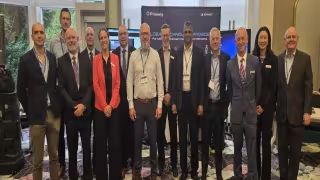
Munich – October 27, 2026 -- More than 100 military satellite communications (MILSATCOM) leaders gathered in Munich for ST Engineering iDirect's biennial Defence Technology Day, where speakers agreed that European sovereign networks must be built to withstand cyberattacks, jamming and physical damage from the outset. Defence agencies, operators, integrators and technology partners attended, and 12 partners exhibited.

Ukrainian officer: resilience cannot be retrofitted

Major Andrii Kovalchuk of the Armed Forces of Ukraine said modern SATCOM systems must survive cyberattacks, radio frequency interference and infrastructure damage at the same time. Speakers throughout the day echoed that resilience has to be embedded in architectures, terminals, waveforms, operational planning and procurement decisions.

Foresight Targets Satellite Network Fragmentation With AI Operations

Image
Foresight Targets Satellite Network Fragmentation With AI Operations

GLOBAL – October 27, 2026 -- Foresight, a network operations platform, lets satellite operators add AI-driven management without replacing the infrastructure they have already invested in, according to a recent Via Satellite webinar.

Fragmented tools slow troubleshooting across multi-orbit networks

Multi-orbit environments, rising service expectations and expanding infrastructure have made traditional network operations harder to scale. Many operators still work across fragmented tools, disconnected data sources and siloed management systems. The result is slower troubleshooting and harder optimization.

iDirect's Foresight AI Targets Up to 60% Cut in NOC Workload

Image
iDirect's Foresight AI Targets Up to 60% Cut in NOC Workload

Global – October 27, 2026 -- ST Engineering iDirect expects its new Foresight AI platform to cut network operations center (NOC) workload by up to 60% and shrink mean time to repair from hours to minutes, according to the company's input to the World Teleport Association (WTA) report "The AI-Driven Teleport."

Foresight KPI gains are projections, not measured results

Shanthakumar Ramakrishnan, Sr. Director of Engineering, said the figures draw on industry benchmarks, operational analysis and Foresight's developing capabilities. The company has run AI proofs-of-concept in network operations, service assurance and service orchestration. It reports the most measurable value in predictive maintenance, anomaly detection and closed-loop automation.

Truveta Data: 40% of Early Foundayo Users Had No Prior GLP-1 Use

Image
Truveta Data: 40% of Early Foundayo Users Had No Prior GLP-1 Use

United States – October 27, 2026 -- An analysis of 5,723 patients on Foundayo (oral orforglipron) found that 40.3% had no evidence of prior GLP-1 medication use, according to Truveta, which is pitching real-time "healthcare intelligence" to life science, healthcare and government teams.

Foundayo uptake runs mostly through primary care

Truveta researchers used Truveta Data to identify patients with a Foundayo prescription or medication dispense between April 1 and July 6, 2026. The drug was approved for obesity in April 2026.

General practice clinicians accounted for 60.0% of prescriptions, and advanced practice providers for another 31.9%. Only 0.1% of patients had evidence of recent oral semaglutide use.

Navigation Use in Sinus Surgery Rises to 41% From 29% Since 2018

Image
Navigation Use in Sinus Surgery Rises to 41% From 29% Since 2018

United States – October 27, 2026 -- Computer-assisted navigation was used in 41.0% of endoscopic sinus surgeries in 2026, up from 29.2% in 2018, a 40.4% relative increase, according to a Truveta Data analysis of adult patients.

Navigation used in 35.5% of 98,971 procedures over the study period

The analysis covered endoscopic sinus surgeries performed between January 1, 2018, and August 31, 2026. Visits within 90 days of a prior surgery code were counted as a single procedure. Navigation was identified through a specific add-on CPT code.

Robotic Knee Replacement Use Triples to 36.1% as Complications Fall

Image
Robotic Knee Replacement Use Triples to 36.1% as Complications Fall

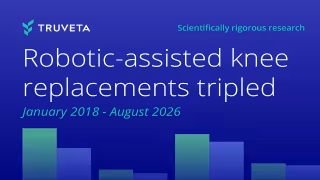
United States – October 27, 2026 -- Robotic assistance in total knee arthroplasty (TKA) rose from 12.4% of procedures in 2018 to 36.1% in 2026, a 191% relative increase, according to an analysis of 362,667 procedures in Truveta Data.

Robotic assistance was used in 24.3% of all procedures in the study period, which ran from January 2018 to August 2026. Robotic-assisted cases ran longer. Median operation time was 136 minutes (IQR 116-160), against 126 minutes (IQR 109-149) without robotics.

Truveta Makes LinkedIn's Seattle Top Startups List for 4th Year

Image
Truveta Makes LinkedIn's Seattle Top Startups List for 4th Year

Seattle – October 27, 2026 -- Truveta has secured a place on LinkedIn's 2026 Top Startups list for Seattle, its fourth consecutive year on the ranking. The annual list covers emerging companies in the Seattle region that are attracting talent, growing quickly and building momentum.

Truveta employs more than 500 people globally

The company said its headcount now exceeds 500 worldwide. It credits the Greater Seattle area's talent pool and entrepreneurial base for shaping the business from the start, and says it plans to keep building a culture around its health mission as it grows.

LinkedIn ranks startups on four hiring and engagement pillars

LinkedIn compiles the list from proprietary platform data. It scores companies on employment growth, engagement, job interest and the attraction of top talent.

Truveta Genome Project Targets Largest De-Identified Exome Database

Image
Truveta Genome Project Targets Largest De-Identified Exome Database

Global – October 27, 2026 -- The Truveta Genome Project aims to build the largest and most diverse de-identified database of exome-wide genomic data linked to high-fidelity clinical data ever assembled, according to a statement from a Truveta executive who joined the company earlier this year.

Health systems founded Truveta during the pandemic to speed up learning

Leading health systems created Truveta during the global pandemic around one premise: healthcare should learn faster. Patient experiences, clinical insights and research findings are meant to feed a shared resource rather than stay siloed within single institutions.

CGM Users on Basal Insulin Show 45% Lower One-Year Mortality Risk

Image
CGM Users on Basal Insulin Show 45% Lower One-Year Mortality Risk

Europe – October 27, 2026 -- Continuous glucose monitoring (CGM) was associated with a 45% lower risk of death at one year among adults with type 2 diabetes on basal insulin, according to a study presented at the 2026 European Association for the Study of Diabetes (EASD) Annual Meeting.

The analysis used Truveta Data to track nearly 28,000 adults with type 2 diabetes receiving basal insulin therapy. Researchers combined longitudinal electronic health record (EHR) and mortality data in a target trial emulation that compared CGM users with non-users.

CGM users show 36% lower two-year mortality risk

At one year, CGM users had a 45% lower risk of death from any cause than non-users. At two years, the reduction was 36%.

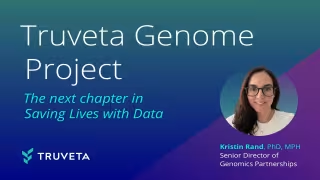
Truveta Genome Project Targets Tens of Millions of Participants

Image
Truveta Genome Project Targets Tens of Millions of Participants

United States – October 27, 2026 -- Truveta aims to enroll tens of millions of consenting participants in the Truveta Genome Project. The goal is the largest and most diverse database of genotypic and phenotypic information ever assembled, according to Kristin Rand, the company's Senior Director of Genomics Partnerships.

The project has moved from planning to enrolling participants and collecting samples, roughly 15 months after Truveta announced it. It builds a consented, de-identified genomic dataset linked with longitudinal clinical data, treatments and outcomes. Truveta has not disclosed current enrollment figures or the number of participating health systems.