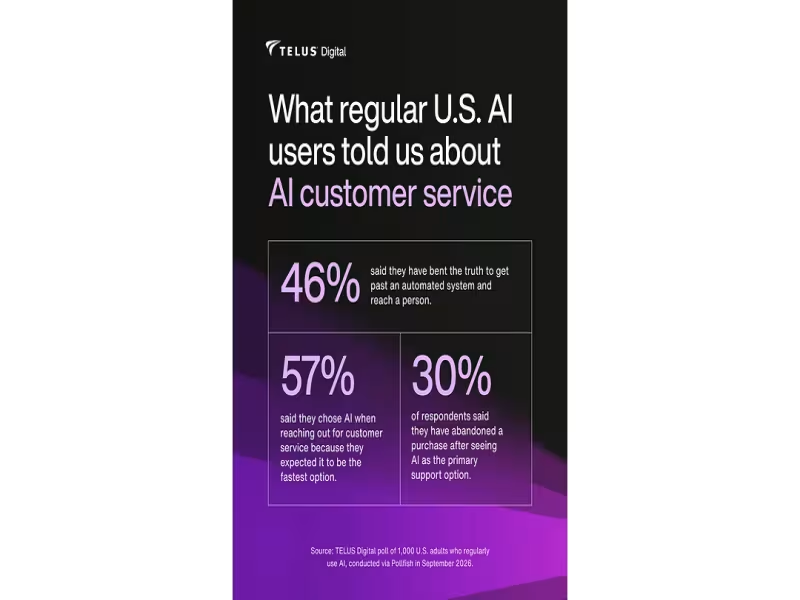
VANCOUVER -- November 24, 2026 -- Forty-six percent of regular U.S. AI users say they have given exaggerated or not entirely accurate information to get past automated AI customer service and reach a person, according to a TELUS Digital poll of 1,000 adults. Another 30% say they dropped a purchase after finding that AI was the main way to get support, equal to about 300 of the 1,000 respondents by our calculation.
TELUS Digital, which sells AI-powered customer experience services, released the results on November 17, 2026. Pollfish ran the online questionnaire in September 2026 among U.S. adults aged 18 to 75 who use AI assistants such as ChatGPT, Gemini and Claude. Results are self-reported, and the company says they may not be representative of all regular AI users.
Explaining the problem and repeating information outrank access to a human as top frustrations
Respondents picked the single most burdensome part of AI customer service from eight options. Three answers drew 60% of responses: explaining the problem in a way the AI understands (23%), repeating the same information (22%) and difficulty reaching a human (15%). The first two, which concern comprehension and memory, total 45%, three times the share for human access.
The other five options each drew 10% or fewer: inaccurate or contradictory answers (10%), waiting for the AI to respond (9%), navigating menus (9%), not knowing whether the AI can resolve the issue (8%) and spending more time than the problem is worth (4%).
Eighty-nine percent used a workaround, and only 12% gave up
Respondents could pick several workarounds. In the poll, 47% simplified or rewrote their explanation, 42% asked the same question a different way and 35% asked for a human agent. Another 28% restarted the chat and 26% repeated the same request several times. Only 12% said they gave up on their issue.
More respondents said they had misstated facts (46%) than said they had asked for a human agent (35%), although the two figures come from separate questions. Of those who admitted bending the truth, 33% of all respondents did it more than once. That is about 72% of the group that admitted it, by our calculation.
The behavior skews young. In the poll, 57% of those aged 18 to 29 said they had done it, against 32% of those aged 62 to 75. That is a gap of 25 percentage points, or about 1.8 times the rate.
Respondents tie AI-only service to lost sales and weaker trust
Fifty-seven percent chose an AI tool for customer service because they expected it to be the fastest option. Yet 56% said they avoid AI customer service at least half the time when another option exists. Among those forced into a workaround, 26% said they would give feedback or file a complaint and 17% said they would lose trust in the company's ability to address their needs.
Seventy-seven percent said a guaranteed human support option would make them more likely to choose one company over another for everyday purchases. TELUS Digital says this indicates that access to a person may help enterprises win and keep customers. The poll measures stated intent, not purchasing behavior. The release does not break results out by industry, although the questions covered retail, travel, financial services and healthcare.
TELUS Digital pitches a four-type model of customer interactions
Jamie Timm, Global SVP of Service Delivery and Operations at TELUS Digital, says the results point to gaps in how some customer experiences are built. The company sorts interactions into four types: self-service tasks, routine requests that automation can resolve, complex issues where a person steps in with AI support, and proactive outreach before a customer asks. According to Timm, it builds an AI strategy for each type.
TELUS Digital says it has more than 80,000 team members across more than 35 countries. It names itself as an implementation partner for the AI platforms Parloa, Cresta and ElevenLabs, and lists partnerships with Genesys, Google, AWS and Zendesk.