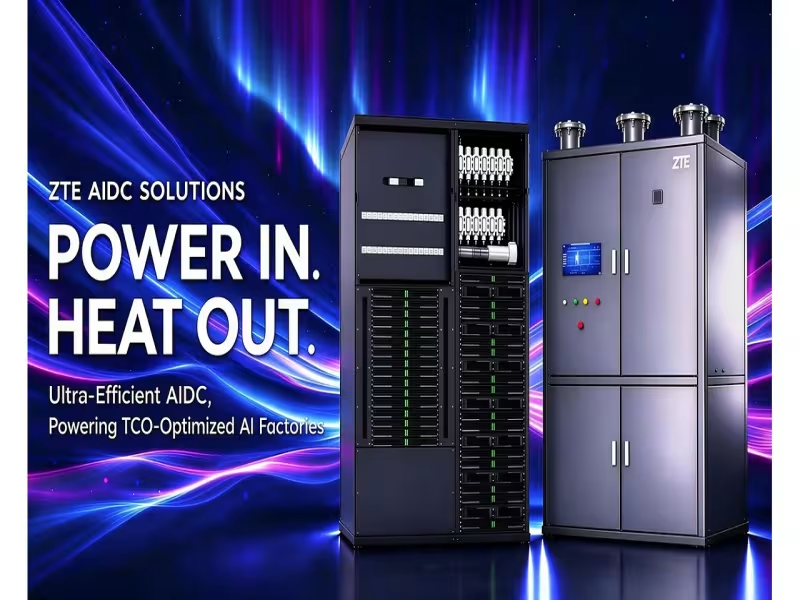
SHENZHEN -- November 24, 2026 -- ZTE has launched a cold-plate liquid-cooling CDU rated at 1.5 MW per unit, expandable to 2.4 MW, alongside an 800V high-voltage DC power system for AI data centers (AIDC). By our calculation, one 1.5 MW unit matches the cooling needed for 50 to 75 racks at the 20-30 kW per-rack limit ZTE cites for air cooling.
ZTE pairs a 1.5 MW CDU with 800V DC to hold PUE within 1.15
The expansion path takes the CDU from 1.5 MW to 2.4 MW, an increase of 60%, using a configuration of 2 to 5 CDU cabinets. ZTE specifies temperature control of ±0.5°C and pressure control of ±0.05 bar. It also lists N+X redundant hot backup, dual power feeds and 24-hour, seven-day operation.
The 800V system can switch between ±400V and 800V standards, which ZTE says allows a phased transition from older installations. Predictive maintenance covers module faults, system faults and battery lifespan. ZTE did not disclose the conversion efficiency or pricing of the 800V system.
The company says the two products together keep PUE stably within 1.15. A PUE of 1.15 means non-IT energy equal to 15% of the IT load.
Nanjing Binjiang Data Center reports PUE of 1.15 at 60 kW per rack
ZTE cites the Nanjing Binjiang Data Center as an early demonstration. The upgrade combined liquid cooling, HVDC power distribution, busway, 32°C air supply and group control optimization. The company reports a PUE of 1.15 at a power density of up to 60 kW.
That density is two to three times the 20-30 kW air-cooling limit ZTE cites. It is 60% of the 100 kW per rack the release describes as quickly being exceeded in GPU clusters. ZTE puts the high end of AIDC loads at 600 kW to 1 MW per rack.
ZTE also says it launched Karakoram-01 with partners in Pakistan. It describes the campus as the country's first and largest purpose-built, AI-ready data center campus. The site uses cold-plate liquid cooling, prefabricated power modules and smart busway.
ZTE's installed base averages about 8 kW per cabinet
ZTE says it has delivered more than 500 projects in over 20 countries. These total more than 400,000 cabinets, more than 3,200 MW of installed capacity and 3.5 million square meters of floor area. Named markets include Indonesia, Uzbekistan, Mexico, Italy, Pakistan, Algeria and Chile.
By our calculation, that works out to about 6.4 MW and 7,000 square meters per project. It also works out to about 8 kW per cabinet, assuming the capacity and cabinet counts cover the same projects. That is below the 10-20 kW the release attributes to traditional data centers. The 100 kW racks the release describes are about 12.5 times that average.
Storage cabinet delivers about two hours at rated power
On the energy side, ZTE lists a 125 kW / 261 kWh commercial and industrial storage cabinet and a 5 MWh containerized unit. The cabinet works out to about 2.1 hours at rated output. Both run with the company's iEMS energy management system.
ZTE names four photovoltaic-storage scenarios: smart PV power stations, grid-side storage, AIDC computing center storage and PV-storage microgrids. The 800V system targets operators, internet companies and professional computing power investors.
ZTE says it plans to turn the 800V system and the 1,500 kW CDU into replicable, scalable industry-standard solutions. It gave no timeline.