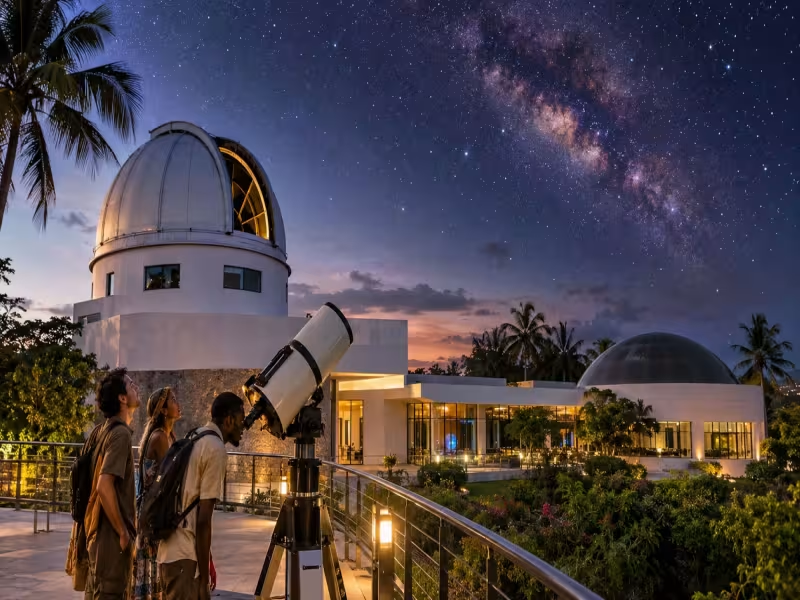
ZANZIBAR -- November 19, 2026 -- The Zanzibar Astronomy and Space Society has set 14 November 2026 as the inauguration date for the Tunguu Space Research Centre, an astro-tourism project in South Unguja, Tanzania, built around a 14-inch robotic telescope. It targets an island that, according to the Bank of Tanzania, received 917,167 international tourist arrivals in 2025.
The planned digital planetarium seats 52 people. One full session would equal about 0.006% of the 2025 arrival count (52 divided by 917,167), so the centre starts as a niche add-on to existing itineraries, not a volume attraction.
Tunguu project combines a 14-inch telescope, an eight-metre dome and a 52-seat planetarium on 4,000 square metres
The telescope has a 14-inch aperture, about 35.6 centimetres. The wider plan includes an observatory dome of roughly eight metres and a planetarium on a site of about 4,000 square metres. The centre is part of the Zanzibar Observatory and Planetarium Project and is developed with international technical collaboration.
The source material separates the fully planned planetarium from the prototype the project organisation describes. It says the availability of regular public sessions and the completion of all infrastructure have not been independently established. The release does not state whether the 14 November inauguration took place. It also gives no investment figure.
Planned audiences are tourists, schoolchildren, university students and researchers. The training programme covers astronomy, robotics, artificial intelligence and technical skills for environmental and natural-resource applications.
Bank of Tanzania data shows Zanzibar arrivals rose 24.5% in 2025, the base the centre depends on
The Bank of Tanzania's Financial Stability Report, published in May 2026, records 917,167 international arrivals in 2025, up 24.5%. By our calculation, that works out to about 736,700 arrivals in 2024, an increase of roughly 180,500 visitors. The report lists accommodation and food services among the activities supporting Zanzibar's growth.
The release says no official revenue forecast specific to Tunguu astro-tourism has been verified. Its contribution to tourism spending is unmeasured.
Airport handled 92% of Zanzibar's 100,729 international visitors in December 2025
The Zanzibar Office of the Chief Government Statistician recorded 100,729 international visitors in December 2025. Of these, 92,421 entered through the airport and 8,308 through seaports, which works out to about 92% and 8%. International flights carried 71,185 arrivals and domestic flights 21,236. International flights thus made up about 71% of all visitors and 77% of airport arrivals.
Airlines and air-inclusive package sellers therefore control most of the access to any astronomy product. The source states that the project has not produced any confirmed airline routes, extra frequencies or added aviation capacity.
Oman's astronomy society and AstroSolutions support the project, while NASA's role is unconfirmed
The Oman Astronomical and Space Society and Omani technical specialists have contributed equipment expertise, scientific education and infrastructure support. AstroSolutions is among the collaborating organisations. The source says sustainable operation will require locally trained technical staff.
NASA ran a spacecraft tracking station in Zanzibar under the code ZZB, established in 1961 and phased out in 1964, an operating span of about three years. It handled telemetry reception, acquisition assistance and air-to-ground voice communications. The source states that the Tunguu development is not established as a NASA-operated facility and that current NASA involvement is unconfirmed.
Zanzibar sits about six degrees south of the Equator, which allows observation of much of both the northern and southern skies. The source lists cloud cover, humidity, rainfall, atmospheric turbulence, moonlight and artificial lighting as factors that limit visibility.