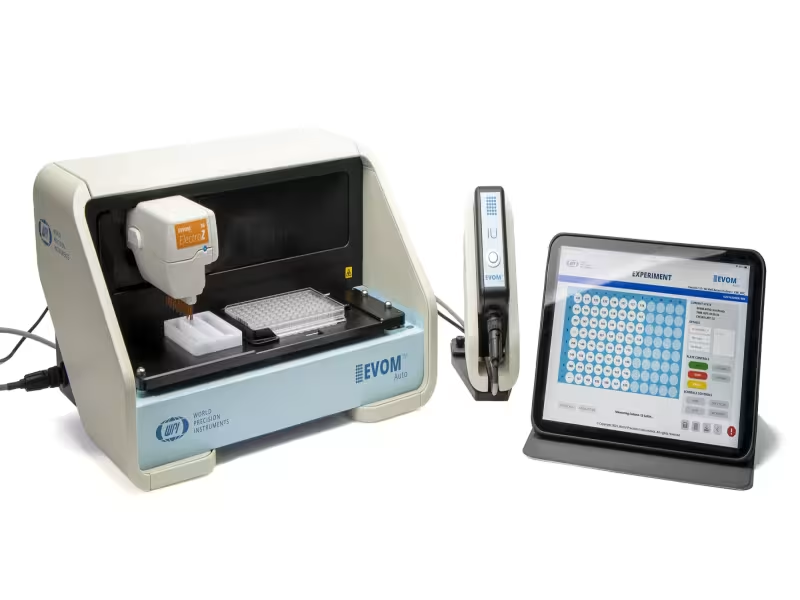
SARASOTA – November 10, 2026 -- World Precision Instruments (WPI) has launched EVOM Auto ElectroZ, which extends its automated transepithelial/endothelial electrical resistance (TEER) platform with electrochemical impedance spectroscopy (EIS) across frequencies from 2 Hz to 100 kHz. The system is available now.
ElectroZ measures impedance from 2 Hz to 100 kHz in under 20 seconds
Conventional TEER measures resistance across a cell layer at a single frequency of 12.5 Hz. ElectroZ captures both resistive and capacitive properties of living cells in a measurement that often takes less than 20 seconds.
The software automatically calculates four parameters:
- TEER Cellular: resistance of the cell layer alone, separated from contributions by media, inserts, electrodes or secreted matrix proteins. It is measured in a single sample, with no separate blank measurements or manual background subtraction.
- TEER Total: combined resistance of the cell layer and background contributions.
- Transepithelial Capacitance (TEC): an indicator of cell growth, size, morphology, maturation, differentiation status and health.
- Tau Ratio: a new impedance-derived parameter that characterizes electrical asymmetry between apical and basolateral membranes, for studying cellular polarity.
Commercial Transwell plates replace specialized electrode-integrated cultureware
Many conventional impedance systems require cells to grow directly on electrode-integrated surfaces. ElectroZ instead uses interchangeable electrode arrays in commercially available Transwell plates. Researchers keep access to both apical and basolateral compartments, which supports polarized cultures, multicellular models and directional transport studies.
WPI lists applications including blood-brain and blood-retinal barriers, intestinal and airway epithelium, and kidney and placental models. The measurements are non-destructive, so cultures remain available for permeability assays, imaging and immunocytochemistry.
One automated platform offers both TEER and EIS modes
Users can choose EVOM Auto Classic for fast TEER readings or ElectroZ for multi-frequency analysis. Automation features include automatic electrode head detection, programmable measurement schedules and automated electrode rinsing. Built-in alignment detection, crash protection and user-defined thresholds support quality control.
ElectroZ software provides customizable frequency profiles, automated equivalent-circuit selection and modeling, and access to raw impedance data. WPI targets drug discovery, disease modeling, tissue engineering and cell culture quality control.
"Resistance doesn't tell the whole story," said WPI CEO Mark Rutledge, who said the system lets researchers examine cells in more depth without changing their established models or workflows.