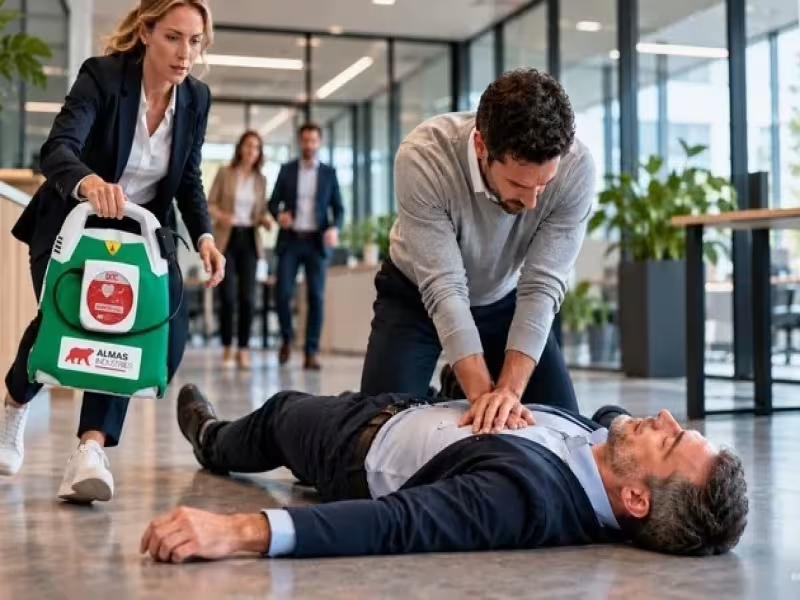
Mannheim – October 28, 2026 -- Irreversible brain damage can begin within three to five minutes of cardiac arrest, while German emergency services need nine minutes on average to arrive, according to the German Resuscitation Council (GRC). Almas Industries argues that employers who buy a defibrillator (AED) without planning the first minutes of response leave that gap unaddressed.
The GRC says well-performed bystander resuscitation can triple the chance of survival. The European Resuscitation Council's 2025 guidelines explicitly include first responders without medical training. The statutory accident insurer DGUV says survival chances rise markedly when resuscitation and, if needed, defibrillation start within the first three minutes.
Five-question check targets AED location, roles and readiness
Almas Industries lists five questions for a workplace emergency review:
- Do employees know where the AED is? Larger sites may need several devices, because a unit that takes minutes to reach wastes critical time.
- Is it clear who calls emergency services, alerts first responders, fetches the AED and guides paramedics across a large site?
- Do staff dare to use the device? Modern AEDs use voice prompts and pictograms and decide on their own whether a shock is needed, but the barrier to acting can still be high. Regular first-aid training and instruction help.
- Is the device ready for use? Batteries and electrodes have limited lifespans, so companies must assign responsibility for monitoring, maintenance, documentation and replacement of consumables.
- Does alerting run in parallel with help on site? When few people are present, simultaneous tasks cost time.
DOC Defibrillator opens a line to a 24/7 emergency control center
Almas Industries' DOC Defibrillator automatically connects to a staffed emergency control center when the wall cabinet is opened. The mobile version needs one button press. The person at the device can then focus on resuscitation while voice prompts and pictograms guide the use.
The system is offered in indoor, outdoor and mobile variants under a rental model. Maintenance, replacement of electrodes and batteries, and instruction of designated device managers are included. First-responder training is available on request.
Joshua Langer, head of personal protection technology at Almas Industries, said the point is not that a defibrillator was bought at some stage, but that it works on the day it is needed.
Germany has no general AED obligation; DGUV advises a risk-assessment review
German law currently contains no general requirement for companies to hold AEDs. A DGUV Forum article recommends examining a purchase as part of the workplace risk assessment. Relevant factors include company size, the number and age of employees, public footfall, special hazards and the expected time for emergency services to arrive.
The decision therefore does not hinge on headcount alone. A production plant, an office, a logistics center and a high-traffic site have different requirements.