FRANKFURT AM MAIN -- November 24, 2026 -- Housing companies in the Initiative Wohnen.2050 (IW.2050) network report a median of just under 23 kg CO2 per square metre and year, down from 23.36 kg in the previous survey. That is about 15% below the 27 kg average of all member companies of the GdW, the German housing association, according to IW.2050's sixth practice report.
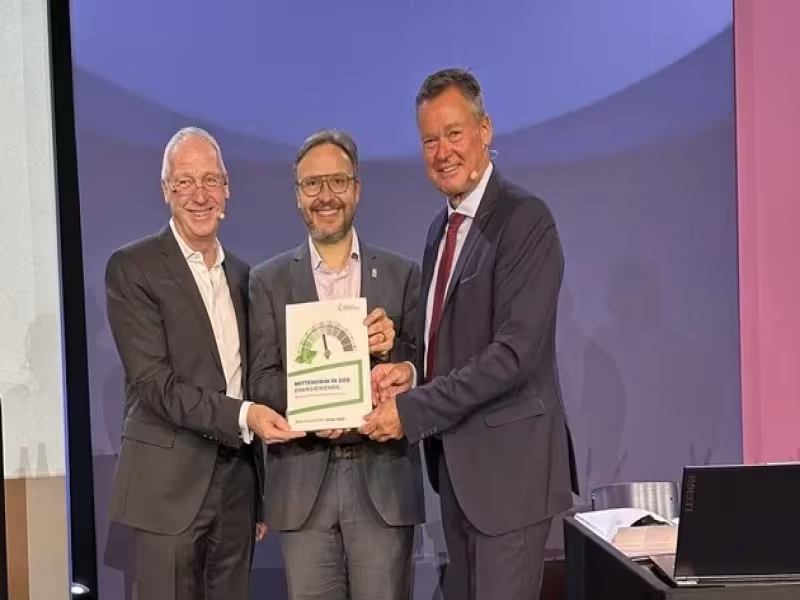
The 220-page report was presented on November 17, 2026 in Berlin at the GdW's "Tag der Wohnungswirtschaft". IW.2050 says its partners' buildings hold about 2.2 million apartments with about 5.8 million residents.
Survey medians fall slightly, and the 2045 projection is lower than a year earlier
The emission data come from a web survey of member companies. The gap to the GdW figure is 4 kg, or roughly 15% of 27 kg, by our calculation. The comparison is not like for like. It sets an IW.2050 median against a GdW average, and the GdW reference covers the 2023 heating period and was last published in 2025.
For the target year 2045, respondents project a median of 5.25 kg CO2/m2/a. The report sets this against 7.36 kg recorded in 2025. The difference is 2.11 kg, or about 29% lower, by our calculation. The release does not state how many of the roughly 250 partners answered the survey.
Sixty-four percent now prioritise CO2 saved per euro over building standard
IW.2050 describes a change of course in the 2026 report. According to the survey, 64% of respondents no longer aim for the highest energy standard per building. They aim to save as much CO2 as possible with the funds available while keeping rents affordable.
Only 5% of respondents lack a finished climate strategy, so by our calculation 95% have one. Another 82% are already implementing theirs. The partner base is 245 companies and 13 institutional partners. By our calculation, 2.2 million apartments across 245 companies works out to about 8,980 apartments per company on average.
IW.2050 names four sources of regulatory and financial pressure on landlords
The report lists the pressures on climate pathways:
- rising construction and credit costs that hinder new building and modernisation of existing stock;
- changing timelines and targets in legislation;
- reduced and less favourable subsidy programmes;
- growing regulatory and administrative requirements.
IW.2050 argues that policy risks destabilising the social housing providers that affordable housing depends on. The GdW distributes the report to the federal ministries and the Bundestag.
KlimaPfadfinder 3.0 separates the CO2 balance from the modernisation path
IW.2050 also presented version 3.0 of its KlimaPfadfinder tool. It separates the current CO2 balance from the modernisation path and accounts for weather, vacancy and changes in the building stock. The network says this eases work with large portfolios.
Two further tools sit alongside it. KlimaFinanzierung shows how climate measures affect balance sheet, earnings and cash flow. KlimaRisikoanalyse assesses physical and transition risks at company and building level. Under its Strategy 2030+, IW.2050 plans to turn these tools, so far mainly Excel-based, into a digital, AI-supported offering in stages. The report is available as a free download.