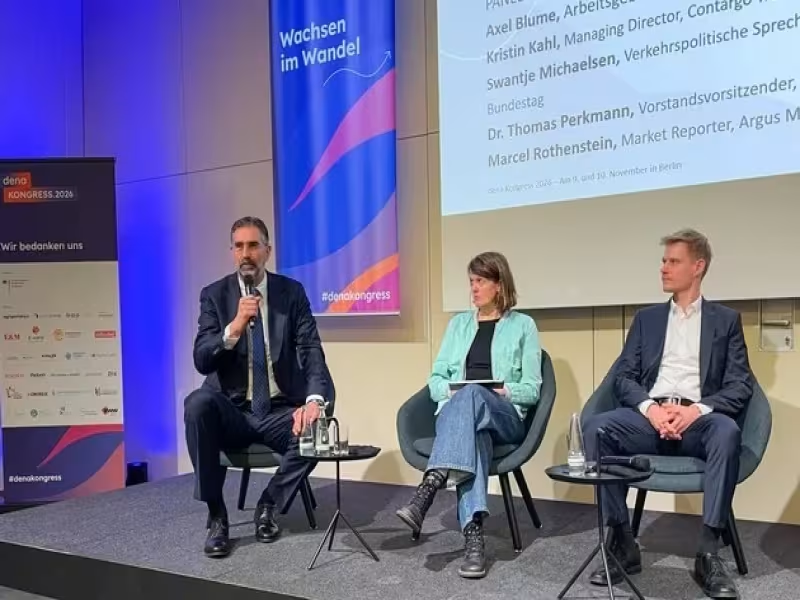
Berlin – November 10, 2026 -- Battery-electric tractor units can already pay back over their entire holding period under current market conditions, according to total-cost calculations by Germany's Westfalen Group. CEO Thomas Perkmann made the case at the dena congress in Berlin, arguing that the result holds only if electricity stays price-competitive with diesel.
Perkmann spoke on the panel "Fuel price crisis at the pump: increasing resilience through renewable energy". His co-panelists were Kristin Kahl of Contargo Truck Fleet, Green Party transport spokesperson Swantje Michaelsen and Argus Media market reporter Marcel Rothenstein. Axel Blume of dena moderated.
Westfalen's cost model ties e-truck economics to the diesel-to-power price ratio
The company's calculation shows that the higher the diesel price and the cheaper the electricity, the larger the advantage of electric drive. Logistics margins are tight, so Perkmann said the energy transition in heavy-duty transport will be decided largely by the power price.
Beyond energy costs, missing grid connections, limited grid capacity and lengthy permitting procedures slow the build-out of charging infrastructure. Grid access and electricity procurement costs must also allow high-power truck charging to be operated profitably, he said.
Westfalen currently operates 83 fast-charging stations with 149 charging points in total. Some of them are suitable for trucks, and further truck charging sites are being piloted at suitable locations.
Perkmann says Rhine low water added to diesel price pressure alongside Hormuz concerns
Fuel prices depend on more than crude oil, Perkmann noted. International product quotations, refinery capacity, exchange rates and disrupted transport routes also play a role. While attention focuses on the Strait of Hormuz, low water on the Rhine has added noticeably to the price, he said, and diesel reacts particularly sensitively to supply and demand shifts.
He is critical of permanent market interventions. In his view, high fossil fuel prices point toward expanding e-mobility.
Westfalen plans HVO at 44 filling stations by end-2026 as a bridge for diesel fleets
For vehicles already on the road, Westfalen sees renewable fuels as a bridge. HVO can run without technical conversion in diesel vehicles that have manufacturer approval, and demand is rising. By the end of 2026, the synthetic fuel is to be available at 44 Westfalen filling stations in total. Biogases such as CNG and LNG can also contribute, and depending on feedstock and production process, greenhouse gas emissions can fall significantly.
Perkmann called on policymakers to give companies planning certainty and to enable the market ramp-up of alternative drives and fuels instead of favoring individual technologies.