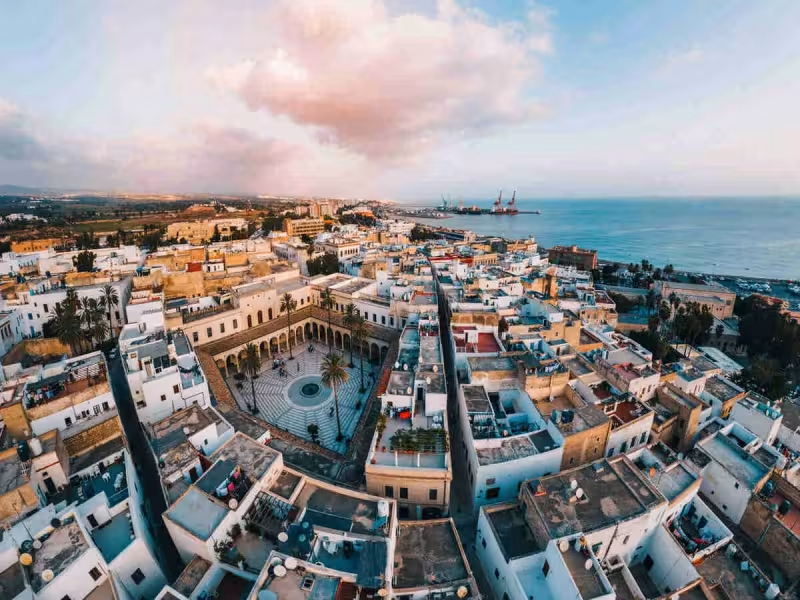
TUNIS -- November 21, 2026 -- Tunisia's Ministry of Tourism and Handicrafts is using the 2027 Arab Tourism Capital title to push annual arrivals toward 12 million. That benchmark is at most about 9% above the more than 11 million visitors the country received in 2025. Tunis won the title on December 8-9, 2025, at the 28th Ordinary Session of the Arab Ministerial Council for Tourism in Baghdad. Tunisia also joined the Council's Executive Office as Deputy President.
Tunisia earned about $245 per visitor in 2025, and the ministry wants higher-value guests
The country generated $2.7 billion in tourism revenue in 2025. Divided by 11 million visitors, that is roughly $245 per arrival. The true figure is slightly lower, because arrivals exceeded 11 million. Tourism Minister Soufiane Tekaya has set a strategic mandate to shift from low-margin mass-market volume to high-value-added quality.
Arrivals grew 26% in March 2026, a rise the source says led North Africa. The 2025 volume was concentrated in a few markets: 3.5 million Algerian, 2.6 million European and 2.25 million Libyan travelers. Together they total 8.35 million, or no more than about 76% of 2025 arrivals. Algeria and Libya alone account for 5.75 million, no more than about 52%.
The 2027 campaign targets affluent visitors from the Gulf Cooperation Council, notably Saudi Arabia and the United Arab Emirates, as well as Egypt and Jordan. The ministry says it will use the Executive Office vice-presidency to build joint regional travel packages. The source gives no 2025 arrival figure for the Gulf markets.
Handicraft exports of 500 million dinars would be 3.1 times the 2024 level
The ministry aims to raise handicraft exports from 160 million dinars in 2024 to 500 million dinars. That is an increase of 340 million dinars, or about 3.1 times the 2024 base. No target year was given.
The preparation blueprint was launched at the Tunis Municipal Theater on December 22, 2025. It uses a participatory process open to private operators, civil society groups, cultural institutions and young Tunisians. By February 25, 2026, ministerial working sessions had begun planning a national design competition for the official logo and graphic identity.
The artisan base comes from the European Union and UNIDO Creative Tunisia program, which finished in May 2026 after seven years. It structured 17 value chains and 6 creative hubs supporting 3,000 artisans. Tunis has belonged to the UNESCO Creative Cities Network for crafts and folk arts since 2017.
Restoration and night lighting are under way in the Medina of Tunis, Carthage (including the Antonine Baths), Sidi Bou Saïd, La Marsa and the La Goulette waterfront, with multilingual signage and better pedestrian access. Under the RÉG-TOUR framework, authorities are legally certifying local hiking guides, community-run guesthouses and traditional culinary tables (tables d'hôtes). The ministry says this will draw visitors to rural and eco-tourism circuits in cooler months.
Meliá plans five hotels and 3,000 rooms while the government spends $1 billion on Tunis-Carthage airport
Meliá Hotels International debuts in Tunisia in 2026 with a development plan for five properties and 3,000 rooms across resort and urban segments. That works out to an average of 600 rooms per property. The government has launched a $1 billion expansion of Tunis-Carthage International Airport. It is paired with expanded direct routes to Gulf, Arab, European and long-haul hubs. The ministry says authorities have also stepped up inspections of cafés, restaurants and historic sites for hygiene and service standards. No budget has been disclosed for the 2027 program itself.
Ministry builds a Tunis 2027 platform and AI tools to manage seasonal demand
Ministry officials, including Aymen Rahmani, are leading the digital pillar. The central Tunis 2027 platform is designed to combine real-time event calendars, heritage itineraries, artisan directories and booking integrations. The ministry is also integrating AI-driven analytics to forecast seasonal travel patterns, manage crowds at heritage sites and personalize itineraries. Augmented-reality apps will render Carthaginian ruins and Medina monuments on visitors' smartphones, backed by a pan-Arab media campaign on regional television, digital networks and travel platforms.