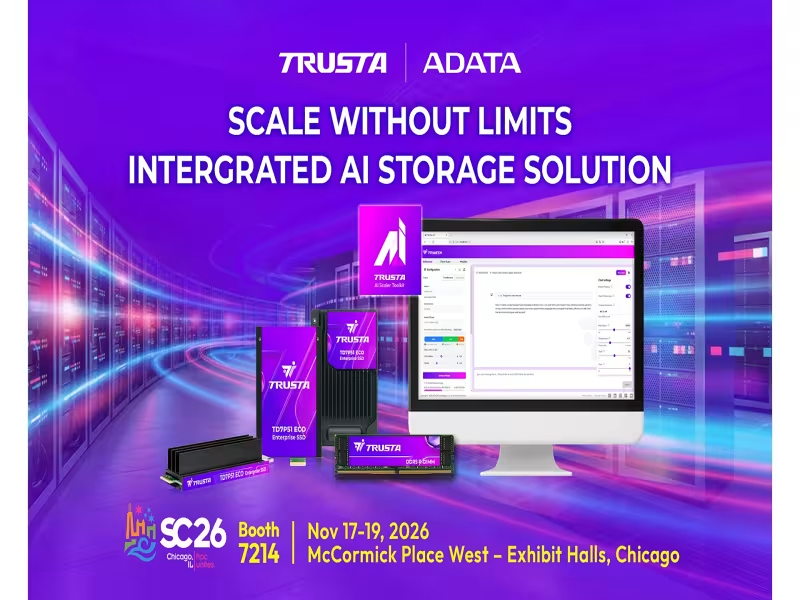
TAIPEI -- November 25, 2026 -- TRUSTA, the enterprise storage brand of ADATA Technology, has upgraded its AI Scaler Toolkit to offload the vLLM KV cache across GPU memory, DRAM and PCIe Gen5 enterprise SSDs, and showed it at SuperComputing 2026 (SC26) in Chicago. The company says an AMX-enabled Strata engine in the toolkit speeds up prompt processing by up to 25%, but its own test notes show that gain was about 11% at 8K tokens and not significant above about 12K tokens.
TRUSTA's best-case 25% prefill gain falls to 11% at 8K tokens
TRUSTA tested in November 2026, comparing its AMX-enabled Strata with upstream Strata v0.2.11. The platform was an Intel Xeon w5-3535X processor with a single NVIDIA RTX 6000 Ada GPU, running a Mixture-of-Experts model. Each test ran at least three times, and TRUSTA reports medians.
- Single input of about 8K tokens: about 11% faster.
- Multi-turn conversation with about 4K new tokens per turn: about 25% faster.
- Single input above about 12K tokens: no significant difference.
The multi-turn best case is roughly 2.3 times the 8K result, by our calculation (25% against 11%). The measurements cover only the prefill stage and compare against upstream Strata, not against vLLM. TRUSTA published no timing figures for the SSD offload path, which it says shortens response waits significantly.
The gain applies to Intel Xeon systems, where AMX lets the CPU process model data directly in DRAM. In this test it appeared in shorter and multi-turn workloads, not in very long single inputs.
Toolkit adds a persistent SSD tier behind GPU and DRAM
The toolkit assigns GPU memory to active requests, DRAM to a fast cache and TRUSTA PCIe Gen5 enterprise SSDs to a large, low-cost tier that persists across restarts. After a server reboot, conversations resume from the cache saved on SSD instead of being recomputed. TRUSTA says this lets enterprises run AI on-premises at lower cost with limited GPU resources.
Installation is one-click, and one interface handles allocation of GPU, DRAM and SSD resources, parameter tuning and model testing. It supports three engines: vLLM, llama.cpp and Strata.
TRUSTA ties the product to a shift in storage demand. According to Counterpoint Research, as cited by TRUSTA, enterprise SSDs accounted for 48% of global NAND flash capacity shipments in Q2 2026, up from 26% a year earlier. That is a rise of 22 percentage points, or about 1.8 times the earlier share. "Enterprises don't need to keep buying expensive GPUs to adopt AI," TRUSTA stated.
TRUSTA pairs the software with 15.36TB Gen5 SSDs and 128GB DDR5 modules
- TD7P51 ECO / T7P5 PCIe Gen5 SSD: up to 15.36TB in U.2, E1.S and E3.S form factors, endurance of up to 3 DWPD, and Flexible Data Placement. TRUSTA quotes power consumption below 20W and energy efficiency 1.7 times better than comparable products, without naming the comparison products.
- Enterprise DDR5 R-DIMM: speeds of up to 6,400MT/s and up to 128GB per module, with built-in ECC that detects and corrects data errors.
SC26 ran November 17-19 at McCormick Place West in Chicago. TRUSTA exhibited at booth 7214. The release says organizers expected more than 450 exhibitors and over 18,000 attendees. TRUSTA notes that actual performance varies by hardware configuration, model and input length.