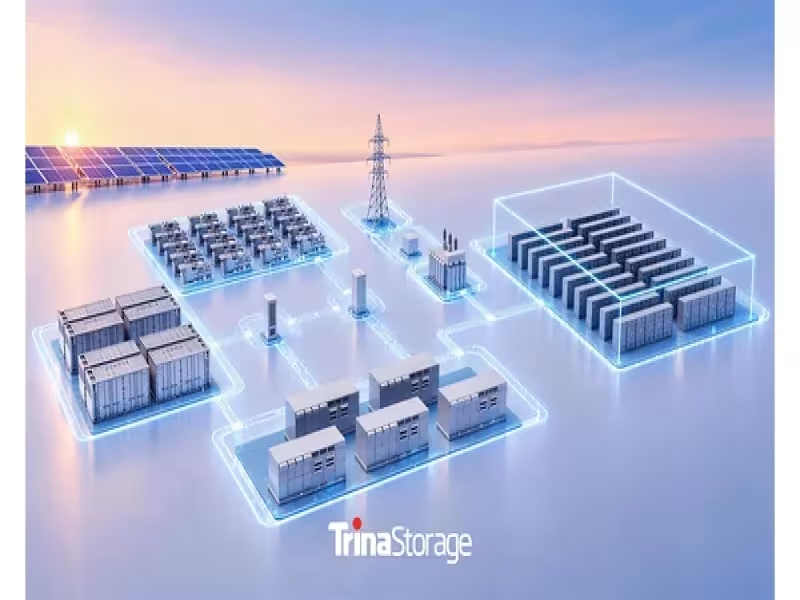
LAS VEGAS -- November 25, 2026 -- Trina Storage unveiled Elementa Hybrid Genset at RE+ 2026 on Nov. 18. The modular plant pairs gas engines with grid-forming batteries to power AI data centers where grid interconnection is delayed, limited or unavailable. Its control architecture is specified for projects from 5 MW to 1 GW, a 200-fold range by our calculation.
The launch follows a preview at Data Center World Power in September.
Gas engines of up to 2.5 MW sit alongside 5 MW battery building blocks
The system has three parts. Reciprocating engines rated up to 2.5 MW supply sustained power, and qualified engine partners provide the equipment while Trina Storage acts as system integrator. Trina's Elementa DC battery systems and Electra AC platform supply fast response and grid-forming capability, with reference configurations built on 5 MW/10 MW blocks. A hybrid plant controller coordinates all sources in real time.
By our calculation, two 2.5 MW engines match the power rating of one 5 MW battery block. At the top of the control range, 1 GW (1,000 MW), 2.5 MW engines alone would take 400 units to match the capacity.
The controller shifts sudden load swings to batteries before engines ramp
Trina says AI workloads can swing power demand quickly and sharply, which gas generators alone may struggle to follow. Batteries react fast but are not designed to carry long outages on their own. The controller uses three functions to split the work:
- Load Transient Sensing: the controller predicts demand changes and triggers a battery response before slower sources can adjust.
- Hybrid Power Coordination: batteries take sudden load increases while gas generators ramp up gradually.
- Fault Isolation: the controller isolates faulty equipment, and batteries and remaining engines support critical loads.
Trina describes four reference scenarios: grid-connected with backup generation, grid-constrained, bridge-to-grid and off-grid. Solar PV can be added where appropriate. Developers choose between two architectures. Load Sensing prioritizes cost efficiency and system performance. Double Conversion provides full electrical isolation and enhanced power quality. The choice depends on the IT load profile and grid conditions.
Grid-forming and certification testing is still under way
Trina is validating the system through simulation, hardware-in-the-loop testing and an integrated platform using real generation, conversion and storage equipment. Testing of grid-forming functions and hybrid control strategies continues, alongside certification work. Final configurations and performance specifications will be set project by project, so the launch does not fix delivered performance figures.
The company did not name its engine partners, give pricing or identify a customer.
Eric Cao, Vice President of Trina North American PV and BESS Business, says the system is designed to coordinate gas, storage and controls according to project needs. Trina Storage is engaging with data center developers and project partners on project-specific configurations.