Vulnerability Management

CIQ Ships PHP2Shell Fixes for Unsupported PHP 8.0 in 3.5 Hours

Image
CIQ Ships PHP2Shell Fixes for Unsupported PHP 8.0 in 3.5 Hours

Global – November 10, 2026 -- CIQ shipped fixed PHP 8.0 packages for Rocky Linux from CIQ Pro (RLC Pro) LTS 9.6 and 9.2 about three and a half hours after the PHP project released its PHP2Shell fix, covering a version upstream no longer supports.

CIQ built PHP 8.0.30 fixes from source-only upstream backports

The PHP project announced a critical security release the day before, disclosing only its severity. CIQ staffed up ahead of disclosure. The upstream fix went public just before 14:00 UTC, and within the hour the base PHP 8.0 fixes for both LTS releases were in review.

The project shipped fixed releases for PHP 8.2, 8.3, 8.4 and 8.5. For PHP 8.0 it published only "minimal source-backports" and no official binaries. RLC Pro LTS 9.6 and 9.2 ship PHP 8.0.30, so CIQ engineers built, tested and published php-8.0.30-3.4.el9_6_ciq for LTS 9.6 and php-8.0.30-1.2.el9_2_ciq for LTS 9.2.


CIQ Patches Critical Linux Kernel Flaw in 72 Hours

Image
CIQ Patches Critical Linux Kernel Flaw in 72 Hours

Global – November 05, 2026 -- CIQ patched every affected kernel stream, more than a dozen across three major releases, within 72 hours of the first customer report on critical Linux vulnerability CVE-2026-98432, which carries a CVSS score of 9.8. The first fixed kernels reached CIQ repositories about 45 hours after the first customer questions.

Anthropic exploit demonstration raised the vulnerability's priority

On Tuesday, October 27, Anthropic reported a working proof-of-concept exploit for the flaw. Many CVEs are patched without proof of exploitability, so a demonstrated exploit raised the priority beyond what the severity score alone indicated. The kernel's CVE Numbering Authority assigned the 9.8 score.

The bug is a use-after-free in the Linux kernel's IPv4 TCP code, triggered by IP options on incoming connections. A network-based attacker can exploit the kernel's continued use of memory it has already released.

CrowdStrike Sees No Successful PHP2Shell Exploits Yet

Image
CrowdStrike Sees No Successful PHP2Shell Exploits Yet

Global – October 31, 2026 -- CrowdStrike Counter Adversary Operations has observed no successful exploitation of the PHP2Shell vulnerabilities in the wild or in its honeypot environments, only testing, probing and unsuccessful attempts.

The firm has also found no fully weaponized exploit, and no proof-of-concept (POC) exploit sufficient for widespread exploitation. Opportunistic attackers are likely to favor proven alternatives, because several other vulnerabilities already deliver unauthenticated remote code execution (RCE) against PHP applications reliably and at scale.

PHP disclosed two CVEs affecting four release branches on October 21, 2026

CVE-2026-109618 and CVE-2026-109619 affect PHP versions earlier than 8.2.35, 8.3.36, 8.4.27 and 8.5.12. Preliminary analysis by industry sources and the vendor indicates that many older versions, including end-of-life releases, are also affected and may receive only limited patches.

AI Turns Parked PHP Bug Into 9.2-Rated Remote Code Execution

Image
AI Turns Parked PHP Bug Into 9.2-Rated Remote Code Execution

Global – October 31, 2026 -- A PHP vulnerability that stalled in triage after a 2024 audit became unauthenticated remote code execution this year once researchers applied frontier AI models, and both PHP2Shell CVEs now carry a CVSS v4.0 score of 9.2.

PHP Foundation admits a 2024 finding stalled for lack of a proven exploit

A 2024 external audit led a PHP core developer to the first signs of an out-of-memory problem, according to the PHP Foundation's account of CVE-2026-109618. An exploit was theorized, but no one found a concrete attack vector. Each candidate fix carried a cost: a compatibility break, new denial-of-service potential, or changes to third-party extensions that seemed impossible to coordinate. Work on the fix stalled and restarted for months.

Node.js Patches Brotli Flaw Enabling Remote Code Execution

Image
Node.js Patches Brotli Flaw Enabling Remote Code Execution

Global – October 29, 2026 -- Node.js issued security releases across all supported lines to fix CVE-2026-111497, a high-severity out-of-bounds write in its bundled Brotli decoder that can lead to remote code execution. A Node.js process that decompresses attacker-controlled Brotli data, including Brotli-encoded HTTP responses it fetches, can be driven to write past the end of its buffer. The result is leaked memory or code execution with the process's privileges.

Ordinary traffic can reach the vulnerable decoder

Node.js bundles Google's Brotli library to back its built-in zlib support. That covers zlib.brotliDecompress(), brotliDecompressSync(), streaming Brotli and transparent decoding of HTTP bodies sent with Content-Encoding: br. Because decompressing untrusted Brotli is common, the bug is reachable across a wide range of services. A web application firewall does not mitigate it.

99.3% of Exposed PHP Hosts Unpatched 24 Hours After PHP2Shell Fix

Image
99.3% of Exposed PHP Hosts Unpatched 24 Hours After PHP2Shell Fix

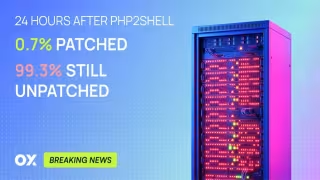
GLOBAL – October 29, 2026 -- Only 14,151 of 1,974,890 measurable PHP instances in the affected version range showed a patched release 24 hours after PHP shipped emergency fixes for the PHP2Shell flaws, leaving 99.3% exposed, according to OX Security.

PHP released the fixes on October 21 for CVE-2026-109618 and CVE-2026-109619. Both are critical vulnerabilities that allow unauthenticated remote code execution in the PHP engine itself. Governments and security agencies urged organizations to patch immediately, and some organizations took systems offline.

93.6% of PHP Hosts Still Exposed to PHP2Shell Five Days After Fix

Image
93.6% of PHP Hosts Still Exposed to PHP2Shell Five Days After Fix

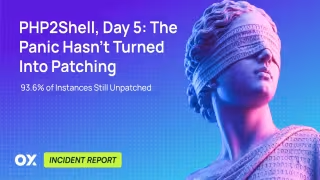
Global – October 29, 2026 -- Five days after the PHP project shipped emergency fixes for the PHP2Shell flaws, 93.6% of measurable PHP instances remain exposed, according to OX Security scans run through October 26, 2026. That is roughly 15 of every 16 hosts the firm can measure.

The PHP project released the fixes on October 21 for CVE-2026-109618 and CVE-2026-109619. Together, the two critical flaws let an unauthenticated attacker execute code remotely inside the PHP engine. Security agencies issued urgent advisories, and some organizations took systems offline while assessing their exposure.

Critical PHP Flaws Rated CVSS 9.2 Face Attacks Before Patch

Image
Critical PHP Flaws Rated CVSS 9.2 Face Attacks Before Patch

Global – October 29, 2026 -- Two critical PHP vulnerabilities, CVE-2026-109618 and CVE-2026-109619, each carry a CVSS score of 9.2 and let unauthenticated attackers run code on web servers. Cyber insurer Coalition says its honeypots recorded exploit-related requests more than five hours before PHP released its fix, and it expects exploitation at scale.

PHP published its advisory on October 21, a day earlier than planned after details leaked online. The flaws sit in PHP itself rather than in any single application. Attackers can also read passwords, authentication tokens, API keys and certificates from server memory without taking over the server.

Apache Airflow SSH/SFTP Defaults Expose Pipelines to MITM, CVSS 8.1

Image
Apache Airflow SSH/SFTP Defaults Expose Pipelines to MITM, CVSS 8.1

Global – October 27, 2026 -- Apache Airflow's SSH and SFTP providers ship with host key verification disabled by default. Two High-severity vulnerabilities, CVE-2026-94134 and CVE-2026-94135, both rated CVSS 8.1, leave connections open to man-in-the-middle attacks, according to OX Security Research.

Both apache-airflow-providers-ssh and apache-airflow-providers-sftp are affected through version 6.0.1. Version 7.0.0 of each package fixes the flaw. The weakness is classified as CWE-322, key exchange without entity authentication.

PHP to patch two CVSS 9.2 remote code execution flaws on Oct. 21

Image
PHP to patch two CVSS 9.2 remote code execution flaws on Oct. 21

Global – October 27, 2026 -- PHP will ship an emergency patch for two critical core vulnerabilities, CVE-2026-109618 and CVE-2026-109619, on Wednesday, October 21, 2026, at 14:00 UTC (10:00 ET). The PHP security team rates both flaws CVSS v4.0 9.2, and researchers describe them as unauthenticated remote code execution.

PHP reserves the right to release before 14:00 UTC

The project may ship earlier if technical details go public or exploitation appears in the wild, according to BleepingComputer. The official advisory names no vulnerable function, no affected versions and no fixed releases.

The CVE IDs, the "PHP 5 through 8" scope and the CVSS 10 figures come from researchers and a leak, not from PHP. Until the release, everything outside the official advisory remains theory.