Ai Governance

IBM Extends HashiCorp Vault to AI Agents With Real-Time Revocation

Image
IBM Extends HashiCorp Vault to AI Agents With Real-Time Revocation

ATLANTA – October 28, 2026 -- IBM is extending HashiCorp Vault to AI agents, issuing each one a governed identity and short-lived credentials, as Gartner data shows only 13% of organizations believe they have the right agent governance in place. The company announced the capabilities at TechXchange 2026.

Gartner projects that by 2028 the average Fortune 500 enterprise will use more than 150,000 AI agents. IBM cites persistent credentials, unclear ownership and disconnected controls as the main obstacles to governing agents that call tools and act across teams, platforms and clouds.


Healthcare Voice AI: Four Tests That Separate Production From Pilot

Image
Healthcare Voice AI: Four Tests That Separate Production From Pilot

United States – October 27, 2026 -- A two-second pause in an AI voice call feels like system confusion, while a 200-millisecond gap feels natural, according to IntelePeer's four-layer framework for judging healthcare voice AI. The company argues that polished vendor demos hide the gaps that stall pilots before production.

Test scenario exposes all four layers in one call

IntelePeer advises buyers to ask vendors to handle a reschedule request for a specific location, provider and insurance plan, where the patient mentions worrying symptoms midway through the call. The scenario tests reliability, real-time performance, integration, and analytics and governance together.

Mark Langanki, Chief AI Officer at IntelePeer, said demos stop being representative once agents connect to backend systems, apply business rules and talk to real people.

Agentic AI Forces Enterprises to Extend Sovereignty to Agent Actions

Image
Agentic AI Forces Enterprises to Extend Sovereignty to Agent Actions

Global – – October 27, 2026 -- Enterprises deploying autonomous AI agents must extend sovereignty controls beyond data location and model hosting to cover agent identity, permissions, execution authority and oversight. Agents can interpret goals, select tools, call APIs, update applications and delegate work to other agents within a single task.

Governance shifts from controlling access to controlling actions

Traditional AI governance centers on datasets, approved models, processing locations and user access. Agentic systems make decisions inside the workflow itself, choosing which system to query, which tool to invoke and which action follows. A procurement agent investigating a supplier issue could pull supplier records, review purchase orders, analyze delivery records, compare contract terms and initiate an approval workflow. That chain spans several databases, applications, APIs, models and identity systems.

AI Agent Testing Must Cover Execution Paths, Not Just Answers

Image
AI Agent Testing Must Cover Execution Paths, Not Just Answers

Global – October 27, 2026 -- Two AI agent runs can return the same correct answer while carrying very different operational risk, which makes output-only checks insufficient for enterprise Quality Engineering (QE), according to a new AI agent testing framework built around four evaluation layers.

Recovered failures can look like clean successes

In the source's example, an agent retrieving an account balance queries an unnecessary privileged system, hits an authorization error, retries twice and then reaches the approved source. The user sees a correct result. An output-level assertion marks the run as a success, while a trace-level evaluation flags it as degraded.

Dust CTO Pitches Company-Owned AI to Curb Model Vendor Lock-In

Image
Dust CTO Pitches Company-Owned AI to Curb Model Vendor Lock-In

Global – October 27, 2026 -- Dust, a collaborative AI platform, is targeting three forms of enterprise AI dependency: reliance on a single model provider, loss of control over agent-generated data, and limited visibility into costs and behavior, according to Co-Founder and CTO Stanislas Polu.

Dust builds a shared layer between staff, company data and multiple models

Polu said Dust lets teams work with AI, switch among supported frontier and open source models, and govern the context, agents and traces their work generates. The platform is multimodel by design, so companies can change models without rebuilding their context and workflows.

Polu argues that agent traces, which record instructions, context, model and tool choices, outputs and human feedback, may become one of a company's most valuable AI assets. He said that corpus could later help companies evaluate or train models for their specific work.

Alteryx CEO: AI Without Auditable Logic Is an Operational Risk

Image
Alteryx CEO: AI Without Auditable Logic Is an Operational Risk

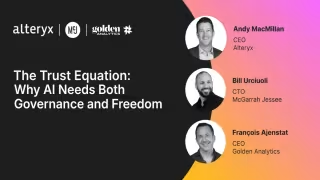
GLOBAL – October 27, 2026 -- Alteryx CEO Andy MacMillan said an AI system that recalculates revenue rules with every user query is not a strategy but an operational risk, as enterprises weigh the speed of generative analytics against the reliability of its outputs.

Alteryx outlines four-part VURA test for trusted AI answers

MacMillan described the company's VURA framework: logic must be visible, calculations understandable, outputs repeatable and results auditable back to source data. He said one clearly wrong or unverified answer erodes user trust almost instantly.

Golden Analytics CEO François Ajenstat said semantic models supply consistent definitions but do not make analytics accessible on their own. He placed the industry in Gartner's trough of disillusionment around semantic models and ungrounded AI. Golden Analytics supplies the exploration front end, while Alteryx supplies the governed workflows and business logic.

CIOs Press Ahead on AI Despite Security and Governance Fears

Image
CIOs Press Ahead on AI Despite Security and Governance Fears

Orlando – October 25, 2026 -- Enterprise AI adoption is continuing in 2026 despite mounting security, accountability and control concerns, CIOs attending Gartner's IT Symposium/Xpo told CIO Dive. In financial services, three-quarters of leaders reported using the technology this year, up from less than one-third in 2024.

Several CIOs compared AI's impact to the dot-com era and the arrival of cloud: it enables business reinvention but brings security and social risks. Gartner analysts said in the keynote that most tech executives are weighing those risks against AI's measurable and unquantifiable value.

Capital One Software executive calls non-adoption an 'extinction event'

Prashant Prahlad, SVP of product at Capital One Software, said skipping AI is not an option for enterprises. "If you don't get on board, it's going to be an extinction event," he said.

Permuta Warns Token Pricing Turns Government AI Into Variable Cost

Vienna, Va. – October 25, 2026 -- Permuta Technologies has published a white paper arguing that token- and consumption-based AI pricing can turn AI from a predictable line item into a variable operating cost for government agencies.

The paper, titled "You Can't Consume Your Way Out of AI Cost Opacity," is the second in the company's series of white papers on AI and government. It examines how the shift in AI pricing models affects government acquisition, budgeting and long-term contract control.

Palantir case study identifies five contract risks for agencies

Using Palantir as a case study, the paper says tokenization mechanics can create budget unpredictability and reduced cost transparency. It also lists ceiling pressure, source-selection complexity and lock-in risk. These risks grow as AI becomes embedded in mission workflows, according to the paper.

Only 20% of AI Initiatives Hit KPIs as CISOs Doubt Data Controls

Image
Only 20% of AI Initiatives Hit KPIs as CISOs Doubt Data Controls

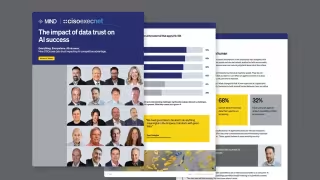
SEATTLE – October 24, 2026 -- Only 20% of enterprise AI initiatives meet their intended KPIs, and 65% of CISOs lack confidence in their data security controls, according to new research from data security vendor MIND and the CISO Executive Network.

The report, "The Impact of Data Trust on AI Initiative Success," finds that 90% of organizations already run enterprise GenAI at scale. Security governance has not kept pace with that deployment.

Survey of 124 CISOs finds policies without machine-speed enforcement

The study combines a survey of 124 CISOs with twenty in-depth interviews drawn from the same group. Organizations have AI policies but struggle to enforce them at machine speed, the report says. Data estates remain unclassified and ungoverned, and security frameworks were built for human behavior rather than autonomous systems.

Bloomberg TV to Air Discoveries Today Episode on AI Security, Oct. 24

Jupiter, Florida – October 19, 2026 -- Bloomberg Television will broadcast a Discoveries Today episode hosted by Daymond John on Saturday, October 24, 2026, at 8:00 p.m. ET, covering four segments: disability support services, AI security governance, automotive retail marketing and behavioral healthcare.

AI governance segment focuses on zero-trust security for critical infrastructure

The security segment addresses zero-trust architecture, operational technology protection, and verifying AI identities, permissions and actions before they can affect sensitive systems. It covers how AI governance is being designed for critical infrastructure and regulated environments. It also covers how AI governance software is being aligned with federal security requirements and frameworks. The segment stresses accountability and verifiable decision-making as ways for organizations to keep control over increasingly autonomous technologies.