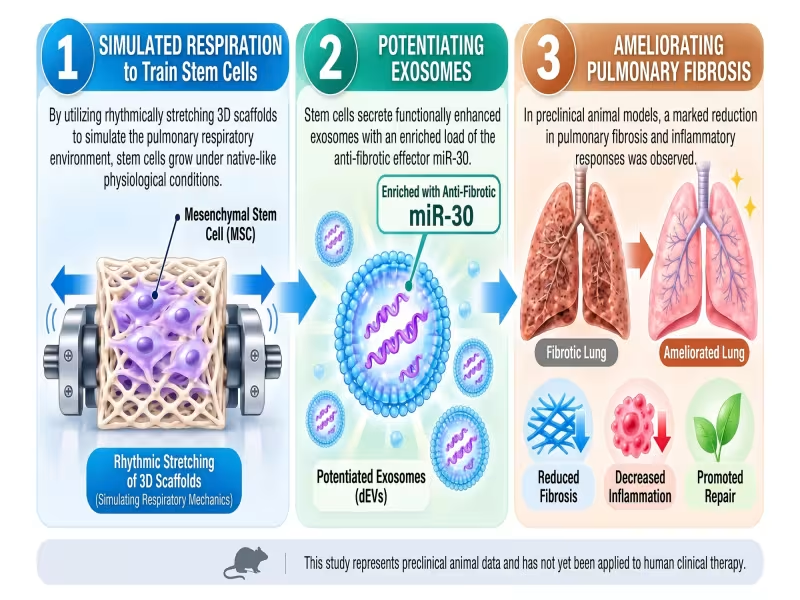
TAICHUNG -- November 24, 2026 -- Researchers at China Medical University Hospital (CMUH) in Taiwan report that a stem cell platform mimicking the stretch of breathing produced extracellular vesicles with about 3.3 times as much of the antifibrotic microRNA miR-30 as cells grown under static conditions. By our calculation, that is an increase of about 230% over the static baseline.
The vesicles reduced lung scarring and inflammatory markers in rats with induced pulmonary fibrosis. The work is preclinical and was published in Biomaterials, a peer-reviewed Elsevier journal.
CMUH team raises miR-30 cargo by stretching stem cells on a lung-matrix scaffold
The researchers grew mesenchymal stem cells on a three-dimensional scaffold containing a lung-derived matrix and stretched it rhythmically to mimic breathing. They then compared the extracellular vesicles (EVs) from these cells with EVs from cells grown statically.
According to Dr. Hsin-Yuan Fang, vice superintendent for surgery, static culture is the conventional way to grow stem cells. The 3.3-fold figure therefore measures miR-30 content against that standard method. The release reports a cargo ratio, not EV yield.
Dr. Jian-Xun Chen, a thoracic surgeon on the team, said the stretching activated the signaling protein YAP, which led the cells to package more miR-30 into the EVs.
Rats given EVs intranasally show less collagen buildup and lower inflammation
The team tested the EVs on human lung fibroblasts and in rats. After intranasal administration, the rats showed less collagen buildup, lower levels of inflammatory markers and improved lung tissue structure. EVs from the breathing-mimicking platform had stronger antifibrotic effects than EVs from static cultures.
In the cell work, miR-30 limited the activation of myofibroblasts, which deposit collagen. It also shifted macrophages from a pro-inflammatory state toward a tissue-repairing state, and the EVs helped restore mitochondrial function in injured cells.
CMUH did not disclose the number of animals per group, the size of the collagen reduction or a clinical timeline.
CMUH superintendent Cho says the approach is not yet ready for patient testing
Dr. Der-Yang Cho, CMUH superintendent, led the research. The team also included Dr. Ming-You Shie, deputy director of the hospital's Xenotransplantation Translational Research Center.
Cho says current pulmonary fibrosis treatments mainly slow the disease and rarely restore scarred tissue. The release notes that antifibrotic drugs can slow progression of idiopathic pulmonary fibrosis, one form of the disease.
"These are preclinical findings, and more work is needed before the approach can be tested in patients," Cho said. He said the team will continue to evaluate safety and efficacy as it works toward clinical translation.