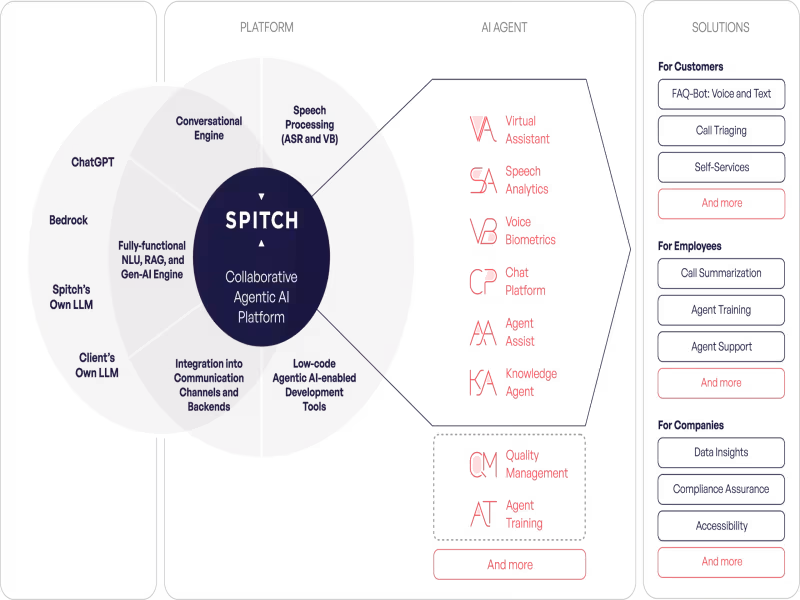
SHERIDAN, WYOMING -- June 24, 2026 -- Swiss AI specialist Spitch AG has published an analysis identifying a strategic reorientation among contact center operators: businesses are moving away from collections of isolated AI tools and toward unified, governance-capable platforms. The company, which offers a collaborative agentic AI platform for call and contact centers, attributes the shift to rising pressure around compliance, data sovereignty, and the need to scale AI deployments in a controlled and auditable way. The analysis positions conversational AI not as a standalone product experiment, but as a core enterprise function requiring structured oversight.
Enterprise Buyers Now Prioritize Control Over AI Capability
The central finding from Spitch's analysis is a change in what enterprise buyers are actually asking vendors to prove. According to the company, the operative question has moved from what AI can do, to which AI systems can be operated safely, scaled efficiently, and governed in a structured way. This shift matters for procurement decisions. Vendors that position themselves around raw capability face a different competitive environment than those that emphasize deployment controls and institutional fit.
Contact center operators in particular are seeking platforms that can unify disparate use cases under shared rules and processes, rather than deploying individual tools that sit outside enterprise governance frameworks.
Low AI Transformation Rates Fuel Demand for Platform Consolidation
Spitch cites external research data to characterize where most organizations currently stand in their AI adoption. According to figures attributed to Deloitte, only 34 percent of companies are using AI for deep-level business transformation. Another 30 percent deploy AI primarily for process optimization. Twenty percent are still running initial applications on a trial basis. That distribution — with the majority of enterprises still in early or limited deployment — helps explain why skepticism toward fragmented AI tooling is growing.
Companies in this position are not looking for more tools to evaluate. They want clear integration paths into existing workflows, measurable outcomes, and a rollout model they can control and audit. A unified platform that handles identity management, knowledge management, analytics, orchestration, and governance within one architecture addresses that need more directly than a portfolio of point solutions.
Data Sovereignty and Regulatory Compliance Drive Vendor Selection
Data sovereignty has become a material selection criterion. Spitch's analysis cites market research indicating that 77 percent of enterprises consider the country of origin of an AI vendor to be an important factor in procurement decisions. For European organizations, local data hosting, transparent processing, and adherence to EU regulatory requirements are non-negotiable conditions.
This creates structural advantages for vendors headquartered and operating within the European regulatory perimeter. It also raises the bar for non-European providers seeking to serve regulated industries. Compliance cannot be added retroactively. It has to be built into the platform architecture from the outset, which gives established European AI companies a defensible position as enterprise buying criteria tighten.
Public Sector Consolidation Faces Governance and Legacy System Hurdles
The consolidation trend extends into the public sector. Spitch references Gartner projections that at least 80 percent of government agencies will deploy AI agents to automate routine decision-making by 2028. The path to that outcome, however, runs through significant structural obstacles.
Forty-one percent of government bodies surveyed identify siloed strategies as the primary barrier to digital adoption. Thirty-one percent cite outdated IT infrastructure. These numbers point to a sector where technology procurement alone is insufficient. Successful AI deployment in government settings requires a governance and platform strategy that runs parallel to the technical implementation — otherwise new tools get absorbed into the same fragmented environment that created the problem in the first place.
Collaborative Human-AI Teams Defined as the Winning Deployment Model
Spitch frames collaborative agentic AI as the design principle most likely to determine which organizations extract lasting value from their AI investments. In this model, AI agents handle routine tasks, data retrieval, and analysis, while human staff retain authority over complex decisions. Transparency in process design and clear human oversight mechanisms are described as preconditions for building institutional trust in automated systems.
The company draws a distinction between AI deployments built for demonstration and those built for sustainable enterprise operation. The latter requires auditability, defined limits on autonomous action, and the ability to intervene at any point in the workflow. That framing also describes the positioning of Spitch's own platform, which combines AI automation with what the company refers to as a human-in-the-loop approach.
Spitch Targets Regulated Industries With Open Modular Platform
Founded in 2014 and headquartered in Zurich, Spitch operates internationally with a focus on companies that face high compliance and service quality requirements. Its platform is built on an open, modular architecture intended to support the automation of customer interactions and the integration of AI across customer service processes.
The company's service model includes strategic advisory and professional services alongside the platform itself — a structure designed for organizations that need implementation support rather than just software licensing. That combination targets the segment of the market where deployment complexity and regulatory exposure are highest.