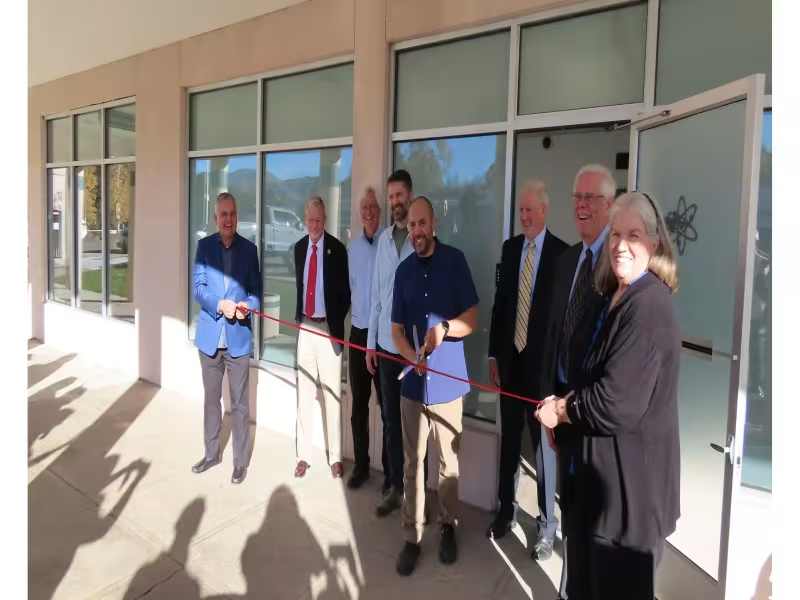
LOS ALAMOS -- November 24, 2026 -- Space Nuclear Power Corp. (SpaceNukes) opened a Manufacture and Materials Development Facility at 150 Central Park Square in Los Alamos on Nov. 13 to make refractory-metal parts for its Generation 2 space nuclear reactor. The company has roughly 15 full-time employees and more than $50 million in contracts and agreements with the Department of War and NASA. That works out to more than $3.3 million in contracts per employee.
The opening came 23 days after SpaceNukes announced, on Oct. 21, an agreement with the Defense Advanced Research Projects Agency under its Fast Capacitance (Fat Cat) program. Under it, the company will design, build and ground-test an actively controlled Kilopower reactor with Los Alamos National Laboratory. The company says it is working to fly a nuclear reactor by 2028.
Refractory alloys, not nuclear physics, set the Generation 2 limit, SpaceNukes says
The company says the radiator makes up most of the mass of a space fission power system. Raising the temperature at which heat is rejected lets a radiator of the same size shed roughly six times as much heat, according to SpaceNukes. Power conversion hardware already sits at the edge of what nickel-based superalloys tolerate over a long mission, the company says. Going hotter means moving to alloys of tungsten, molybdenum, tantalum, rhenium and niobium.
"The limit is metal," CEO Andrew Phelps said. He says the physics was proven in 2018. In March 2018, the team that is now SpaceNukes ran a space reactor at full temperature and power for 28 hours, according to the company.
Parts that no supplier sells are moving in-house
SpaceNukes says these metals are difficult to form and that many of the component shapes and materials it needs cannot be bought from any supplier. The new facility handles additive manufacturing of nickel-based and refractory alloys. It handles no radioactive material.
Omar Mireles, director of manufacture and materials, leads the facility and heads the Generation 2 program. He spent 13 years as a research engineer and principal investigator at NASA's Marshall Space Flight Center. There he led the $25 million Refractory Alloy Additive Manufacturing Build Optimization project. That single project cost more than the under $20 million SpaceNukes says it took to bring its 2018 reactor from concept to full power in three years.
Mireles said additive manufacturing suits parts that are highly complex, made from hard-to-form materials, produced in low volumes and open to design changes. He said the liquid rocket engine community learned these lessons over two decades and that SpaceNukes' needs are similar.
Ohio site tests the hardware Los Alamos will make
The Los Alamos facility complements SpaceNukes' integration and test facility in Medina, Ohio, led by chief engineer Marc Gibson. SpaceNukes is now building hardware there to test components for its Generation 2 reactors.
The company's contract backlog is now more than 2.5 times the under $20 million it spent on the 2018 reactor, by our calculation. It also has two completed Space Force design reviews and a Los Alamos National Laboratory license for the reactor technology its founders invented there.
The company did not disclose the facility's cost or the operating temperature targeted for the Generation 2 reactor.
The grand opening included remarks from Phelps and Mireles, a ribbon cutting and tours. Guests included staff from the office of Sen. Martin Heinrich, D-N.M., Los Alamos National Laboratory and its Feynman Center for Innovation, and the Los Alamos County Council.