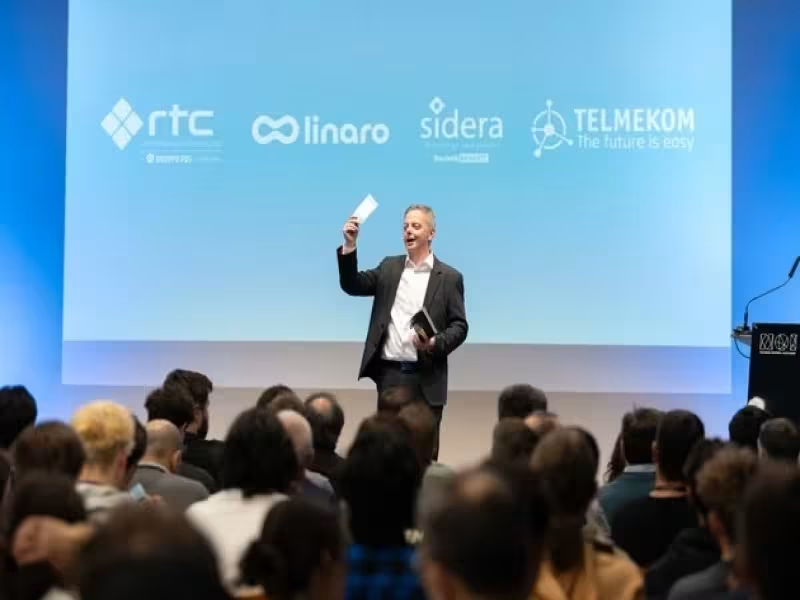
BOLZANO -- November 25, 2026 -- The 26th SFSCON, the South Tyrol Free Software Conference, drew more than 1,200 participants and over 160 speakers to the NOI Techpark in Bolzano on November 13 and 14, with digital sovereignty as its main theme. That works out to roughly 7.5 attendees per speaker, based on the minimum figures the organizers published.
The organizers say the aim was to discuss how Europe can become more independent, secure and competitive through free software and open technologies.
Four academic institutions joined the SFSCON programme for the first time in 2026
According to the organizers, 2026 was the first year of cooperation with the Martin-Luther-Universität Halle-Wittenberg, the Just Transition Center, Bucerius Law School and the Weizenbaum Institute in Berlin. The central topics were open-source hardware, the right to repair and the EU's Cyber Resilience Act.
Legal scholar Lucas Lasota spoke on software freedom and device neutrality. Technology historian Artemis Yagou covered the history and culture of source code.
Linaro and Hooghiemstra & Partners speakers addressed AI infrastructure and EU strategy
Davide Ricci, vice president and general manager of Linaro, presented how companies can build their own AI infrastructure with open technologies while keeping control of their data. That is the framing the organizers give his talk.
Walter van Holst, senior adviser at the law firm Hooghiemstra & Partners, asked whether digital sovereignty is conceivable without open source. He compared the open-source community's ideas with the EU Commission's current sovereignty strategy. The release does not report his conclusion.
Patrick Ohnewein, chief digital officer of the NOI Techpark and chair of SFSCON, said sovereignty comes from people writing code, shaping rules and putting solutions into practice, not from declarations of intent. He described open source as a lever for innovation, competitiveness and resilience across Europe.
Harald Welte received the European SFS Award after speaking on open mobile networks
Welte, who described himself as a pioneer of free software in telecommunications in the conference programme, spoke on open mobile networks and the protection of open-source licences. He also won the European SFS Award, presented by the Free Software Foundation Europe and the Linux User Group Bozen-Bolzano-Bulsan. The organizers say he was the first to enforce the GNU GPL licence in court. He is also a co-founder of the Osmocom project, which makes mobile technology accessible that otherwise stays closed.
Daniele Gobbetti received the SFS Award. He is one of the central developers of Gadgetbridge, a free app that connects smartwatches and fitness trackers to a smartphone without storing personal data.
A 24-hour hackathon brought in students from five countries
The NOI Hackathon ran as a 24-hour programming marathon in which young developers build digital solutions to challenges from business practice. Through a cooperation with the SUNRISE Alliance, a European university alliance, students from Portugal, Poland, Cyprus, Germany and Italy took part.
The EU co-finances SFSCON under the EFRE project 1114 IMPACT 2. The organizers did not disclose the amount of the co-financing.