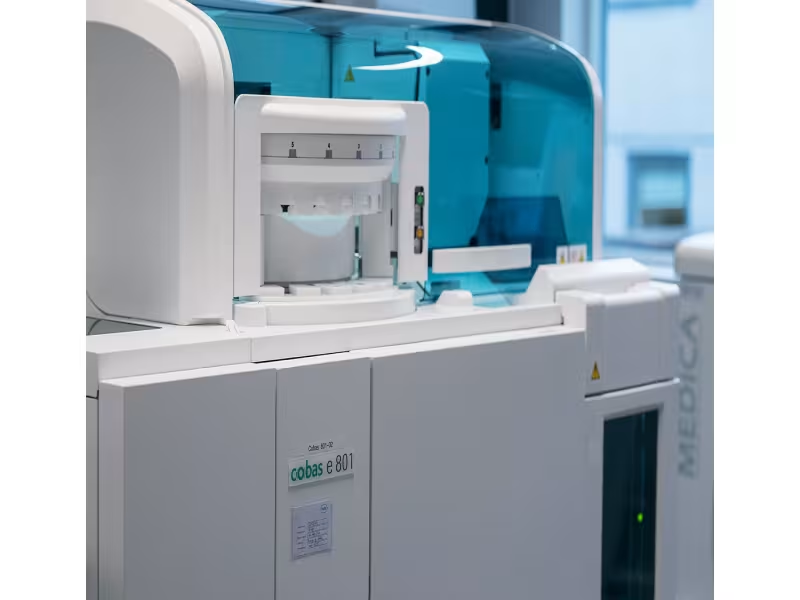
HERLEV -- November 24, 2026 -- Roche Diagnostics is making a research prototype of the Endotrophin (ETP) assay available on its cobas e801 analyzers at Nordic Bioscience's CLIA lab, the Danish biomarker company said on November 16, 2026. ETP is the second biomarker from the two companies' collaboration to reach the Roche platform, after Elecsys PRO-C3, which is available as a CE-marked test.
The assay is a sandwich immunoassay that quantifies the intact 77-amino-acid Endotrophin, a signaling pro-peptide released during the formation of type VI collagen. Nordic Bioscience says Endotrophin is associated with fibrosis, inflammation and adverse outcomes in cardiovascular, kidney and metabolic disease.
Endotrophin reaches Roche's platform at an earlier stage than PRO-C3
The two assays sit at different points. PRO-C3 carries a CE mark. The release describes ETP only as a research prototype and names no CE mark or FDA clearance for it. Access is also narrow: the prototype runs at Nordic Bioscience's own CLIA lab, and the release does not extend it to other laboratories. The company did not disclose a timeline for a commercial ETP test.
Nordic Bioscience cites data from more than 50,000 patients
According to the company, Endotrophin has been measured in more than 50,000 patients with cardio-kidney-metabolic disease. In heart failure with preserved ejection fraction (HFpEF), elevated levels have been associated with mortality and adverse outcomes. The FDA has issued a letter of support for continued research of Endotrophin as a trial enrichment tool in HFpEF. By the release's description, that letter covers research use of the biomarker, not clearance of the Roche assay.
A study by Yoshiji and colleagues, published in Circulation in 2026 and presented as Abstract 6394 at the AHA Scientific Sessions 2026, reports that Endotrophin captures fibroinflammatory risk beyond PREVENT and NT-proBNP in adults with obesity. In chronic kidney disease, the company says Endotrophin levels rise with disease activity, high levels predict eGFR decline, and changes in Endotrophin track changes in kidney function.
CEO Karsdal calls Endotrophin a treatment target as well as a marker
Nordic Bioscience cites three lines of evidence for a causal role. Mendelian randomization studies link Endotrophin to coronary artery disease. Knock-out models show protection against kidney fibrosis and loss of kidney function. CD44 has been identified as the Endotrophin receptor.
CEO Morten Karsdal says Endotrophin may be the best biomarker for cardio-renal syndrome and a treatment target. "We see it as a new TNF-alpha story," he said.