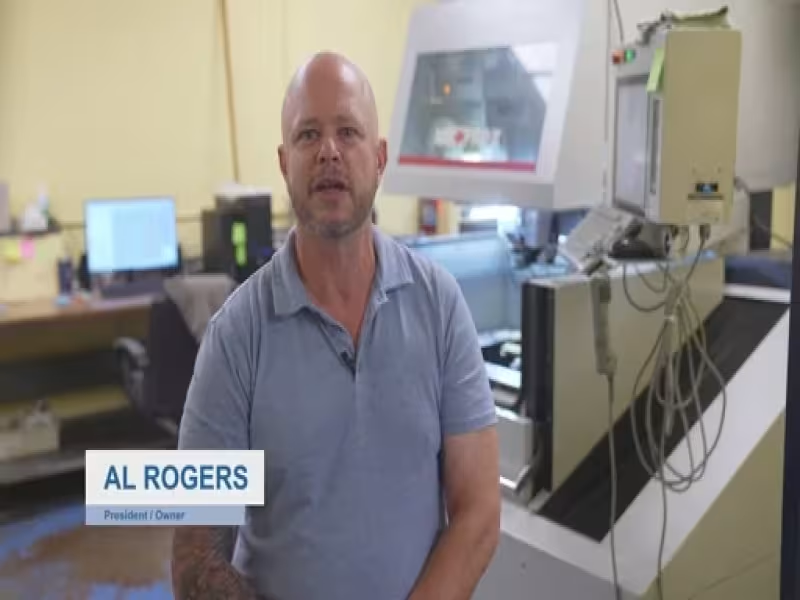
Rochester – November 10, 2026 -- Progressive die stamping combines punching, bending, forming, trimming and piercing in one continuous workflow, allowing manufacturers to produce large runs of identical metal parts with tight tolerances, according to Al Rogers of CAR Stamping & Machining.
Rogers, a precision metal stamping expert based in Rochester, New York, outlined the process in a HelloNation article.
One die replaces multiple separate setups
A metal strip feeds through a progressive die, and each station performs a specific operation. With every press stroke the material advances, and the finished part separates at the final station. Combining several forming and cutting operations in one tool removes many of the setup and handling steps required by other stamping methods, which speeds production and reduces variation between parts.
Tooling investment pays back as volumes grow
Designing and building the tooling requires careful planning and engineering. The article states that the investment becomes more valuable as production quantities increase. Once the tooling is complete, manufacturers can produce finished components quickly and lower the cost per part over extended runs.
Die design accommodates steel, aluminum, copper and brass
Manufacturers may work with steel, stainless steel, aluminum, copper, brass and other alloys, depending on the component's requirements. Each die is engineered for the selected material to maintain dimensional accuracy through every stage of production.
Four factors decide when the method fits
The article names production volume, part complexity, material type and quality expectations as the key selection criteria. Progressive die stamping is often preferred when multiple forming operations are required and high volumes demand dependable consistency.
The process is widely used in automotive, aerospace, electronics and industrial equipment manufacturing, the article notes. In these sectors, parts must fit together precisely and perform reliably under demanding conditions.