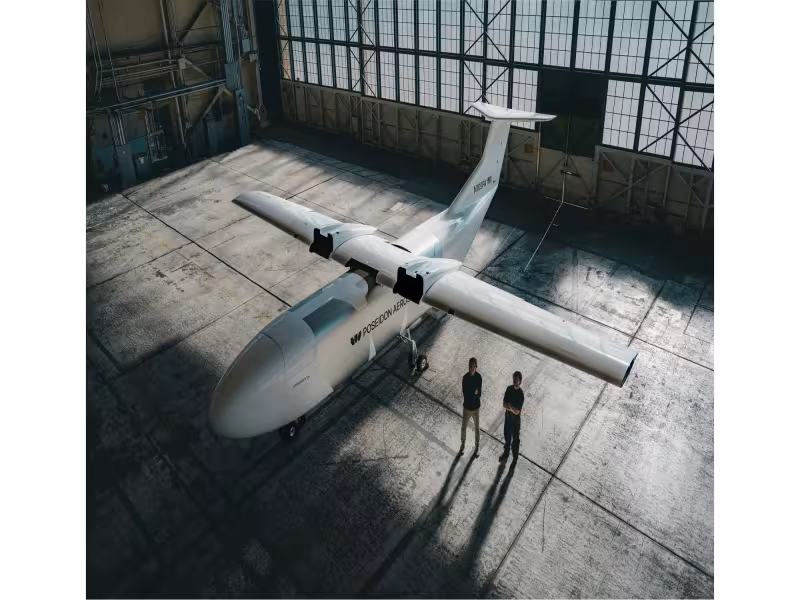
BOSTON -- November 24, 2026 -- Poseidon Aerospace cut the time needed to build an aerodynamic database for its Egret autonomous cargo aircraft from eight months to three weeks, Flexcompute said on November 17. Using 30-day months, that is a reduction of about 91%, from roughly 240 days to 21, or about 11 times faster by our calculation.
Poseidon also ran 10x more simulations with Flexcompute's GeometryAI and Flexcompute Flow (formerly Flow360), according to Flexcompute.
Later design study took 8.4 days against an estimated 200
In a subsequent design study, Poseidon's team finished in 8.4 days on Flexcompute Flow with cloud GPU computing. The company estimates its prior workflow would have needed 200 days. That works out to about 23.8 times faster and about 192 days saved. The release's summary table rounds the gain to 25x.
The 200-day figure is an estimate, not a measured run.
GeometryAI shortens manual geometry cleaning from a week to 15-30 minutes
GeometryAI prepares aircraft geometry for simulation. Poseidon says manual cleaning previously took about one week and now takes 15 to 30 minutes.
Rohan Sharma, VP of Engineering at Poseidon, describes a three-part chain: GeometryAI prepares the geometry, Flexcompute Flow returns results, and an internal Python workflow with an AI agent connects the steps. The aim, he says, is "less time managing tools and more time engineering the aircraft." He describes Poseidon as a small engineering team.
Flexcompute says the faster loop gave Poseidon a more accurate picture of lift, drag and flight dynamics. It says this allowed faster tuning of the aircraft's flight-control systems.
Poseidon raised $60 million in September, 80% of its total funding
Poseidon was founded in 2024 and is based in Alameda, California. It has raised $75 million to date. A $60 million Series A in September 2026, led by TQ Ventures, accounts for 80% of that total.
Egret is a 50-foot unmanned freighter that carries 4,000 lb of cargo. Poseidon says it is built to operate from short paved or unpaved strips.
Flexcompute calls its approach a Physics Twin: a virtual representation of an aircraft design, grounded in established physics, that is used from the design stage rather than to monitor an aircraft after it is built. It describes the Poseidon work as an early example. Poseidon says the added simulation capacity is meant to speed validation ahead of flight testing.
Neither company disclosed when Egret is scheduled to begin flight testing.