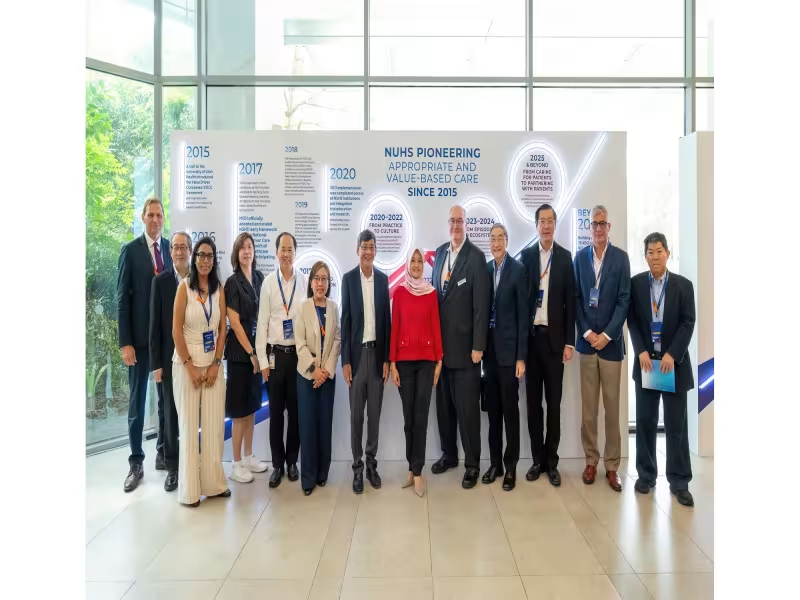
Singapore – September 17, 2026 -- The National University Health System (NUHS) has treated more than 300,000 patients under its value-based care framework over the past decade, cutting hospital bed days by 18,225 and generating over SG$13 million in annual cost avoidance.
NUHS marked the milestone at its Appropriate and Value-Based Care (AVBC) Symposium 2026, officiated by Mdm Rahayu Mahzam, Minister of State for Digital Development and Information and for Health. The event tracked the evolution of Singapore's Value-Driven Outcomes (VDO) framework, which NUHS first adopted in 2015 as the country's first healthcare cluster to do so.
VDO framework prevents 793 emergency readmissions since 2015
Since its 2015 launch with 14 pilot conditions at the National University Hospital (NUH), the VDO methodology has expanded to cover more than 75 clinical conditions, service lines and population health programmes across primary, secondary and tertiary care. The model prevented 793 emergency readmissions within 30-day windows and was adopted nationally through the Ministry of Health's National Value-Driven Care programme in 2017, which began with 18 conditions before scaling to public acute hospitals cluster-wide.
"A decade in, the data speaks for itself: when you measure what matters to patients, the system works better for everyone," said Adj A/Prof Diarmuid Murphy, Group Chief Value Officer, NUHS.
NUHS@Home shifts 11,400 patients from wards to home care since 2020
NUHS@Home, the system's Mobile Inpatient Care at Home programme, has treated over 11,400 patients and saved more than 68,200 hospital bed days since 2020. Among patients tracked between May 2022 and June 2026, 87% completed care at home without hospital return, the 30-day readmission rate stood at 9.3%, and over 95% said they would recommend the service.
Virtual Care Centre triages 6,000 calls, cuts ED referrals to 13.5%
The Virtual Care Centre, launched by Alexandra Hospital as a post-discharge helpline, has handled more than 6,000 medical calls since 2020. Of these, 60% of callers were advised to continue monitoring their condition, while only 13.5% required referral to emergency services, freeing Emergency Department capacity for acute cases.
Total Knee Replacement outcomes improve as length of stay halves
Early VDO pilot data on Total Knee Replacement (TKR) care at NUH showed perioperative blood transfusion rates falling from 12.52% in 2017 to 3.58% in 2021, while venous thromboembolism prophylaxis rates rose from 90.05% to 95.02% over the same period. Length of stay for TKR patients dropped from four-to-five days to one-to-two days. Parallel Enhanced Recovery After Surgery protocols at Ng Teng Fong General Hospital achieved comparable reductions, enabling patients to return home within one to two days versus four to five days previously.
Stroke recovery data reveals hidden anxiety and fatigue burden
Patient-Reported Outcome Measures collected from young adult stroke survivors aged 18-60 at NUH found anxiety symptoms in 39.4% of patients, pain interference in 31.5%, depressive symptoms in 26.8%, fatigue in 24.4% and sleep disturbance in 16.5%. NUHS is now combining these patient-reported metrics with clinical outcomes data to identify care gaps not captured by standard functional recovery or readmission measures.
NUHS also launched two publications at the symposium: "A Practical Framework for Measuring Health Outcomes at the National University Health System, Singapore: The First Decade of Our Journey" and the "NUHS Clinical Outcomes Book," the latter described as the first of its kind in Singapore.