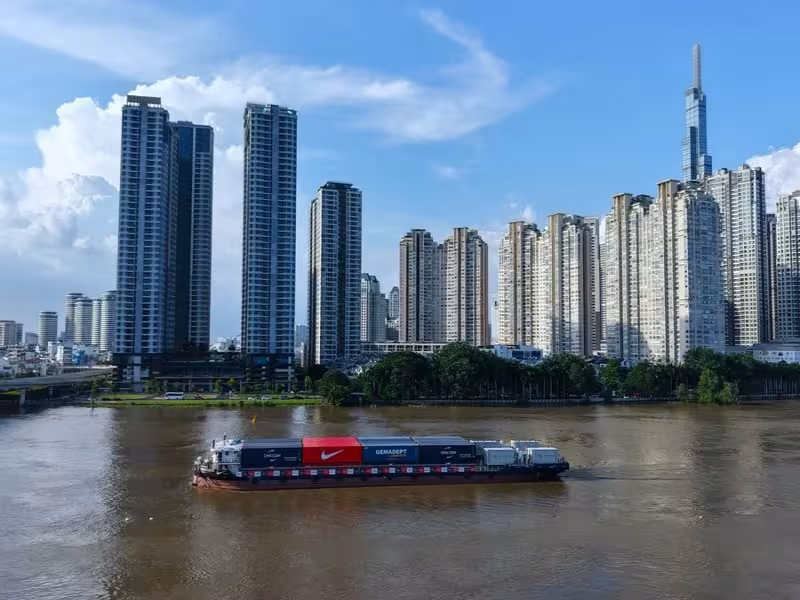
HO CHI MINH CITY — November 19, 2026 -- Nike is launching a fully electric inland waterway service in Vietnam with CMA CGM and Gemadept, and expects the electric barge to avoid about 778 tons of CO2 emissions a year. By our calculation, that works out to roughly 2.1 tons per calendar day (778 tons divided by 365 days).
The barge connects Nike's inland drop-off location in Ho Chi Minh City with the Gemalink deep-sea terminal in Cai Mep. The round trip is more than 100 miles. According to Nike, the route produces zero direct greenhouse gas emissions. The service combines the electric barge, dedicated charging infrastructure and renewable electricity.
The barge recharges on solar power from a farm at the Gemalink terminal
Nike says the batteries are recharged with certified renewable electricity supplied through a solar farm at the terminal. The 778-ton figure is Nike's own estimate, and the company did not disclose the baseline it was measured against, or the barge's capacity, trip frequency or investment cost.
Nike Chief Sustainability Officer Cimarron Nix describes the project as an example of turning partnerships into practical emissions cuts that also strengthen supply chain resilience.
Nike says transport emissions fell 56% in FY25 against FY20
Nike names transportation as one of four areas of its emissions work, alongside materials, manufacturing and its own operations. The company says its transport measures include reducing air freight, scaling lower-carbon maritime fuels and expanding the use of electric vehicles. Together, it says, these cut emissions from inbound and outbound transportation by 56% in FY25 compared with FY20. By our calculation, that leaves transport emissions at about 44% of the FY20 level.
Nike's 2030 Science-Based Targets include a 35% reduction in emissions across its extended supply chain, also from an FY20 baseline. The 56% transport reduction is 21 percentage points above that 35% figure. The two numbers cover different scopes, since one measures transportation only and the other the extended supply chain, so they are not directly comparable.
Against the 56% transport reduction, the barge's estimated 778 tons covers a single route between Ho Chi Minh City and Cai Mep. Nike lists the barge as one example within a wider set of transport measures that also covers air freight, maritime fuels and electric vehicles.