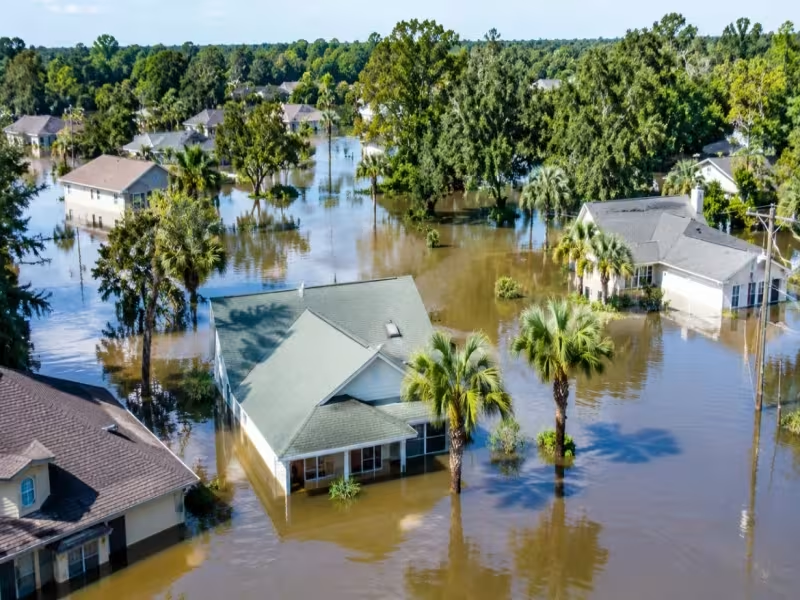
UNITED STATES -- November 24, 2026 -- A U.S. Government Accountability Office (GAO) report from October 2026 estimates that about 13 million properties with high modeled flood risk lie outside FEMA's designated high-risk areas, and National Flood Insurance Program (NFIP) coverage there stands at 2%. The figures appear in an analysis of flood insurance claims by the law firm Anidjar & Levine.
Inside designated high-risk areas, NFIP coverage is estimated at 43%. That is about 21 times the outside-zone rate, by our calculation. The GAO figure excludes private flood policies, so it does not measure total insurance protection.
Heavy rainfall drives most modeled risk outside FEMA hazard areas
The GAO flood-type analysis covered almost 12.8 million modeled high-risk properties outside Special Flood Hazard Areas. Heavy rainfall was the primary risk for 62% of them. That works out to roughly 7.9 million properties.
As of April 2026, approximately 86% of properties classified as high-risk through modeling were estimated to lack NFIP coverage.
Texas posts the highest share of claims outside high-risk zones
Anidjar & Levine examined residential NFIP claims with identifiable flood-zone classifications for 2014 to 2024. Across the United States, 28.1% of those claims came from properties outside designated high-risk areas. A separate FEMA benchmark puts the share at 29% for all NFIP claims in the same period. The firm's figure covers residential claims only.
Texas recorded the highest share among the 30 qualifying states at 52.1%, followed by Maryland at 45.9% and New York at 39.0%. Texas's index score of 185.0 means its share is 85% above the national benchmark. Ten states exceeded the national residential benchmark, including inland states such as Ohio, Tennessee, Wisconsin and Oklahoma.
Florida's claim share is low, but its outside-zone payouts reach $598.4 million
Florida ranked 30th of the 30 states, with 11.4% of classifiable residential claims coming from outside high-risk areas and an index score of 40.6. The study identified 17,265 outside-zone residential claim records in Florida, against 138,288 nationwide. Positive payments on the Florida records totalled $598.4 million, or about $34,700 per record by our calculation. The release gives a figure of $7.20 billion for the rest of the country.
County shares vary widely. Bay County recorded 48.3%, more than four times the state figure. Polk County recorded 40.5%, Orange County 39.6%, Seminole County 36.8%, Duval County 30.6% and Volusia County 29.2%.
In Gulf County, the median paid household flood claim outside designated high-risk areas was $81,497. That equals 133.2% of the county's median annual household income of $61,179. The release does not state the period or the number of claims behind the Gulf County median.
Standard NFIP policies exclude living expenses and cap payouts at $350,000
Eligible household policies provide building coverage of up to $250,000 and contents coverage of up to $100,000, a combined ceiling of $350,000. Standard NFIP policies do not cover additional living expenses, so temporary housing costs fall to the policyholder.
Primary residences made up 83.5% of outside-zone residential claim records nationally and 78.3% in Florida. In 2024, the national median positive household claim payment outside designated high-risk areas was $43,948. Florida's median was $26,126, about 59% of the national figure by our calculation. Manatee County's median was $43,436.
Anidjar & Levine notes that the claims data describes the distribution of historical insured claims, not the probability that an individual property floods.