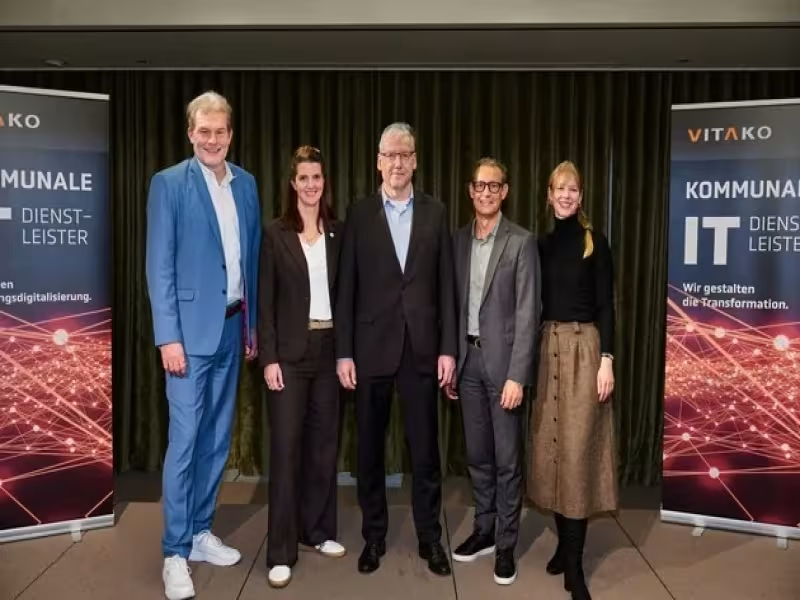
BERLIN -- November 25, 2026 -- The network VITAKO put eight named speakers on stage for its conference on municipal cybersecurity, and ITDZ Berlin used the slot to set out four components it says local cyber defence rests on. Speakers came from the Federal Office for Information Security (BSI), ekom21, eGo-MV, govdigital, SIS Schwerin and VITAKO itself. Four of them joined the closing panel, which a fifth, VITAKO managing board member Lars Hoppmann, moderated.
ITDZ Berlin derives four requirements from the attack on Berlin's Senate administrations
Dr. Tim Freyer, head of communication services at ITDZ Berlin, the capital's central IT provider, reported on the cyberattack on the Berlin Senate administrations. He said it shows that municipal cybersecurity rests on four components:
- operational cybersecurity anchored in one place, with sovereign data and infrastructure;
- an independent, technically autonomous position responsible for governance and business continuity management;
- central audit and control powers held by existing state-level expert bodies;
- funds reserved for cybersecurity within a digital budget.
The release gives no date, scope or damage figure for the attack.
BSI says municipal protection levels remain too uneven
Stefanie Euler, head of unit I 12 (implementation advice for states and municipalities) at the BSI, presented Grundschutz++, advisory services and the Cyberdome. She said the threat to public administration keeps rising, partly because AI automates attacks. In her assessment, municipal protection levels are still far too heterogeneous. She urged every municipality, regardless of size, to start now. As an entry point she named the BSI's "Weg in die Basisabsicherung" guidance.
Mecklenburg-Vorpommern law makes an information security management system binding
Frederik Meyer of eGo-MV described the state's new information security law. It obliges state and municipal bodies to take comprehensive security measures and to run a binding information security management system (ISMS). Meyer named shared standards, central structures, reporting channels, training and technical solutions as its basis.
Other speakers covered cooperation models. Bastian Schäfer of ekom21 presented Hessen3C. Dr. Isabel Skierka-Canton of govdigital described networking public IT providers, shared cybersecurity services and Cyberdome trials, which she said enable a cross-organisation threat picture. René Schülke of SIS Schwerin showed a tool that merges management systems into one integrated system for decision-makers.
VITAKO asks for permanent funding, matching ITDZ Berlin's fourth component
VITAKO chairman William Schmitt, who also chairs Komm.ONE, said no municipality can meet the challenges alone and that municipal IT providers must pool expertise. The panel concluded that providers will keep bundling their efforts to offer municipalities more shared services.
VITAKO's closing statement calls for reliable, permanent funding, above all at municipal level, that does not depend on annual budget debates. That demand parallels Freyer's fourth component, reserved cybersecurity money inside a digital budget.