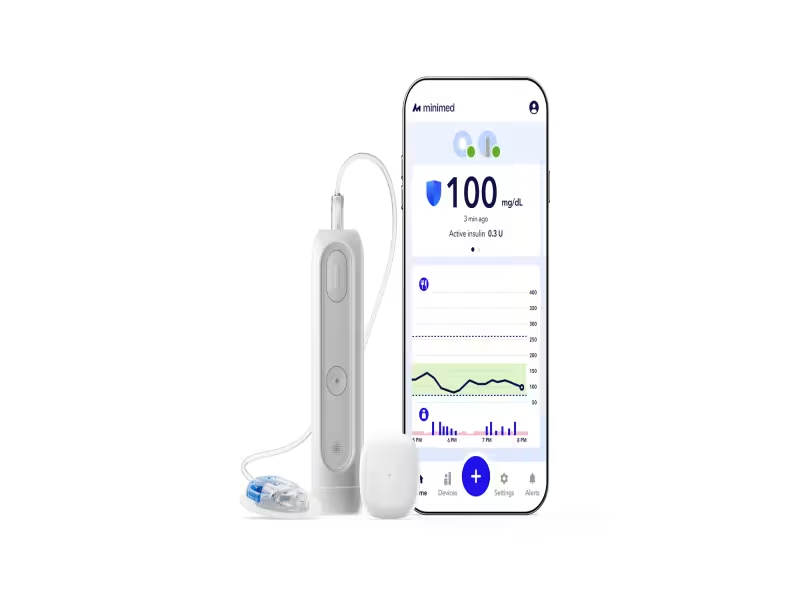
NORTHRIDGE, Calif. -- November 24, 2026 -- MiniMed (Nasdaq: MMED) began commercial shipments of its MiniMed Flex insulin pump across Europe on Nov. 17, 2026, after an initial customer experience phase in select markets. The screenless device is the company's first app-controlled pump. MiniMed says it is about half the size of its MiniMed 780G pump.
MiniMed Flex runs the 780G algorithm, so the cited outcomes come from 780G users
Flex uses the SmartGuard algorithm from the 780G system. It adjusts insulin delivery every five minutes based on readings from the MiniMed continuous glucose monitor. MiniMed says the 780G has been used by hundreds of thousands of people.
The clinical figures in the release all come from 780G studies, which the company calls relevant to Flex because the algorithm is the same:
- 80% time in range for real-world users with recommended settings
- More than 90% overnight time in range in a real-world study
- 9 of 10 users on optimal settings above the international goal of 70% time in range
- Automatically delivered insulin rising from 0% to 17.2% over three years
The 80% benchmark applies to users over 15 who ran a 100 mg/dL (5.5 mmol/L) glucose target and a two-hour active insulin time for at least 95% of the time. Flex is CE Marked from age two, so its labeled population is wider than the group behind that figure. Flex remains a hybrid closed-loop system, and users must still announce meals.
Flex holds 300 units and pairs with a seven-day infusion set
The pump holds up to 300 units of insulin and works with the Extended infusion set, which can be worn for up to seven days. MiniMed says this means up to 96% fewer injections than traditional therapy. The company's footnote assumes four injections a day for 30 days against one set change every seven days. By our calculation, that is 120 injections against about 4.3 set changes a month, a reduction of about 96%.
All primary functions run through an iOS or Android app. The pump has a rechargeable battery and is waterproof to 2.4 meters (8 feet) for up to one hour and 45 minutes. Wireless updates are meant to deliver future improvements, including a next-generation algorithm that is in development and not yet approved or commercially available.
The company did not disclose pricing, reimbursement terms or which countries are receiving shipments first.
Europe rollout starts with Simplera Sync, and Abbott's Instinct sensor follows in 2027
Flex is CE Marked for people aged two and older with insulin-treated type 1 or type 2 diabetes. It is also CE Marked for use during pregnancy. It is rolling out gradually across European markets.
Launch units pair with MiniMed's Simplera Sync sensor, which offers up to seven days of wear. Compatibility with Abbott's Instinct sensor is planned for 2027. Instinct is rated for up to 15 days of wear, about twice the Simplera Sync figure by our calculation.
Slobodan Radumilo, MiniMed's Senior Vice President and Chief Commercial Officer for EMEA and APAC, says the company plans to expand access in the coming months. Dr. Sharona Azriel, an endocrinologist at Infanta Sofia University Hospital in Madrid, reports that adults with long-standing type 1 diabetes responded well to a pump that stays out of sight in her early experience with the device.