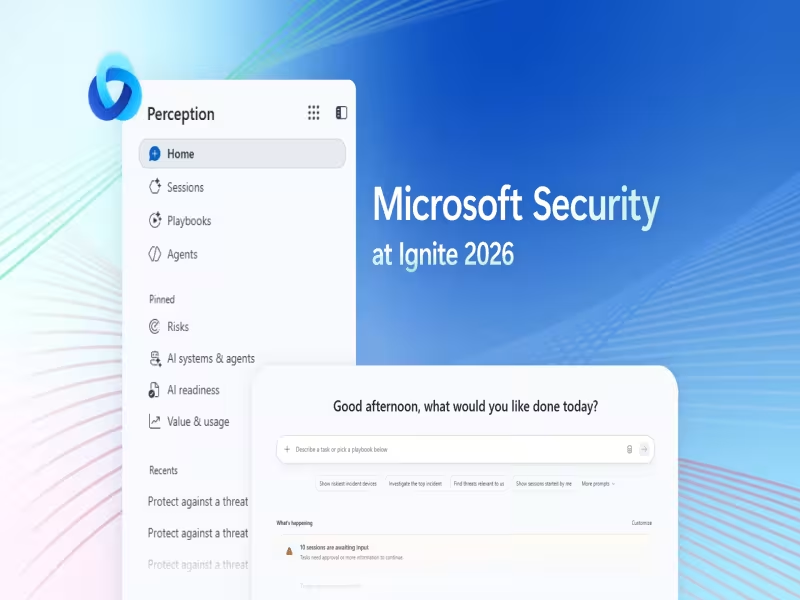
GLOBAL -- November 25, 2026 -- Microsoft has made Microsoft Perception, a platform that coordinates red, blue and green team AI agents through playbooks, generally available at its Ignite 2026 conference. Microsoft says more than 96,000 vulnerabilities have been published to the CVE Program in 2026, up from roughly 40,000 in 2024. By our calculation, that is an increase of about 140%.
Microsoft Perception puts red, blue and green agents in one loop
Red team agents simulate attacks before a breach. Blue team agents detect, triage and investigate. Green team agents fix and remediate. Microsoft says customers set the guardrails and sign off on high-impact actions, and automated triggers launch playbooks when an incident meets criteria the customer sets.
Six of the eight named agents are generally available, by our calculation:
- Blue team: Alert Triage Agent, Attack Investigation Agent, Detection Authoring Agent and Threat Intelligence Agent.
- Red team: Recon Agent (generally available); Web App Pen Test Agent (preview).
- Green team: Posture Prioritization Agent (generally available); Risk Reduction Agent (public preview).
Green team playbooks cover Microsoft, Amazon Web Services and Google Cloud. New cost dashboards and a cost estimator let customers track AI usage and forecast spending. Microsoft did not disclose Perception pricing.
PHP flaws show exploit timelines shrinking, Microsoft says
Microsoft points to two critical remote code execution vulnerabilities that PHP disclosed this fall. Tens of millions of internet-facing PHP services ran affected versions at disclosure. Nearly two weeks later, about 29 million remained vulnerable.
Security researchers built a working, weaponized exploit within roughly a day of the PHP2Shell disclosure, according to Microsoft. It says such work once took a specialist team months, and that the gap between discovery and exploit is shrinking "from months to minutes." Five other major disclosures landed the same day.
Defenders are not keeping pace. Only 26% of vulnerabilities in the Cybersecurity and Infrastructure Security Agency's Known Exploited Vulnerabilities catalog were remediated in 2025, per Microsoft, which means about 74% were not. The company says remediation typically takes weeks to months and attributes part of the CVE surge to AI-assisted discovery tools.
Vulnerability shielding targets the patch gap
Vulnerability shielding, now in preview, applies targeted, temporary protection to vulnerable assets until a permanent patch is installed. The Risk Reduction Agent proactively suggests shielding when patches are not immediately available. In supported scenarios, the protections can include changes to network accessibility and permissions.
Other releases are scheduled for January 2027:
- AI Readiness Initiatives in Perception, which turn Secure Now guidance into plans with shared progress tracking, enter preview.
- Enhanced data classification in Microsoft Purview becomes generally available.
- Grounding protection for Copilot based on sensitive information types enters preview. Microsoft says it lets customers adopt Copilot without labeling every file first.
- Expanded data loss prevention controls for prompts to Copilot and to local agents on Windows enter preview.
ISOC in Defender bundles Sentinel SIEM features for E5 and E7 customers
The Integrated Security Operations Center in Microsoft Defender is generally available for core capabilities. It combines SIEM, user and entity behavior analytics, threat intelligence, and threat protection and disruption. Eligible Defender Suite, Microsoft 365 E5 and Microsoft 365 E7 customers receive all Microsoft Sentinel SIEM features, 90-day default retention for Defender data, more than 500 connectors, reduced ingestion rates and a built-in data lake. The full breadth of SIEM capabilities is in preview.
Microsoft says its own and partner sources produce more than 165 trillion signals a day. That works out to roughly 1.9 billion signals per second. The company says these signals feed the context layer that the Perception agents draw on.