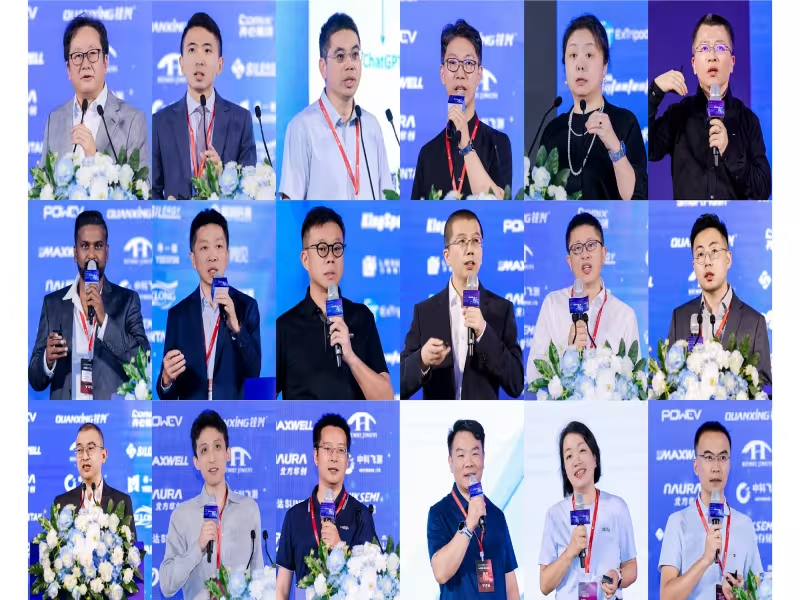
Shenzhen – September 27, 2026 -- Memory and storage executives from Samsung, Sandisk, Solidigm, Arm and Lenovo converged in Shenzhen on September 23 to argue that AI inference workloads, not training alone, are now the primary driver reshaping storage architecture demand. The 5th GMIF2026 Innovation Summit, co-hosted by the Shenzhen Memory Industry Association (SMIA) and Peking University's School of Integrated Circuits, drew IDMs, controller makers, OSATs, and AI infrastructure vendors under the theme "The Future Built on AI Memory and Storage."
SMIA marks five years of GMIF as agenda shifts toward AI-driven supply chains
SMIA President Rixin Sun opened the summit by reviewing its growth since founding in 2019, noting the event has expanded in scale and industry reach each year. Sun said SMIA will pursue a more specialized approach going forward, linking storage suppliers with AI compute and end-user application companies to drive supply-demand matching.
Morgan Stanley flags rising memory share of AI capex as "memory wall" challenge grows
Daniel Yen, Executive Director at Morgan Stanley, said generative and agentic AI are pushing up complexity in model weight loading, KV cache management, and data scheduling, lifting memory and storage's share of AI capital expenditure. Peking University's Prof. Yimao Cai pointed to high-bandwidth flash (HBF) and heterogeneous architectures combining HBM, NAND, and RRAM as emerging responses to capacity, bandwidth, and cost pressures from large-model inference.
Samsung, Sandisk, and Solidigm detail SSD roadmaps built around KV cache and tiering
Samsung Memory China CVP Kevin Yoon outlined progress on Z-NAND, PCIe Gen6 SSDs, and ultra-high-capacity data center SSDs designed to tier storage media for KV cache and model weight storage under agentic AI workloads. Sandisk's Maya Zhang said NAND flash is becoming central to AI infrastructure as multimodal models and long-context processing expand cache demands, with QLC technology set for broader adoption. Solidigm's Benny Ni said memory offloading and data tiering with high-capacity QLC SSDs are becoming core components of AI system architecture as inference complexity climbs.
Arm, Silicon Motion, and BIWIN highlight storage's expansion from cloud to edge devices
Arm's John Xavier Lionel said AI deployment will increasingly span cloud, edge, and device as small models and heterogeneous NPUs advance, giving local storage a larger role in hosting model weights and knowledge bases. Silicon Motion's Stanley Huang described controller and scheduling technologies improving storage efficiency across enterprise SSDs, mobile UFS, autonomous driving, and robotics. BIWIN Chairman Sam Sun said AI is driving distinct storage demands across data centers, edge, and endpoints, citing Mini SSDs and wide-temperature industrial SSDs as product responses.
Lenovo frames enterprise AI buildout as "token factory" operations challenge
Lenovo ISG China's Tao Zhou said sustaining stable token output has become a critical priority as enterprise AI moves from proof-of-concept to large-scale deployment, requiring top-level design, data governance, and pooled training/inference resources. Infplane CTO Wei Xiong said hot/cold data tiering can shift more inference workload onto SSDs to reduce memory footprint and improve token output efficiency.
Application vendors show AI storage integration reaching automotive and enterprise workflows
SYNCORE's Junjia Chen discussed agent architecture in smart cockpit and vehicle-wide intelligence applications. Dify APAC General Manager Lusha Chen introduced a "workflow plus agent" model connecting large models with enterprise knowledge bases and business systems. Paratera's Gongjie Liu detailed multi-model access and enterprise AI services built around a MaaS platform, while OKN Technology's Ming Zhao described test equipment evolving to support PCIe 6.0 SSDs and higher-speed AI workload simulation.