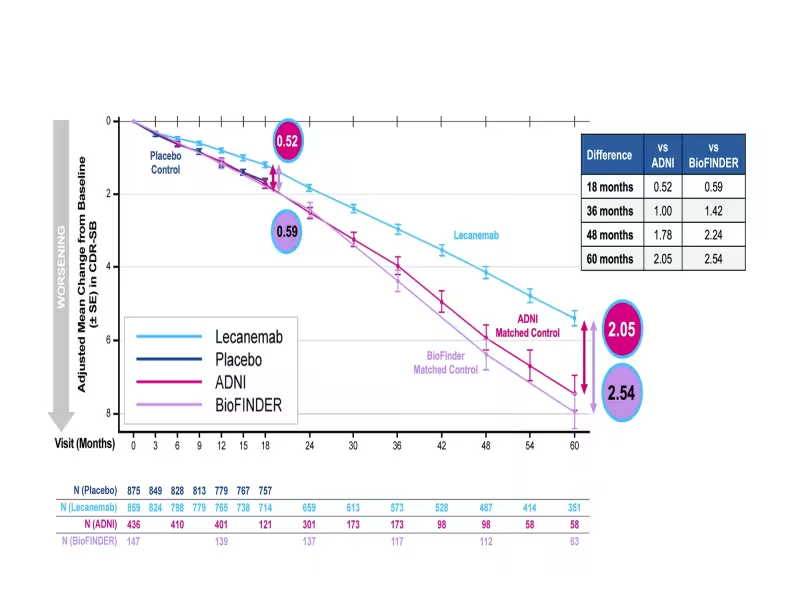
TOKYO -- November 24, 2026 -- Five years of continuous lecanemab treatment left 61.9% of patients progressing to the next stage of Alzheimer's disease, against 77.5% in a natural-history cohort from the Alzheimer's Disease Neuroimaging Initiative (ADNI), Eisai and Biogen reported at the 19th Clinical Trials on Alzheimer's Disease (CTAD) conference in Boston. The companies put this at a 36% relative risk reduction, measured by CDR-SB staging.
The data cover 351 patients from the Phase 3 Clarity AD study who stayed on treatment through the 18-month core study and the long-term extension (LTE). By our calculation, that is about 39% of the 898 patients randomized to lecanemab (10 mg/kg intravenously every two weeks). Clarity AD enrolled 1,795 patients in total, and 897 were assigned to placebo. Of those who completed the core study, 95% chose to join the LTE.
The five-year comparison is not against placebo. The placebo-controlled phase ran 18 months, so the longer-term benchmarks are external cohorts: ADNI and BioFINDER, a study led by Lund University in Sweden. The companies note that all BioFINDER subjects are at the MCI stage and have lower baseline CDR-SB scores than the trial population.
Lecanemab patients declined 2.05 CDR-SB points less than the ADNI benchmark at five years
Against ADNI, the difference in mean change from baseline was 1.00 points at three years, 1.78 at four and 2.05 at five. Against BioFINDER, it was 1.42, 2.24 and 2.54 points. The companies say the benefit continues to accrue over time.
The yearly increments are shrinking. The ADNI gap widened by 0.78 points between years three and four, then by 0.27 between years four and five. The BioFINDER gap widened by 0.82, then by 0.30.
The headline relative-risk figures also differ from the raw percentages. For progression from MCI to mild dementia, or from mild to moderate dementia, 61.9% against 77.5% is a 15.6-point gap and a relative difference of about 20%. The companies report 36%. For progression to moderate or severe dementia, 31% against 48.7% is a 17.7-point gap and a relative difference of about 36%. The companies report 49%.
Low-tau patients show 62% improvement on CDR-SB after five years of lecanemab
An optional tau PET substudy identified patients with low tau accumulation, who are considered to be at an earlier stage of the disease. In that group, 66% showed no decline on CDR-SB at five years and 62% showed improvement. On the ADAS-Cog14 cognition scale, 55% showed no decline and 52% improved. On the ADCS MCI-ADL daily-living scale, 69% showed no decline and 62% improved.
The companies say the results suggest that starting and continuing treatment at earlier biological stages may help slow clinical decline. The release does not state how many patients are in the low-tau group.
ARIA-E incidence falls from 13.5% in year one to 0.6% in year five
Incidence of amyloid-related imaging abnormalities with edema/effusion (ARIA-E) was 13.5% in the first 12 months. In the following 12-month intervals it was 3.6%, 1.1%, 1.3% and 0.6%. The placebo group recorded 1.7% over 18 months. The year-one rate is about eight times the placebo figure, though the observation windows differ. The year-five rate is more than 20 times lower than year one. The companies report no new safety findings.
Regulators have approved lecanemab in 53 countries and regions, with subcutaneous dosing expanding
Lecanemab is approved in 53 countries and regions and under review in 6. Intravenous maintenance dosing every four weeks, after the initial 18-month phase, is approved in 9 countries, with filings in 11 more. The U.S. FDA approved subcutaneous maintenance dosing (360 mg, LEQEMBI IQLIK) in August 2025. Subcutaneous initiation dosing (500 mg) won U.S. approval in July 2026 and approval in China and Japan in September 2026. Applications are under review in 4 countries.
Eisai leads development and regulatory submissions and has final decision-making authority. Eisai and Biogen co-commercialize and co-promote the product. The AHEAD 3-45 Phase 3 study in preclinical Alzheimer's disease has been running since July 2020. The Tau NexGen study in dominantly inherited Alzheimer's disease, which uses lecanemab as the backbone anti-amyloid therapy, has run since January 2022.