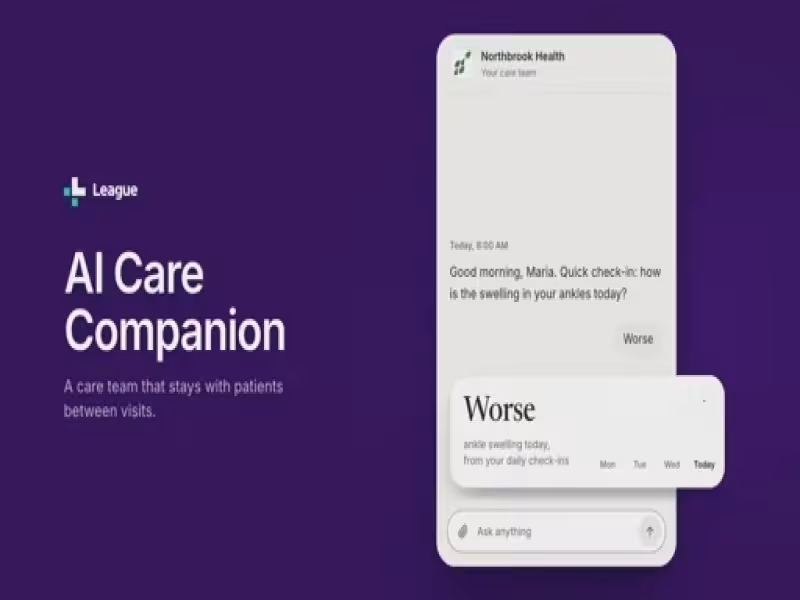
LAS VEGAS -- November 24, 2026 -- League made AI Front Door for payers and AI Care Companion for providers generally available on Nov. 16. The company says customers can launch in as little as 12 weeks. Both products run on three new League Labs models, and the safety-escalation model has an error rate of 0.28% in League's own tests, against 4.64% for Google's Gemini 3.5 Flash Lite, by our calculation about 17 times lower.
League's safety model scores 99.72% accuracy against 95.36% for Gemini 3.5 Flash Lite
The Safety-Critical Escalations Model flags member and patient messages that need a human and routes them to a person. In League Labs' internal evaluations it reached 99.72% accuracy, versus 95.36% for the Gemini model, a gap of 4.36 percentage points. Measured as misses, that is 0.28% against 4.64%, a reduction of about 94%.
Latency fell from 1.121 seconds to 0.374 seconds, a cut of about 67%, or roughly three times faster. League did not disclose the size or composition of the evaluation data, and the figures have not been independently verified.
Two retrieval models answer 2.2 and 3.9 times more questions than Gemini 3.5 Flash, League says
The Synthetic Question Generator small language model anticipates what members and patients will ask about their health data, so incoming questions match the right information. Against Gemini 3.5 Flash, League reports 2.2 times more questions answered adequately or better, 11% better coverage and 42% less irrelevant information.
Adding a Semantic Expansion model, which rewrites long, ambiguous or shorthand-heavy questions before retrieval, raises those figures to 3.9 times and 42% better coverage. It adds about 430 milliseconds per request. Both models are measured against the same baseline, so the combined system answers about 1.8 times as many questions adequately as the generator alone (3.9 divided by 2.2).
The three models are not benchmarked against the same Gemini variant: the escalation model is compared with Flash Lite, the other two with Flash. League defines adequate answers as the share of questions where the retrieved data is relevant and complete enough to answer fairly well or better. Coverage is how much of the needed information is found.
Five built-in safeguards answer the top three requirements in a Healthcare Dive survey
The release cites a Healthcare Dive survey of 150 payer and provider executives. Built-in healthcare compliance ranked first at 49%, automatic escalation to a person second at 48%, and runtime controls on what an agent can say or do third at 46%. No requirement reached half of respondents.
League lists five safeguards:
- Agents answer only from approved knowledge, not the model's world knowledge.
- Guardrails block restricted information before it reaches the model and prohibited responses before they reach users.
- Releases are gated by evaluations against synthetic patient scenarios, edge cases and golden datasets.
- Escalations pass on conversation history and context.
- Drift detection and revalidation run continuously, with a per-interaction audit record.
The Forge by League platform underneath is built to HITRUST r2, SOC 2 Type II, ISO 27001, HIPAA and PIPEDA standards, according to the company, and is subject to NIST AI Risk Management Framework governance.
Payers and providers start from different agent sets and different targets
AI Front Door puts four agents behind one entry point, reachable by chat, text or in-app widget: benefits navigation, care finding, care gap outreach and health coaching. League targets lower call center volume, fewer out-of-network visits and fewer open HEDIS and Stars gaps.
For providers, health systems choose the first patient population, from chronic condition management to post-surgical care, and League configures AI Care Companion around that population's workflows. Features include scheduling, symptom tracking, care plan support, caregiver workflows and protocol-based escalation. The stated targets are better care plan adherence and fewer avoidable ED visits, after-hours calls and missed follow-ups. These are targets, not reported results, and the company did not disclose customer deployment results or pricing.
League demonstrated both products at Booth #2836 at HLTH 2026, which ran Nov. 15 to 18 in Las Vegas, alongside the Forge by League console, a dashboard that tracks agent completions, escalations and accuracy by use case. The company will hold a technical webinar on the release on Dec. 9, 2026.