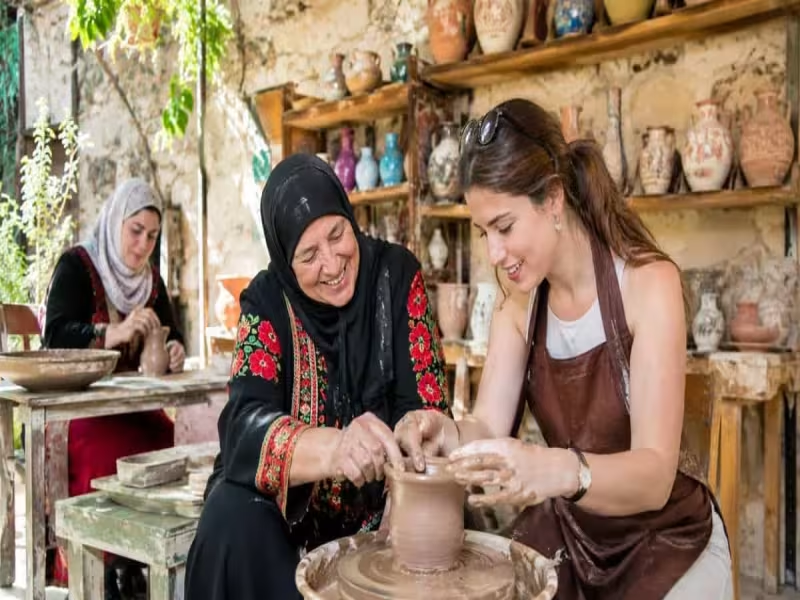
JORDAN -- November 24, 2026 -- Jordan has replaced ministry licensing for craft makers with registration for individuals and classification for businesses under Regulation No. 3 of 2026, changing the rules for artisans that tour operators may book. The Cabinet approved the regulations in January 2026. On 12 November the Central Bank reported tourism income of US$7,076.7 million for January–October 2026, 6% higher than a year earlier.
By our calculation, a 6% rise means roughly US$400 million more than in the same period of 2025 (about US$6,676 million to US$7,076.7 million). October's US$724.8 million is about 10% of the ten-month total and roughly 2% above the monthly average of US$707.7 million. The bank's figures do not measure craft bookings or artisan earnings.
Jordan's Cabinet moves craft oversight from ministry licences to registration and classification
The Prime Ministry links the change to lower costs and more rural workshops. Association-fee provisions also support women and people with disabilities. The regulation appears in the official gazette, but it does not show that every artisan is ready for visitors, so agents must check capacity and terms.
On 14 November Jordan's official news agency documented shemagh-fringing and mihbash making in Ajloun. The report encouraged tourism links but announced no new daily attraction.
Iraq Al-Amir publishes the most bookable terms: four activities, JD5 to JD15, 9am to 3pm
An October 2026 government report lists pottery, handmade papermaking, weaving and soap-making at Iraq Al-Amir, west of Amman. Visiting hours run from 9am to 3pm daily, and activity charges range from JD5 to JD15. The top charge is three times the lowest, and the window is six hours. Agents should reconfirm both fees and schedules.
The Jordan Tourism Board identifies a women-run cooperative founded in 1993 and a Handicrafts Village established in 2001. It reports training more than 150 women from Wadi Seer, a historical total rather than a current headcount. Jordan Pass does not list craft workshops as a bundled benefit, so a visit to the Iraq Al-Amir archaeological attraction does not automatically include a cooperative session.
In Jerash, the official destination portal identifies a handicrafts association founded in 2008. It offers sand-bottle decorating, shemagh weaving details, pottery, rug weaving and mosaic making. Official February 2026 reporting says Dibeen Forest Reserve embroidery, pottery and beeswax-candle workshops supported at least 28 local jobs, mostly held by women. That is not a national employment total.
Japan, Türkiye and Armenia sell hands-on craft at different depths
The Japan National Tourism Organization describes Inami, in Toyama Prefecture, as a town with around 200 woodcarvers. Its Bed and Craft experience pairs accommodation in an artisan-designed building with an optional three-hour apprenticeship, half the daily window at Iraq Al-Amir. The organisation also promotes papermaking at Aoya Washi Studio in Tottori.
Türkiye's official European Route of Ceramics links Avanos, Kütahya, İznik and Çanakkale with museums and working potters. UNESCO inscribed traditional çini-making in 2016. Armenia's tourism portal lists khachkar stone-carving masterclasses, a copper-jewellery session at Buduart in Dilijan and willow-weaving at Yegheg studio in Yeghegnadzor. UNESCO inscribed khachkar craftsmanship in 2010 and Gyumri's blacksmithing in 2023.
None of the four countries has announced a joint craft-tourism programme. Jordan held tourism-cooperation talks with Japanese and Turkish counterparts in September and October 2026, covering air access and travel products. No craft-specific flights were announced.
Operators can split activity fees from retail sales and size groups to workstations
Jordan's JD5–JD15 band is not a full package price. Transport, guiding, translation, meals, materials and time must be priced separately, and a low workshop fee does not show an artisan's earnings after costs. Operators can record whether payment goes to a cooperative, an individual maker or an intermediary. Group sizes should follow the number of workstations and the instructor's capacity, not coach seats.
No official comparative dataset shows that craft workshops are driving tourism growth across the four countries.
UNESCO lists a US$1,638,405 budget for its local-community and sustainable-tourism project in Petra and Wadi Rum, scheduled through December 2026. It covers heritage conservation, tourism skills and women-owned businesses, not a dedicated craft fund. An October Jerash agreement targets digital skills and visitor-accessibility tools.